The Prisoner
Jean-Léon Gérôme · 1861
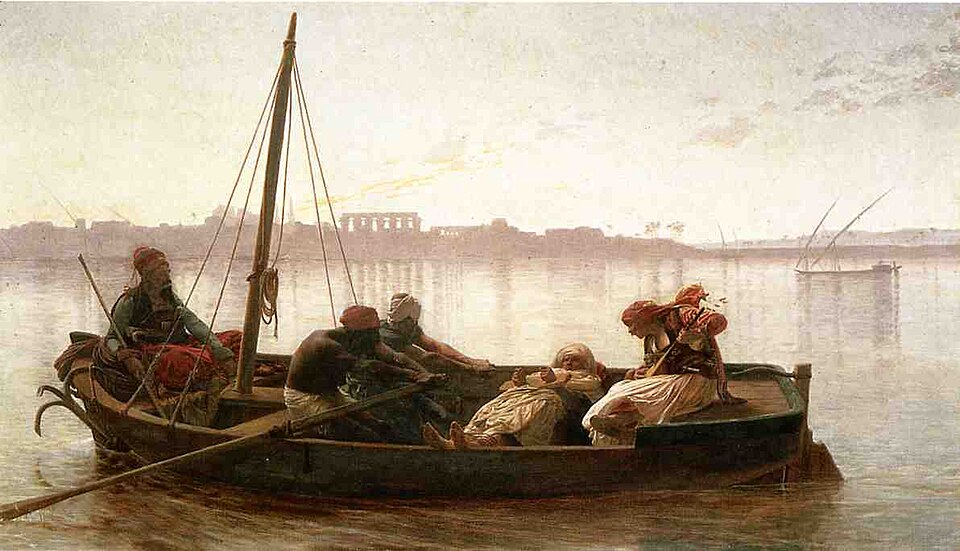
At dusk a boat glides down the Nile. A bound prisoner lies still under the eyes of two guards, while a singer mocks him with his song, and far off the temple of Luxor fades into the evening haze. Gérôme turned memories of Egypt into a quiet tragedy.
The story behind the painting
Jean-Léon Gérôme drew on his journey to Egypt to make this painting in 1861. The city of Nantes bought it as soon as it was finished, that same year, and it is still held at the Musée d'Arts de Nantes. It is a modest canvas, about 45 by 78 cm, but it became one of Gérôme's great public successes. Its style is close to that of his teacher Charles Gleyre, especially Gleyre's painting Le Soir, Evening, a link that matters for one reading of the picture.
What to look for
A helmsman steers the boat on the Nile at twilight. On board, a prisoner in shackles is watched by two guards, and an Arnaut, an Albanian soldier, sings with a stringed instrument called a tchegour and seems to be mocking him. In the distance rises the temple of Luxor. Notice how the bright, warm colours of the figures stand against the soft, misty tones of the setting, and how the very wide horizon line makes the scene feel endless. The composition is close to another Gérôme in Nantes, The Plain of Thebes.
Meaning and intent
The endless horizon deepens the tragedy of the prisoner, who accepts his fate stoically while he is probably being taken toward new torments. A closer study of the faces suggests another reading: the captive looks like Gleyre, while the helmsman resembles Gérôme himself. The source proposes, with a perhaps, that the painter may have wanted to distance himself from Gleyre's artistic guardianship, steering on alone while his master sits bound. It is offered as a possibility, not a certainty.
Legacy
The painting was a huge success at the Salon of 1863, the same year Gérôme showed Louis XIV and Molière. He had an engraving made of it by Goupil and painted a second autograph version in 1863. After damage noticed following its showing at the Salon of 1867, he restored the canvas himself in 1868. The picture also inspired the poet José-Maria de Heredia to write a sonnet, Le Prisonnier, published in his collection Les Trophées.
Schon gewusst?
- Painted in 1861 after Gérôme's journey to Egypt.
- Bought by the city of Nantes the same year.
- A huge success at the Salon of 1863.
- Inspired a poem by José-Maria de Heredia.
Über den Künstler
Jean-Léon Gérôme (1824-1904)
Sitzen · Akademische Kunst · Barke · Schwarze · Gruppe von Menschen · optische Reflexion · Gefangener · Musée d'Arts de Nantes
Mehr von Jean-Léon Gérôme
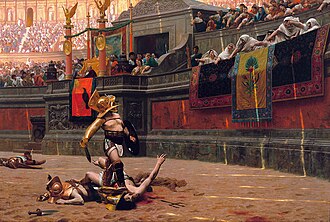 Pollice verso - Jean-Léon Gérôme (1872)
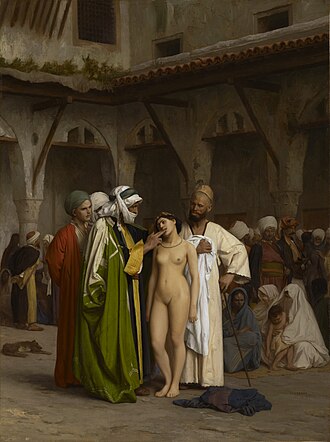 Der Sklavenmarkt - Jean-Léon Gérôme (1866)
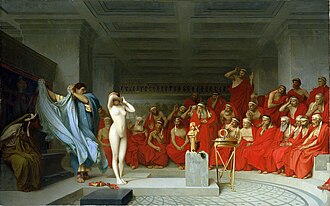 Phryne vor dem Areopag - Jean-Léon Gérôme (1861)
 Die Wahrheit steigt aus dem Brunnen - Jean-Léon Gérôme (1896)
 Bonaparte Before the Sphinx - Jean-Léon Gérôme (1867)
 Cleopatra and Caesar - Jean-Léon Gérôme (1866)
 The Duel After the Masquerade - Jean-Léon Gérôme (1857)
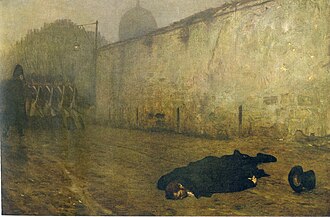 The Execution of Marshal Ney - Jean-Léon Gérôme (1868)
Werke verwandter Künstler
 Das Frühstück im Grünen - Édouard Manet (1863)
 Olympia - Édouard Manet (1863)
 Der Ursprung der Welt - Gustave Courbet (1866)
 Ein Begräbnis in Ornans - Gustave Courbet (2020)
 Nelke, Lilie, Lilie, Rose - John Singer Sargent (1885-1886)
 Madame X - John Singer Sargent (1884)
 Die Freiheit führt das Volk - Eugène Delacroix (1830)
 Der Tod des Sardanapal - Eugène Delacroix (1827)
 Der Tod des Sokrates - Jacques-Louis David (1787)
 Der Schwur der Horatier - Jacques-Louis David (1784)
 Die Schwestern Waldegrave - Joshua Reynolds (1780)
 Porträt des Colonel George K. H. Coussmaker vom Regiment der Garde-Grenadiere - Joshua Reynolds (1782)