Die Schwestern Waldegrave
Joshua Reynolds · 1780
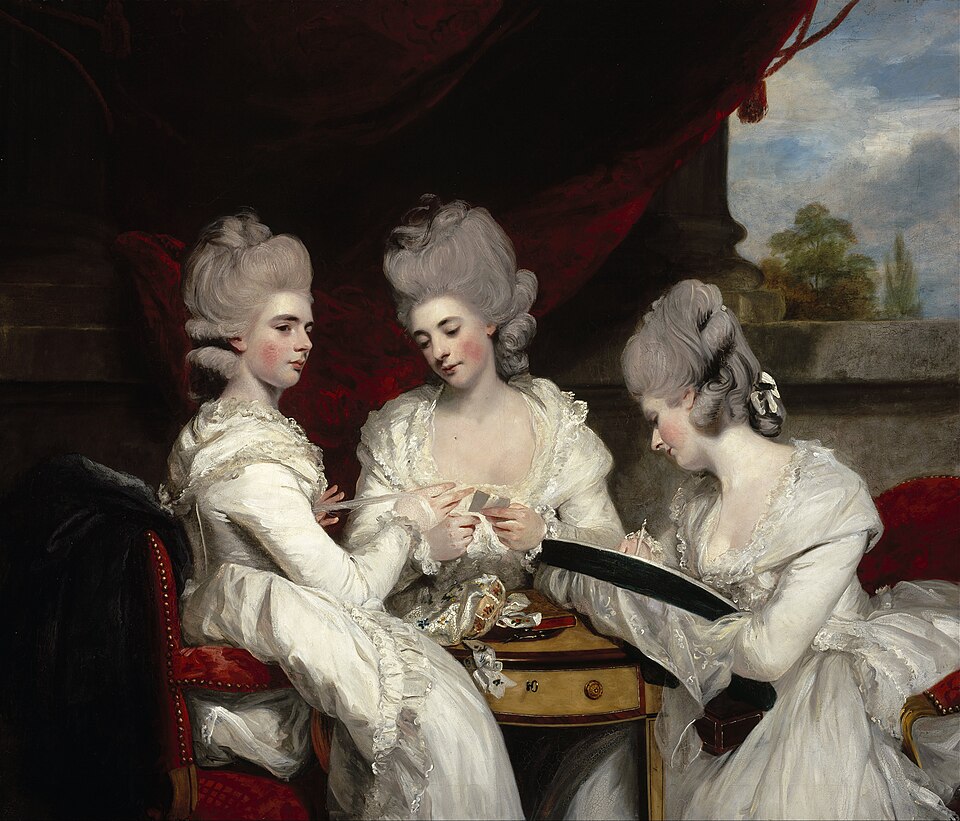
Three sisters in white silk sit around a table, winding silk and working lace, none of them meeting your eye. Their mother commissioned the portrait from Reynolds for a very practical reason: all three were unmarried.
The story behind the painting
The sisters were Elizabeth Laura, born 1760, Charlotte Maria, born 1761, and Anna Horatia, born 1762, daughters of James Waldegrave, 2nd Earl Waldegrave, and Maria Walpole. Their mother's illegitimate birth and her second marriage to William Henry, Duke of Gloucester, against the wishes of his brother George III, meant the family was banned from court, which made finding good matches difficult. A first attempt, a portrait of two sisters as Venus and Juno by Ozias Humphrey, displeased their mother, who found it immodest. Reynolds was then commissioned to paint all three. They sat for him in May 1780 and March 1781. All three had already suffered disappointments in love.
What to look for
From left to right are Charlotte, holding a skein of silk, Elizabeth, winding it onto a card, and Anna, working tambour lace. They are shown three-quarter length around a table, in white silk polonaise gowns and powdered hair, the height of late eighteenth century fashion. Notice the locked drawer on the table, a common symbol of chastity. No sister looks at the viewer; Horatia is even turned almost away, in profile. Reynolds balanced each figure against the others. His assistants painted the background drapery and columns, and you can compare the highly finished drapery with the looser drawer and hands.
Meaning and intent
The painting was meant to present the sisters as beautiful, well brought up and accomplished, and therefore marriageable. White stood for feminine virtues, reinforced by their quiet needlework, and their downcast eyes push modesty to the extreme. Their great-uncle Horace Walpole, who arranged the commission, had wanted them shown as the Three Graces garlanding their mother's bust. Reynolds, who had already painted Three Ladies Adorning a Term of Hymen in 1773, refused to repeat himself. Viewers still saw the Graces in them, though Walpole felt the sisters recalled the three Fates rather than the Graces. He nevertheless praised the composition and the perfect likenesses.
Legacy
The portrait was shown as Portrait of three ladies at the Royal Academy exhibition at Somerset House from 30 April to 2 June 1781. It was mostly praised as a scene of domestic elegance, though some critics complained of too much white drapery. Valentine Green soon made a mezzotint of it. Reynolds seems to have painted a second version with variations, now lost. The picture belonged to Walpole's Strawberry Hill collection, then passed through his relatives and the Waldegrave family, was sold by Lord Carlingford in 1887, and in 1952 was acquired by the National Gallery of Scotland with help from the National Art Collections Fund.
Schon gewusst?
- Painted 1780 to 1781 and exhibited at the Royal Academy in 1781.
- Commissioned by the sisters' mother to attract suitors.
- Horace Walpole arranged the commission.
- In the Scottish National Gallery since 1952.
Über den Künstler
Joshua Reynolds (1723-1792)
Schottische Nationalgalerien · Familienporträt
Mehr von Joshua Reynolds
 Porträt des Colonel George K. H. Coussmaker vom Regiment der Garde-Grenadiere - Joshua Reynolds (1782)
 Lady Cockburn and Her Three Eldest Sons - Joshua Reynolds (1773)
 Lady Elizabeth Delmé and Her Children - Joshua Reynolds (1770s)
 Elizabeth Kerr, Marchioness of Lothian - Joshua Reynolds (1769)
 General John Burgoyne - Joshua Reynolds (1766)
 Thaïs - Joshua Reynolds (1781)
 David Garrick Between Tragedy and Comedy - Joshua Reynolds (1761)
 Lady Worsley - Joshua Reynolds (1779)
Werke verwandter Künstler
 Die letzte Fahrt der Temeraire - J. M. W. Turner (1839)
 Rain, Steam and Speed - The Great Western Railway - J. M. W. Turner (1844)
 Pollice verso - Jean-Léon Gérôme (1872)
 Der Sklavenmarkt - Jean-Léon Gérôme (1866)
 Das Frühstück im Grünen - Édouard Manet (1863)
 Olympia - Édouard Manet (1863)
 Der Ursprung der Welt - Gustave Courbet (1866)
 Ein Begräbnis in Ornans - Gustave Courbet (2020)
 Nelke, Lilie, Lilie, Rose - John Singer Sargent (1885-1886)
 Madame X - John Singer Sargent (1884)
 Die Freiheit führt das Volk - Eugène Delacroix (1830)
 Der Tod des Sardanapal - Eugène Delacroix (1827)