Bonaparte Before the Sphinx
Jean-Léon Gérôme · 1867
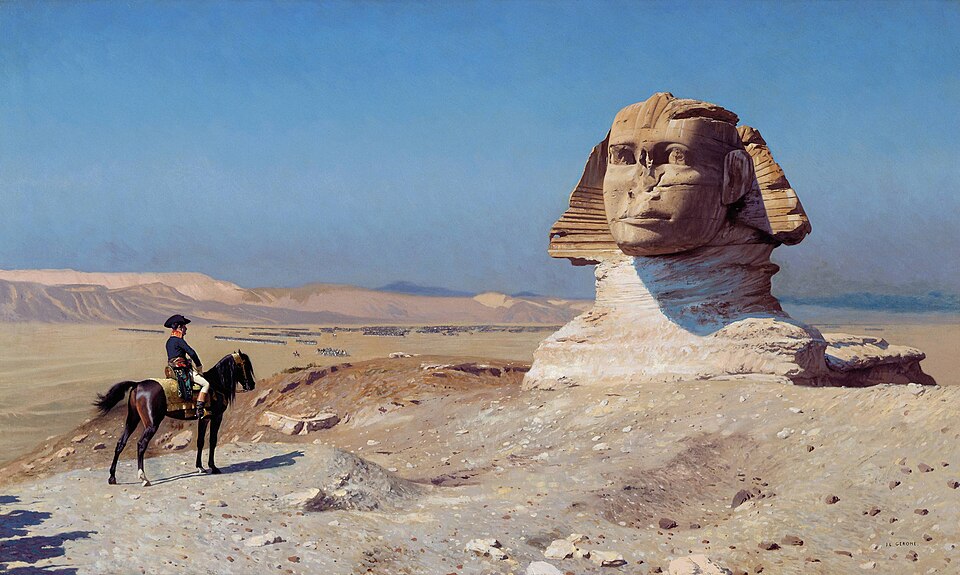
A lone rider on a horse faces the vast stone face of the Sphinx, his army small in the distance. Gérôme first called this picture Oedipus: the young man of destiny meeting a riddle thousands of years old.
The story behind the painting
In the 1860s Gérôme painted several pictures of Napoleon during the Egyptian campaign of 1798 to 1799, and he returned to the theme in the 1880s. He was well placed to do so: he was already famous for Egyptian subjects and landscapes drawn from long travels in the region from the mid-1850s. The sources disagree on the date. Wikipedia calls this an 1886 painting shown at that year's Salon, while Wikidata dates it to 1867. Its pendant, Bonaparte in Cairo, is the same size and may have been painted at the same time.
What to look for
Napoleon sits on horseback in front of the Great Sphinx of Giza, with his army behind him. Wikidata gives the canvas as about 62 by 102 cm. Reviewing the Salon of 1886, The New York Times described the young Corsican gazing in meditation at the enormous enigmatic face of stone, and noted that the master kept out all distracting details: not even the Pyramids are shown, only the cloudless sky, the smooth sand from whose drifts the gigantic face rises, and the solitary man thinking to himself.
Meaning and intent
Gérôme showed the work under the title Oedipus, referring to the myth in which every traveller to Thebes had to answer the Sphinx's riddle or die, and to earlier paintings of it, such as the one by Ingres. That story is about intelligence, but also about a man meeting his destiny. In Gérôme's Napoleon pictures the general is always deep in thought, unlike usual military paintings of specific battles or heroic action. Here Napoleon is set in silent dialogue with the Sphinx, a young man of destiny before a monument thousands of years old.
Legacy
The New York Times called it one of Gérôme's finest historical studies. The painting popularized Napoleon in front of the Sphinx as a subject in art and in caricature. In 1898 it was bought, together with its pendant Bonaparte in Cairo, by William Randolph Hearst. Seen side by side, the two offer a contrast: Bonaparte gazing up at the mysterious Sphinx, and down upon the conquered city of Cairo. The painting is now at Hearst Castle in California. Gérôme returned to Napoleon again with a sculpture of his entry into Cairo, shown at the Salon of 1897.
Schon gewusst?
- Shown at the Salon of 1886 under the title Oedipus.
- Wikidata dates it to 1867, Wikipedia to 1886.
- Bought by William Randolph Hearst in 1898.
- Now at Hearst Castle, California.
Über den Künstler
Jean-Léon Gérôme (1824-1904)
Historienmalerei · Hauspferd · Akademische Kunst · Reiten · Reiterporträt · Napoleon Bonaparte · anstarren · Militäruniform · Zweispitz
Mehr von Jean-Léon Gérôme
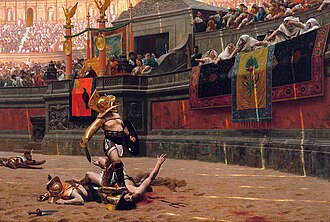 Pollice verso - Jean-Léon Gérôme (1872)
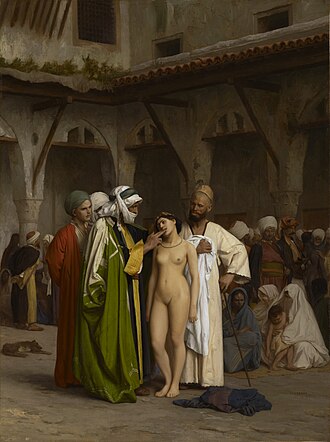 Der Sklavenmarkt - Jean-Léon Gérôme (1866)
%20-%2001.jpg) Phryne vor dem Areopag - Jean-Léon Gérôme (1861)
Phryne vor dem Areopag - Jean-Léon Gérôme (1861)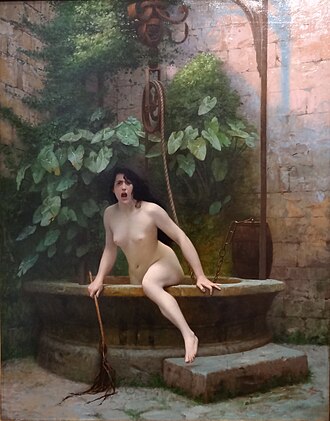 Die Wahrheit steigt aus dem Brunnen - Jean-Léon Gérôme (1896)
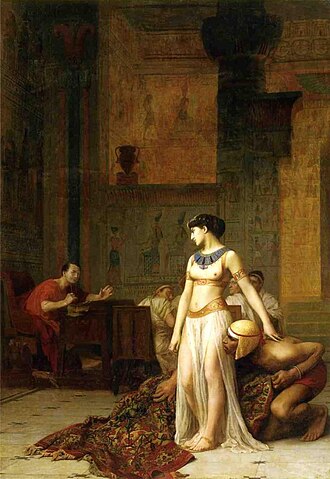 Cleopatra and Caesar - Jean-Léon Gérôme (1866)
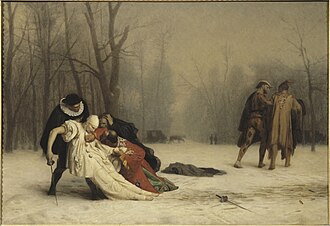 The Duel After the Masquerade - Jean-Léon Gérôme (1857)
.jpg) The Execution of Marshal Ney - Jean-Léon Gérôme (1868)
The Execution of Marshal Ney - Jean-Léon Gérôme (1868)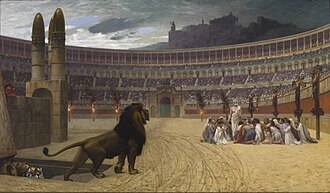 Das letzte Gebet der Christen im Circus Maximus - Jean-Léon Gérôme (1883)
Werke verwandter Künstler
 Das Frühstück im Grünen - Édouard Manet (1863)
 Olympia - Édouard Manet (1863)
 Der Ursprung der Welt - Gustave Courbet (1866)
 Ein Begräbnis in Ornans - Gustave Courbet (2020)
 Nelke, Lilie, Lilie, Rose - John Singer Sargent (1885-1886)
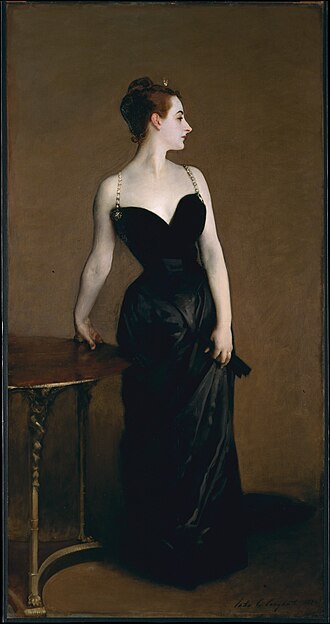 Madame X - John Singer Sargent (1884)
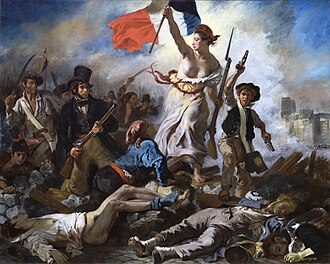 Die Freiheit führt das Volk - Eugène Delacroix (1830)
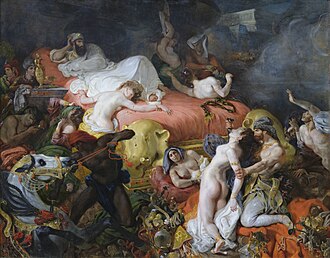 Der Tod des Sardanapal - Eugène Delacroix (1827)
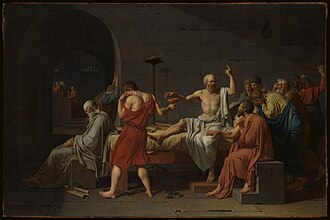 Der Tod des Sokrates - Jacques-Louis David (1787)
 Der Schwur der Horatier - Jacques-Louis David (1784)
 Die letzte Fahrt der Temeraire - J. M. W. Turner (1839)
 Rain, Steam and Speed - The Great Western Railway - J. M. W. Turner (1844)