Lady Elizabeth Delmé and Her Children
Joshua Reynolds · 1770s
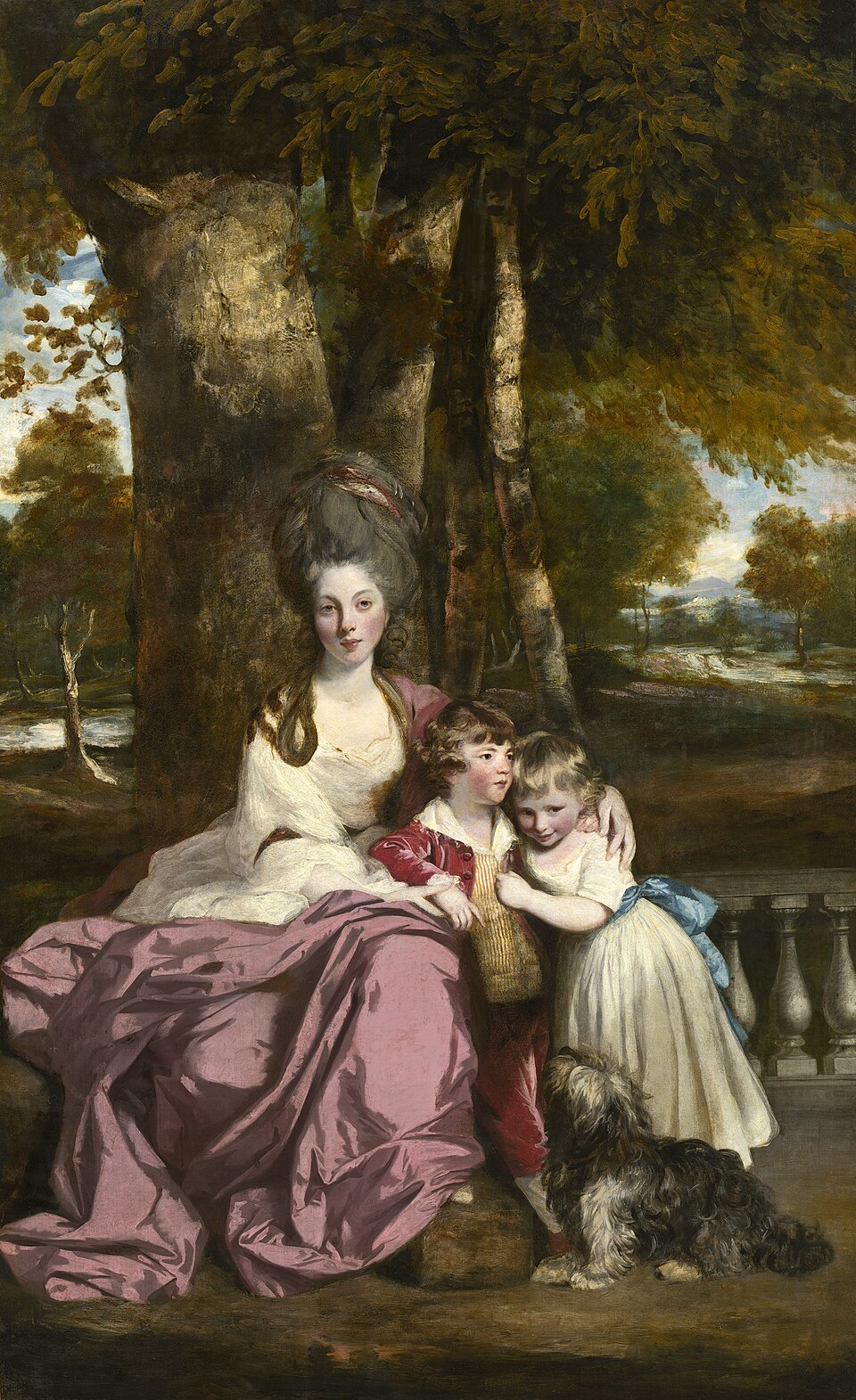
A tall, calm aristocrat sits with her two children folded against her, a cascade of rose satin over her knees. Reynolds wanted portraiture to rise to the level of history painting, and this is one of his grandest attempts.
The story behind the painting
Born Lady Elizabeth Howard in 1746, the third daughter of the 4th Earl of Carlisle, she married Peter Delme, a Member of Parliament, in 1769. In April and June 1777 she sat for Reynolds with her children John and Isabella Elizabeth. Completing the picture took about two years, long enough for the children to change noticeably. Wikipedia dates the painting 1779, while Wikidata gives only the 1770s. Reynolds was paid for it in 1780, and in 1789 he touched it up and revarnished it.
What to look for
The canvas is large, about 238 by 147 cm. The three figures form a triangle, an allusion to Raphael's Madonnas such as the Madonna of the Goldfinch and the Madonna of the Meadow. The browns of the background recall Rembrandt and Titian. The writer Cynthia Saltzman describes Lady Delme's long, elegant face, heavy-lidded eyes and towering powdered hair, her white dress, and the cloak that spills over her knees in rose-coloured satin, a sign of both beauty and luxury.
Meaning and intent
The National Gallery of Art in Washington calls this a majestic group portrait. It explains that Reynolds worked from abstract principles of design rather than close observation, believing each person should wear the expression usual for their rank. He therefore suppressed individual psychology to give these aristocrats grandeur. Saltzman sees the picture as one of the finest examples of his aim to raise portraiture to history painting, and notes that English portraits of the time flattered sitters as members of a ruling class that made the world better.
Legacy
Lady Elizabeth was remembered as the beauty of the Court of Queen Charlotte. Widowed in 1789, she married Captain Charles Garnier of the Royal Navy in 1794; he drowned in 1796, and she died in June 1813. The painting crossed the Atlantic and was given to the National Gallery of Art in Washington in 1937 as part of the Andrew W. Mellon collection. There the Raphael-like triangle of mother and children still greets visitors with its cool, composed dignity.
Schon gewusst?
- Sittings took place in April and June 1777.
- Dated 1779 by Wikipedia; Wikidata gives the 1770s.
- The triangular grouping alludes to Raphael's Madonnas.
- Given to the National Gallery of Art, Washington, in 1937.
Über den Künstler
Joshua Reynolds (1723-1792)
National Gallery of Art · Familienporträt · Andrew W. Mellon collection
Mehr von Joshua Reynolds
 Die Schwestern Waldegrave - Joshua Reynolds (1780)
 Porträt des Colonel George K. H. Coussmaker vom Regiment der Garde-Grenadiere - Joshua Reynolds (1782)
 Lady Cockburn and Her Three Eldest Sons - Joshua Reynolds (1773)
 Elizabeth Kerr, Marchioness of Lothian - Joshua Reynolds (1769)
 General John Burgoyne - Joshua Reynolds (1766)
 Thaïs - Joshua Reynolds (1781)
 David Garrick Between Tragedy and Comedy - Joshua Reynolds (1761)
 Lady Worsley - Joshua Reynolds (1779)
Werke verwandter Künstler
 Die letzte Fahrt der Temeraire - J. M. W. Turner (1839)
 Rain, Steam and Speed - The Great Western Railway - J. M. W. Turner (1844)
 Pollice verso - Jean-Léon Gérôme (1872)
 Der Sklavenmarkt - Jean-Léon Gérôme (1866)
 Das Frühstück im Grünen - Édouard Manet (1863)
 Olympia - Édouard Manet (1863)
 Der Ursprung der Welt - Gustave Courbet (1866)
 Ein Begräbnis in Ornans - Gustave Courbet (2020)
 Nelke, Lilie, Lilie, Rose - John Singer Sargent (1885-1886)
 Madame X - John Singer Sargent (1884)
 Die Freiheit führt das Volk - Eugène Delacroix (1830)
 Der Tod des Sardanapal - Eugène Delacroix (1827)