David Garrick Between Tragedy and Comedy
Joshua Reynolds · 1761
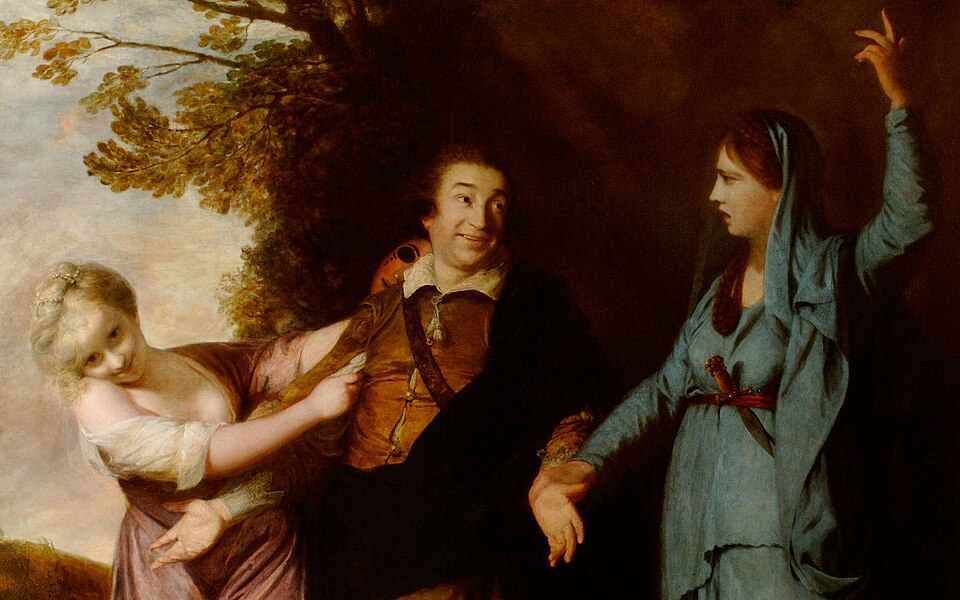
The great actor David Garrick is pulled two ways: Tragedy grips his wrist, Comedy tugs his arm and smiles at us, and he is already giving in. Reynolds painted it in 1761, and in 2018 the internet rediscovered it as an eighteenth century distracted boyfriend.
The story behind the painting
David Garrick was famous as both tragedian and comedian, and he had been linked with the Muses of Tragedy and Comedy since a poem by William Whitehead in 1747. Reynolds painted the picture mainly in 1760 to 1761, around the time of his portrait of Laurence Sterne. Edward Edwards called it Reynolds's first attempt at historical composition. Horace Walpole left the earliest known description of it. It shows the actor not on stage but caught in a choice.
What to look for
Garrick stands in the centre in a van Dyck costume against fields and woodland. Tragedy, in a strong blue dress with head and arms covered as if in mourning, is lit sharply from above against a dark ground, grips his wrist and raises her other hand, a dagger among her attributes. Comedy, fair hair slightly tousled, in washed-out mauve and dappled light, holds a mask and smiles at the viewer. The side of Garrick's face turned to Comedy smiles in the light, while the other side, in shadow, looks worriedly at Tragedy. Comedy is painted in a rococo manner recalling Correggio, Tragedy in a neoclassical manner after Guido Reni.
Meaning and intent
Art historians compare the scene to the Choice of Hercules between Virtue and Pleasure, a subject the Earl of Shaftesbury recommended as moral art. Reynolds turns it into a parody: Hercules chooses the modest Virtue, but Garrick starts to yield to the less modestly dressed Comedy. The picture can also be read as Reynolds himself moving from strict portraiture, Tragedy, toward wittier imagery, Comedy. David Mannings suggested the composition was inspired by Guido Reni's Lot and his Daughters Leaving Sodom.
Legacy
Reception was mixed at first. Edward Fisher's mezzotint of 1762 spread the image, and at least fourteen pirated versions followed, one sold in France in 1765 as L'Homme entre le Vice et la Vertu. Garrick's own 1775 play The Theatrical Candidates alludes to it, and it may have helped inspire Fuseli. On 16 April 2018 a viral post compared it to the distracted boyfriend meme. Long at Waddesdon Manor with the Rothschild family, it passed to the National Trust after Jacob Rothschild's death in 2024 and remains on display there.
Schon gewusst?
- Painted mainly in 1760 to 1761 by Joshua Reynolds.
- A playful parody of the Choice of Hercules.
- Spread by Edward Fisher's 1762 mezzotint and many pirated prints.
- Now owned by the National Trust and shown at Waddesdon Manor.
Über den Künstler
Joshua Reynolds (1723-1792)
Porträt · Allegorie · National Trust
Mehr von Joshua Reynolds
 Die Schwestern Waldegrave - Joshua Reynolds (1780)
 Porträt des Colonel George K. H. Coussmaker vom Regiment der Garde-Grenadiere - Joshua Reynolds (1782)
 Lady Cockburn and Her Three Eldest Sons - Joshua Reynolds (1773)
 Lady Elizabeth Delmé and Her Children - Joshua Reynolds (1770s)
 Elizabeth Kerr, Marchioness of Lothian - Joshua Reynolds (1769)
 General John Burgoyne - Joshua Reynolds (1766)
 Thaïs - Joshua Reynolds (1781)
 Lady Worsley - Joshua Reynolds (1779)
Werke verwandter Künstler
 Die letzte Fahrt der Temeraire - J. M. W. Turner (1839)
 Rain, Steam and Speed - The Great Western Railway - J. M. W. Turner (1844)
 Pollice verso - Jean-Léon Gérôme (1872)
 Der Sklavenmarkt - Jean-Léon Gérôme (1866)
 Das Frühstück im Grünen - Édouard Manet (1863)
 Olympia - Édouard Manet (1863)
 Der Ursprung der Welt - Gustave Courbet (1866)
 Ein Begräbnis in Ornans - Gustave Courbet (2020)
 Nelke, Lilie, Lilie, Rose - John Singer Sargent (1885-1886)
 Madame X - John Singer Sargent (1884)
 Die Freiheit führt das Volk - Eugène Delacroix (1830)
 Der Tod des Sardanapal - Eugène Delacroix (1827)