Elizabeth Kerr, Marchioness of Lothian
Joshua Reynolds · 1769
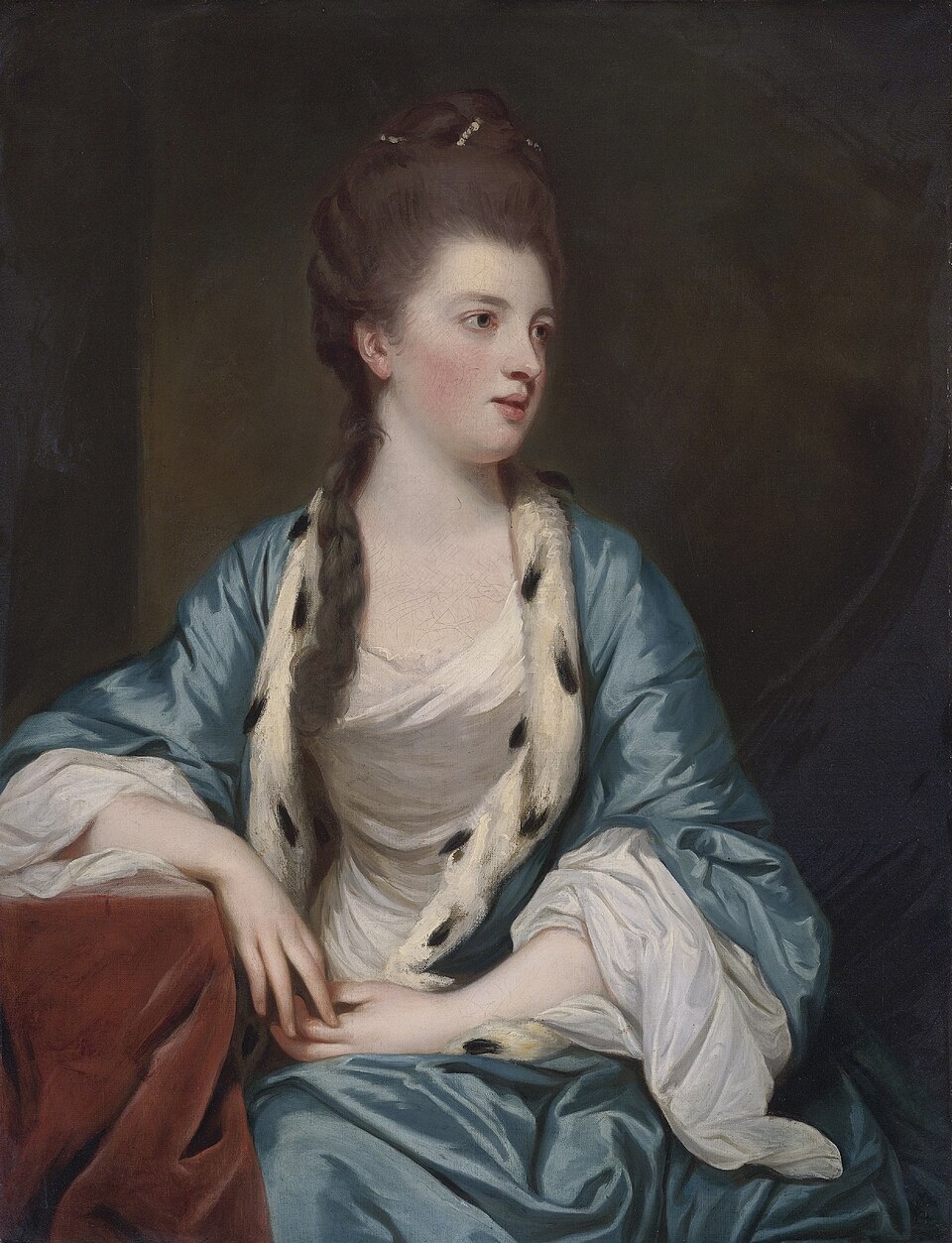
Seated in a gown inspired by ancient Greece, her hair piled high in the fashion of the day, a young Irish-born aristocrat meets the painter's gaze. Reynolds painted her at least three times.
The story behind the painting
This portrait by Joshua Reynolds, oil on canvas and dated around 1769, shows Elizabeth Kerr, born Elizabeth Fortescue, daughter of Chichester Fortescue, High Sheriff of County Down in Ireland. She married in 1762 into the Kerr family, and her husband later succeeded as Marquess of Lothian in 1775. Reynolds painted her at least twice more in that period, in half-length portraits now at Blickling Hall and Fyvie Castle. This version, 97.7 by 74.4 centimetres, was engraved by John Spilsbury in 1770, though he altered a few details of the dress. It now hangs in the Museo Soumaya in Mexico City.
What to look for
Elizabeth is shown seated, three-quarter length, her hands resting in her lap and her right forearm on a table. Her dress takes its inspiration from the ancient Greek chiton, and over it she wears an overmantle of bluish silk edged with ermine, a fur that signals her noble status. Her hairstyle, high and heavily ornamented, draws on ancient Roman busts and was highly fashionable at the time; a single braid falls over her right breast. Reynolds sets her pale skin against a darker background, so that her face and shoulders glow. Take time with the textures: silk, fur and skin, each handled differently.
Meaning and intent
The classical dress was more than costume. By dressing his sitter in a style recalling ancient Greece and Rome, Reynolds lifted a portrait of a contemporary woman toward the timeless dignity of antiquity, while the ermine reminded viewers of her rank. Some art historians argue that the work follows the four principles of painting that Reynolds set out in his Discourses on Art: invention, colour, drapery and expression. Seen that way, the portrait is also a demonstration of his ideas, combining a thoughtful pose, harmonious colour, carefully studied fabrics and a calm, composed expression.
Legacy
The portrait passed down through the family to Lord Charles Beauchamp Kerr, the couple's seventh child and second son, and then to his son Captain Beauchamp Kerr. Before 1899 it belonged to an E. Beckett, who sold it to the dealers Agnew's, and four days later it went to George J. Gould. After a long period in a private collection in Washington, D.C., it was sold at Sotheby's New York in 2011 to its present owner. Today in Mexico City, it offers visitors an elegant example of how Reynolds blended fashion, antiquity and status in the portraits of eighteenth-century British society.
Schon gewusst?
- Oil on canvas, about 1769, 97.7 x 74.4 cm
- Engraved by John Spilsbury in 1770, with changes to the dress
- Reynolds painted her at least twice more; those portraits are at Blickling Hall and Fyvie Castle
- Now in the Museo Soumaya, Mexico City
Über den Künstler
Joshua Reynolds (1723-1792)
Porträt · Akademische Kunst · Museo Soumaya
Mehr von Joshua Reynolds
 Die Schwestern Waldegrave - Joshua Reynolds (1780)
 Porträt des Colonel George K. H. Coussmaker vom Regiment der Garde-Grenadiere - Joshua Reynolds (1782)
 Lady Cockburn and Her Three Eldest Sons - Joshua Reynolds (1773)
 Lady Elizabeth Delmé and Her Children - Joshua Reynolds (1770s)
 General John Burgoyne - Joshua Reynolds (1766)
 Thaïs - Joshua Reynolds (1781)
 David Garrick Between Tragedy and Comedy - Joshua Reynolds (1761)
 Lady Worsley - Joshua Reynolds (1779)
Werke verwandter Künstler
 Die letzte Fahrt der Temeraire - J. M. W. Turner (1839)
 Rain, Steam and Speed - The Great Western Railway - J. M. W. Turner (1844)
 Pollice verso - Jean-Léon Gérôme (1872)
 Der Sklavenmarkt - Jean-Léon Gérôme (1866)
 Das Frühstück im Grünen - Édouard Manet (1863)
 Olympia - Édouard Manet (1863)
 Der Ursprung der Welt - Gustave Courbet (1866)
 Ein Begräbnis in Ornans - Gustave Courbet (2020)
 Nelke, Lilie, Lilie, Rose - John Singer Sargent (1885-1886)
 Madame X - John Singer Sargent (1884)
 Die Freiheit führt das Volk - Eugène Delacroix (1830)
 Der Tod des Sardanapal - Eugène Delacroix (1827)