The Intervention of the Sabine Women
Jacques-Louis David · 1799
.jpg)
A woman throws herself between two armies, arms wide, her babies at her feet. David began imagining The Intervention of the Sabine Women in prison, and painted it as a plea for love over bloodshed.
The story behind the painting
After the Reign of Terror, David was imprisoned in the Luxembourg Palace from 29 May to 3 August 1795 as a supporter of Robespierre. There he began planning the work, hesitating between this subject and Homer reciting his verses. According to a popular account, he chose it to honour his estranged wife, Charlotte, after she visited him in jail, with love prevailing over conflict and the protection of children as its theme. He saw it as a sequel to Poussin's Rape of the Sabine Women. Work started in autumn 1795 with help from his student Pierre-Maximilien Delafontaine, in a temporary studio in the Louvre from February 1796. It took him nearly four years.
What to look for
At the centre Hersilia, daughter of the Sabine leader Titus Tatius and wife of Romulus, rushes between her husband and her father and places her babies between them. A vigorous Romulus is about to strike the half-retreating Tatius with his spear, but hesitates. Behind them rises the Tarpeian Rock, where Romans threw traitors to their deaths, a reference to civil conflict, and towering walls that have been read as an allusion to the Bastille. The female figures blend real aristocratic models with classical sculpture: Aurore de Bellegarde posed for Hersilia, and her sister Adèle for the crouching woman beside her.
Meaning and intent
The painting was seen as a plea for the French people to reunite after the bloodshed of the Revolution. Giving the Sabine women the faces of Parisian women of his own day has been interpreted as offering a family basis for reconciling a divided, warring France. The sources disagree on how the models came: one account of 1850 says the de Bellegarde sisters and Thérésa Tallien offered themselves, another by David's student Delécluze in 1855 says a friend brought the sisters, whose long hair caught his eye. Delécluze adds that David repainted the crouching woman's face after Adèle, and called rumours of an affair baseless.
Legacy
First shown at the Louvre on 21 December 1799, a few weeks after the coup of 18 Brumaire, it has been called the major artistic event of the late 1790s in Paris. David conceived and promoted it himself, charging admission, writing a booklet explaining his use of nudity, and placing a mirror so visitors saw themselves within the scene; 50,000 people came. Its light gowns started a fashion for antique-style dresses. Napoleon refused a state purchase, and Louis XVIII acquired it in 1819 together with Leonidas at Thermopylae. France issued stamps with Hersilia's head from 1977. It is in the Louvre.
Schon gewusst?
- Planned while David was in prison in 1795, finished in 1799.
- Shown at the Louvre in December 1799 to 50,000 paying visitors.
- Aurore and Adèle de Bellegarde modelled for the central women.
- Acquired by Louis XVIII in 1819; now in the Louvre.
Über den Künstler
Jacques-Louis David (1748-1825)
Mann · Gemäldeabteilung des Louvre · Klassizismus · Historienmalerei · Speer
Mehr von Jacques-Louis David
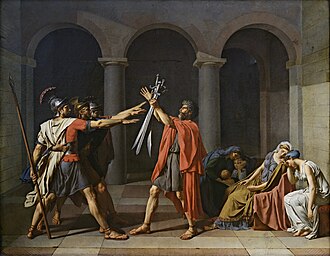 Der Schwur der Horatier - Jacques-Louis David (1784)
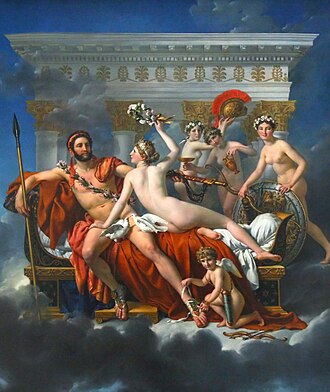 Mars Venus entwaffnet - Jacques-Louis David (1824)
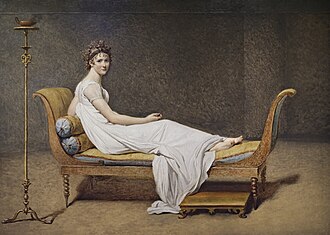 Porträt Madame Récamier - Jacques-Louis David (1800)
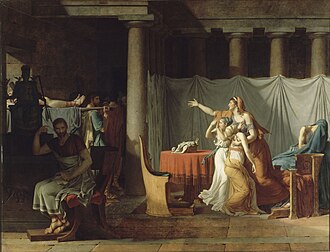 Die Liktoren bringen Brutus die Leichen seiner Söhne - Jacques-Louis David (1789)
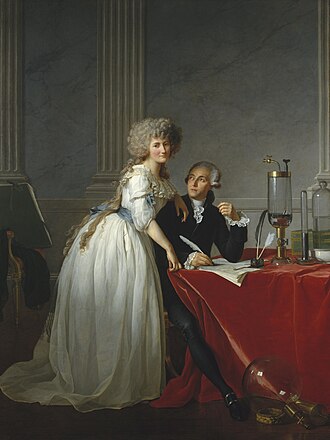 Antoine‑Laurent Lavoisier (1743–1794) und seine Frau - Jacques-Louis David (1788)
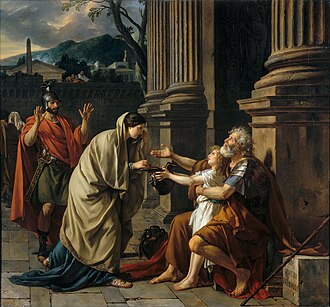 Belisar bittet um Almosen - Jacques-Louis David (1781)
Cupid und Psyche - Jacques-Louis David (1817)
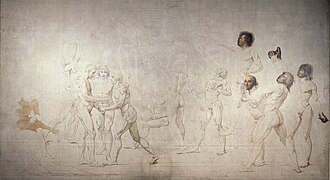 The Tennis Court Oath - Jacques-Louis David (1791)
Werke verwandter Künstler
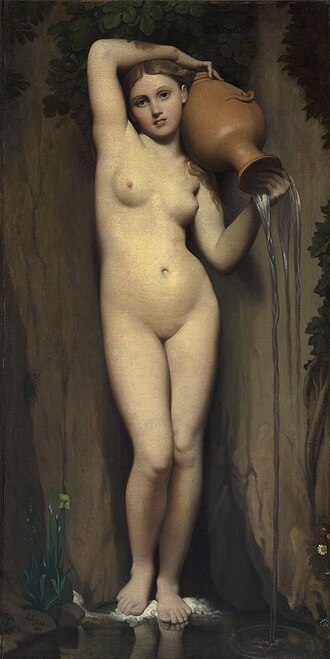 Die Quelle - Jean-Auguste-Dominique Ingres (1856)
 Napoleon I auf seinem kaiserlichen Thron - Jean-Auguste-Dominique Ingres (1806)
 Die Erschießung der Aufständischen - Francisco Goya (1814)
.jpg) Die nackte Maja - Francisco Goya (1800)
Die nackte Maja - Francisco Goya (1800)