The Happy Lovers
Gustave Courbet · 1844
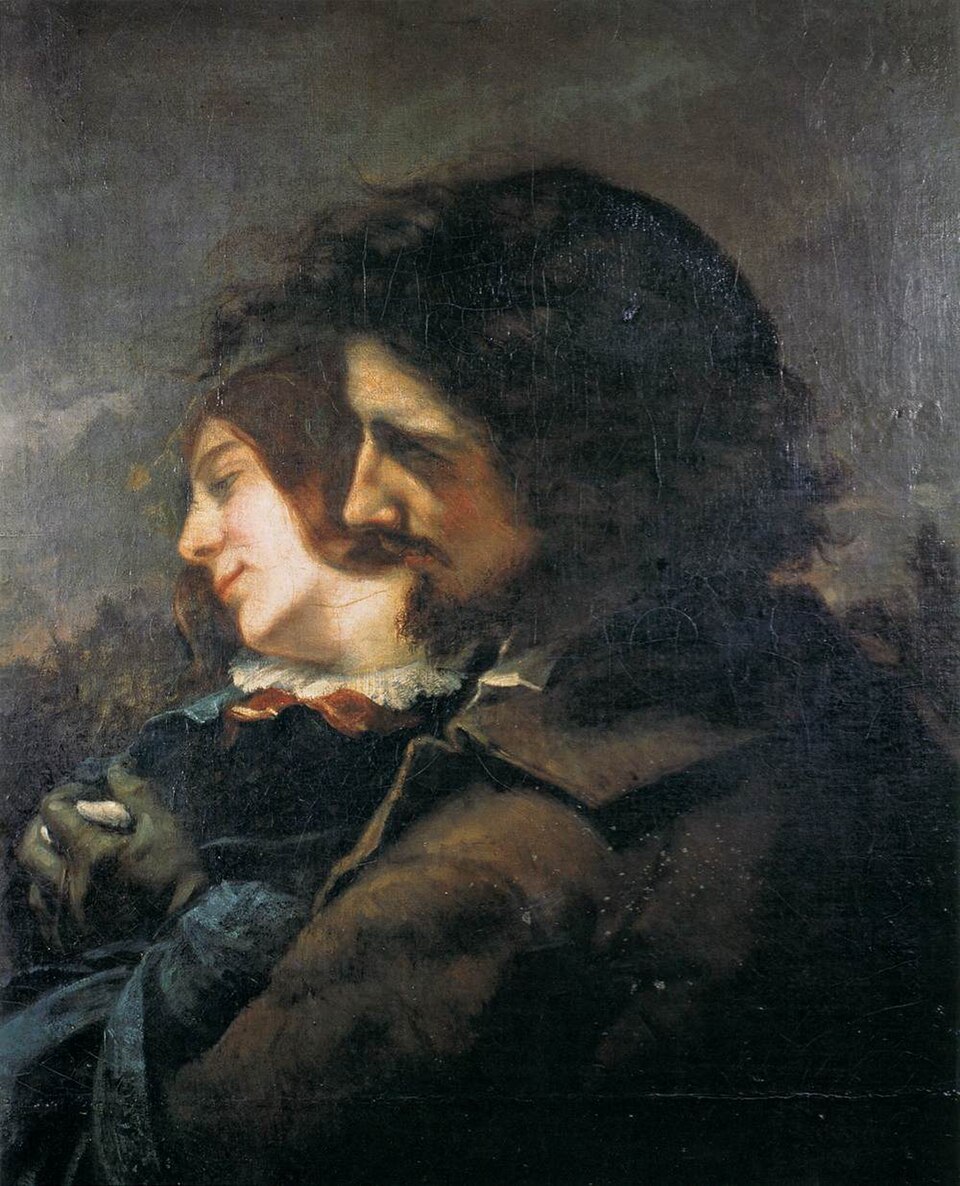
Two lovers lean into each other as if caught in the whirl of a waltz, and the man is Courbet himself. X-rays show that he changed his mind more than once before he let them go.
The story behind the painting
Courbet painted The Happy Lovers around 1844. The title is one given later. When it was shown in 1855 at the Pavillon Courbet in Paris, the painter's own exhibition, one of its earlier titles was The Waltz. Both this canvas and a second version show the artist himself and a woman in profile. The woman may be Virginie Binet, the mother of the artist's son, who was born shortly after the painting was made, and who also appears in The Wheat Sifters of 1854. Several preparatory drawings for the painting are known, a sign of how carefully Courbet worked toward this image.
What to look for
The painting has been described as two lovers leaning against each other in the whirlwind of a waltz. Look at their profiles close together, and at the sky and trees around them. Radiography shows how the picture changed. The original format was square, but Courbet added a band about 10 cm wide at the bottom. There are pentimenti, traces of earlier ideas: the woman's hand once rested on the man's shoulder, and the setting was a bay, not a landscape. The canvas now measures about 77 by 60 cm.
Meaning and intent
Painting himself as one half of a happy couple, Courbet turns a self-portrait into a scene of feeling. The earlier title, The Waltz, points to movement and closeness rather than a posed portrait. The changes found under the paint suggest he searched for the right gesture and setting before settling on this embrace. He then repeated the motif in a second version, under the title The Lovers in the Countryside, Sentiments of Youth, as if the idea of young love was worth saying twice.
Legacy
The painting was sold in the Courbet sale of 1881, bought by M. Hard and resold to M. Brame, and entered the Musée des Beaux-Arts de Lyon in 1892. His friend the engraver Félix Bracquemond reproduced it as an etching. X-rays proved that the Lyon canvas came first. The second, smaller version shows no pentimenti and was given to the Petit Palais in Paris in 1909 by Juliette Courbet, so the two lovers now live in two cities.
Schon gewusst?
- Painted around 1844 and shown as The Waltz in 1855.
- Shows Courbet and a woman, possibly Virginie Binet.
- X-rays show a square first format and a changed setting.
- In the Musée des Beaux-Arts de Lyon since 1892.
Über den Künstler
Gustave Courbet (1819-1877)
Frau · Selbstbildnis · Baum · Himmel · Paar · Bart · Musée des Beaux-Arts de Lyon · Gustave Courbet
Mehr von Gustave Courbet
 Der Ursprung der Welt - Gustave Courbet (1866)
 Ein Begräbnis in Ornans - Gustave Courbet (2020)
 Le Sommeil - Gustave Courbet (1866)
 Das Atelier des Künstlers - Gustave Courbet (1855)
 Frau mit Papagei - Gustave Courbet (1866)
 Die Steinklopfer - Gustave Courbet (1850)
 Die Begegnung, oder Bonjour, Monsieur Courbet! - Gustave Courbet (1854)
 Mädchen an der Seine - Gustave Courbet (1857)
Werke verwandter Künstler
 Impression, Sonnenaufgang - Claude Monet (1872)
 Seerosen - Claude Monet (1906)
 Das Frühstück im Grünen - Édouard Manet (1863)
 Olympia - Édouard Manet (1863)
 Es frischt auf - Winslow Homer (1873)
 Nebelwarnung - Winslow Homer (1885)
 Die Sternennacht - Vincent van Gogh (1889)
 Caféterrasse am Abend - Vincent van Gogh (1888)