Portrait of Richard Gallo
Gustave Caillebotte · 1881
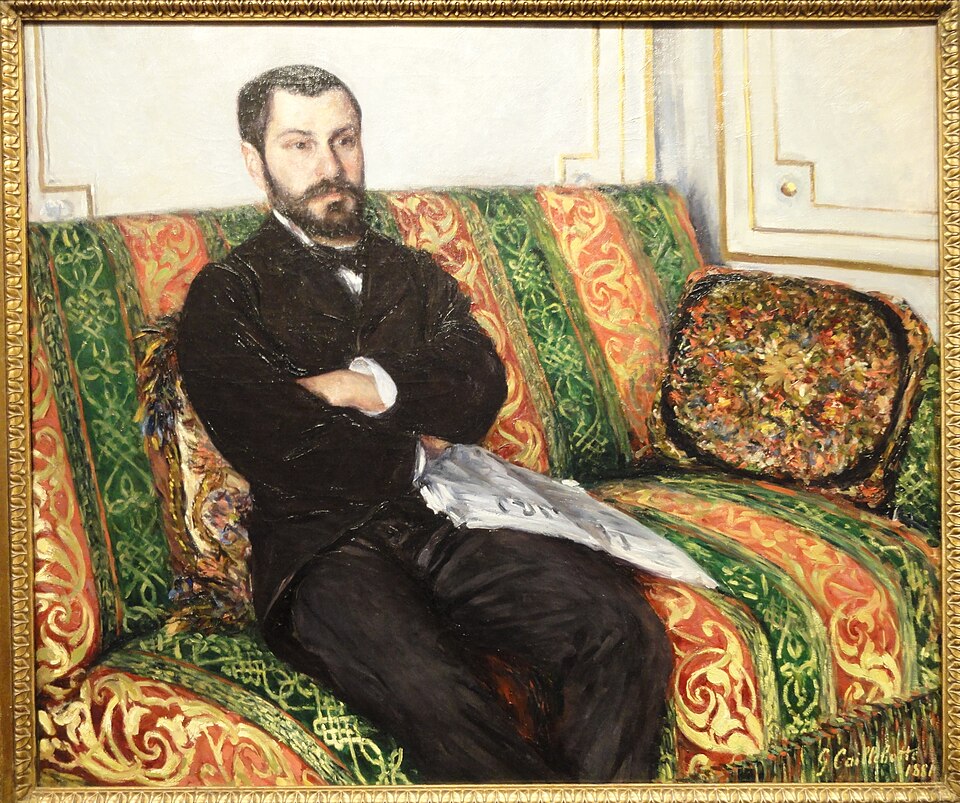
A young man in black sits on a striped sofa, arms crossed, a copy of Le Figaro open on his knee. Gustave Caillebotte painted his childhood friend Richard Gallo in 1881, and the newspaper says as much about Paris as the face does.
The story behind the painting
Richard Gallo was a childhood friend of Gustave Caillebotte, the son of a banker and a member of the wealthy bourgeoisie. Between 1878 and 1884 Caillebotte painted him seven times; this canvas of 1881, about 97 by 116 cm, is one of them. That year Gallo became a journalist at Le Constitutionnel, a conservative republican paper owned by his brother-in-law Alcide Grandguillo. He lived at 40 rue du Rocher, near the apartment Caillebotte shared with his brother Martial on the Boulevard Haussmann.
What to look for
Gallo is dressed elegantly in black, a strong contrast with the muted tones of the sofa. His arms are crossed and a newspaper lies unfolded on his left thigh. Around him, gilded woodwork, the costly sofa fabric and his careful dress all speak of his social position. His attitude is confident but reserved. Look at the diagonal angle of the view, the direction of his gaze, and the arabesques and stripes of the sofa fabric: these are where Caillebotte's impressionist eye shows most clearly.
Meaning and intent
The newspaper is a pointed detail. It is not Le Constitutionnel, where Gallo worked, but Le Figaro, its new competitor, an allusion to the competitive Paris press and to the 1881 law on the freedom of the press, much debated that year. The face and black suit show the influence of Caillebotte's teacher Léon Bonnat, but the composition expresses an impressionist view of modern life. Kirk Varnedoe saw the Gallo series as a coherent personal statement about the modern world.
Legacy
Caillebotte showed the painting at the last impressionist exhibition in 1882, where it went relatively unnoticed. The two men were close: Caillebotte also painted Gallo with himself in his studio in Self-Portrait at the Easel of 1879 to 1880, a sign that they shared views on the culture, art and politics of their time. The portrait now belongs to the Nelson-Atkins Museum of Art in Kansas City, a quiet picture of friendship and of a new kind of Parisian life.
Schon gewusst?
- Painted by Gustave Caillebotte in 1881.
- One of seven portraits of his friend Richard Gallo, 1878-1884.
- The newspaper on his knee is Le Figaro.
- Shown at the last impressionist exhibition in 1882.
Über den Künstler
Gustave Caillebotte (1848-1894)
Porträt · Impressionismus · Nelson-Atkins Museum of Art · Sofa
Mehr von Gustave Caillebotte
 Straße in Paris an einem regnerischen Tag - Gustave Caillebotte (1877)
 Die Parkettschleifer - Gustave Caillebotte (1875)
 Verschneite Dächer - Gustave Caillebotte (1878)
 Le Pont de l'Europe - Gustave Caillebotte (1876)
 Die Orangenbäume - Gustave Caillebotte (1878)
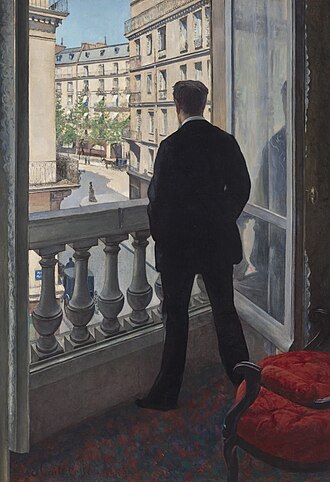 Junger Mann am Fenster - Gustave Caillebotte (1876)
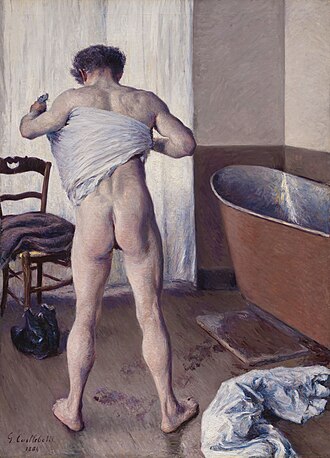 Man at His Bath - Gustave Caillebotte (1884)
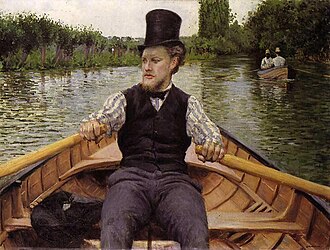 Ruderer mit Zylinder - Gustave Caillebotte (1878)
Werke verwandter Künstler
 Impression, Sonnenaufgang - Claude Monet (1872)
 Seerosen - Claude Monet (1906)
 Das Frühstück im Grünen - Édouard Manet (1863)
 Olympia - Édouard Manet (1863)
 Tanz im Moulin de la Galette - Pierre-Auguste Renoir (1876)
 Das Frühstück der Ruderer - Pierre-Auguste Renoir (1881)
 Wiege - Berthe Morisot (1872)
 Sommertag - Berthe Morisot (1879)
 Der Absinth - Edgar Degas (1875)
 Die Bellelli Familie - Edgar Degas (1858)
 Der Kanal von Loing - Alfred Sisley (1892)
 The Watering Pond at Marly with Hoarfrost - Alfred Sisley (1876)