The Watering Pond at Marly with Hoarfrost
Alfred Sisley · 1876
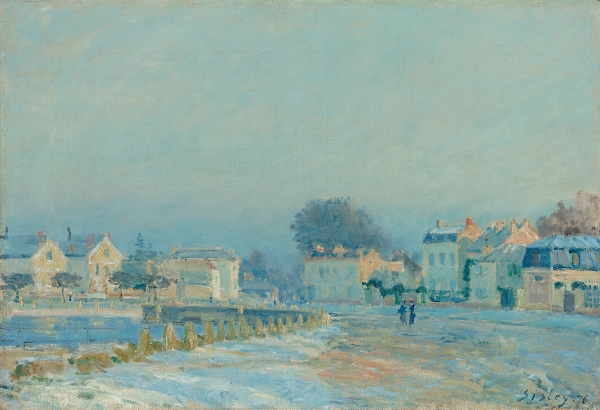
Frost on the ground, a village gathered around a still basin of water. Sisley could see this trough from his window at Marly, and in 1876 he painted it in winter, a royal relic turned into a place to water horses.
The story behind the painting
Sisley moved into 2 avenue de l'Abreuvoir in Marly-le-Roi in the winter of 1874 to 1875 and stayed until 1877. A window of his house overlooked the abreuvoir, the watering trough, and he made several studies of it. The basin was the last remnant of the cascades, pools and fountains of Louis XIV's Château de Marly, whose gardens André Le Nôtre had designed and which were destroyed under the First Empire. By Sisley's time it was used to water horses and wash linen for Louveciennes and Marly, yet it was still the only part of the estate classified as a historic monument, since 1862.
What to look for
This is a winter scene, about 50 by 65.5 cm. You can make out the ramp that let horses walk into the water in summer, though it is more prominent in another work, Horse Bath in Port-Marly. The scholar Lisa Portnoy Stein argues that Sisley slightly shifted things and made the basin smaller, the better to place the village and its houses at the centre of the composition. Compared with the other paintings of the group, its horizontal format strengthens that impression: the eye travels across the frosted water to the houses beyond.
Meaning and intent
Sisley painted the trough again and again without much changing his viewpoint, but he dramatically changed the background, proving he could vary views of a small piece of countryside. The subject broke with the themes of the Paris Salons of the 18th and early 19th centuries. Like Pissarro, Monet and Renoir, he cared more about the trough's everyday, practical use than about its status as a relic of the Ancien Régime or its past as an ornamental lake. The famous Chevaux de Marly statues that once adorned it had already gone to the Place de la Concorde in Paris.
Legacy
The Wikipedia article ranks Sisley's watering trough paintings and his Flood at Port-Marly series among Impressionist masterworks, comparable to Monet's Gare Saint-Lazare series. This canvas belonged to the Sisley collector François Depeaux of Rouen, was sold in Paris in 1906 and bought by Paul Durand-Ruel, went to Paul Cassirer in Berlin in 1913, and passed through the collections of Curt Hirschland and Wildenstein before Mr and Mrs Paul Mellon. It is now in the Virginia Museum of Fine Arts in Richmond. Since the 1990s a full-size reproduction has stood near the spot where it was painted.
Schon gewusst?
- Painted in 1876 at Marly-le-Roi.
- Sisley's window overlooked the watering trough.
- The trough was the last remnant of Louis XIV's Marly gardens.
- Now in the Virginia Museum of Fine Arts, Richmond.
Über den Künstler
Alfred Sisley (1839-1899)
Mehr von Alfred Sisley
 Der Kanal von Loing - Alfred Sisley (1892)
 Aquädukt von Marly - Alfred Sisley (1874)
 Schnee in Louveciennes - Alfred Sisley (1875)
 Maschinenhaus der Pumpe in Marly - Alfred Sisley (1873)
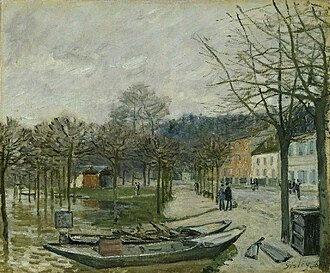 The Flood at Port Marly - Alfred Sisley (1876)
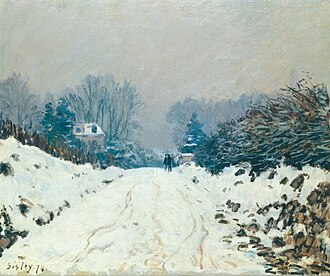 Schneelandschaft in Louveciennes - Alfred Sisley (1874)
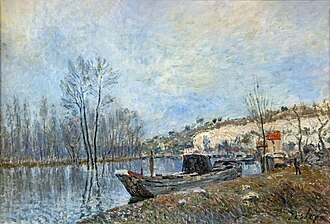 Die Ufer des Loing in Richtung Moret - Alfred Sisley (1883)
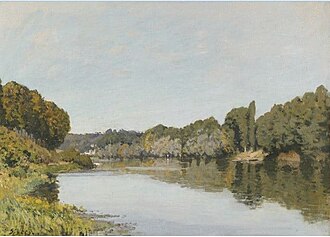 The Seine at Bougival - Alfred Sisley (1873)
Werke verwandter Künstler
 Impression, Sonnenaufgang - Claude Monet (1872)
 Seerosen - Claude Monet (1906)
 Das Frühstück im Grünen - Édouard Manet (1863)
 Olympia - Édouard Manet (1863)
 Tanz im Moulin de la Galette - Pierre-Auguste Renoir (1876)
 Das Frühstück der Ruderer - Pierre-Auguste Renoir (1881)
 Wiege - Berthe Morisot (1872)
 Sommertag - Berthe Morisot (1879)
 Der Absinth - Edgar Degas (1875)
 Die Bellelli Familie - Edgar Degas (1858)
 Straße in Paris an einem regnerischen Tag - Gustave Caillebotte (1877)
 Die Parkettschleifer - Gustave Caillebotte (1875)