Ruderer von Chatou
Pierre-Auguste Renoir · 1879
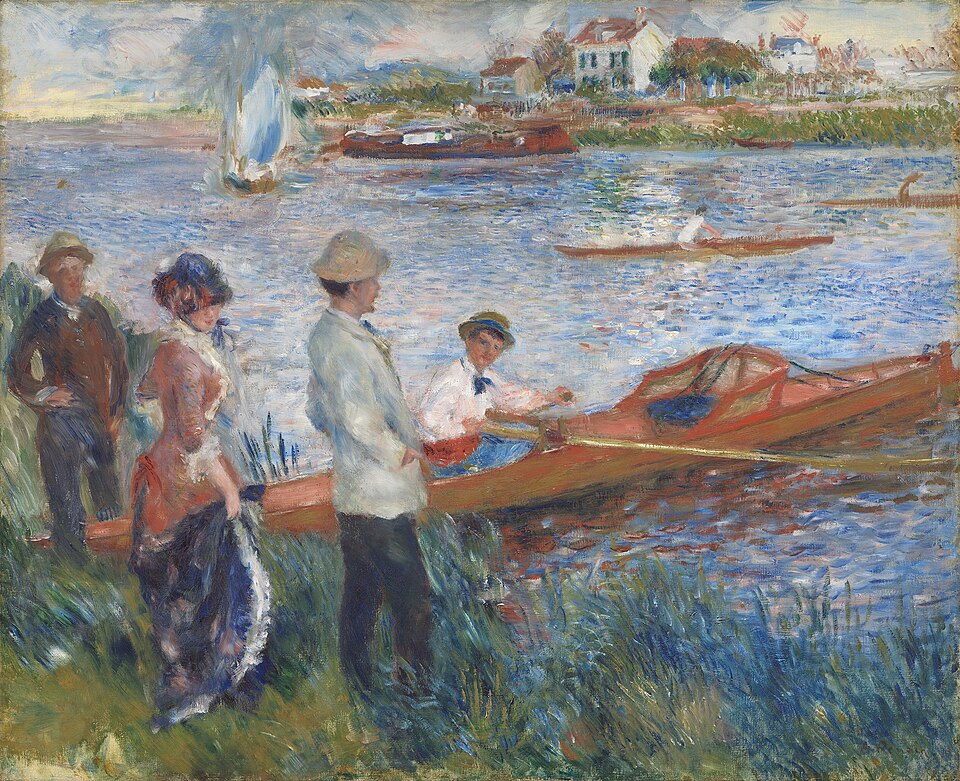
A summer day on the Seine, a vermilion rowing boat cutting across the water, and on the bank the woman Renoir would one day marry. Oarsmen at Chatou is full of sunlight, leisure and quiet affection.
The story behind the painting
Renoir painted the picture in 1879 on the banks of the Seine at Chatou, west of Paris, a place he returned to regularly for nearly fifteen years. It is signed A. Renoir 79 at lower right. The woman in the scene is Aline Charigot, whom Renoir would marry later, in 1890, and beside her stands Edmond, the painter's brother. The canvas was probably first shown in 1882 at the seventh Impressionist exhibition in Paris under the simple title Oarsmen. So the picture is both a scene of modern life and a gathering of the people closest to him.
What to look for
The standing figures form a vertical anchor for the sharp diagonal of the vermilion rowing boat in the foreground, which in turn works against the river and its banks flowing away to the upper left. Their uprights also steady the horizontal lines of other boats and distant shores, which widen the glittering water. Bright colours dominate, laid on with quick, short strokes, ranging from scarlet to the palest pinks. A patch of blue-grey sky at upper left seems to push forward. The figures gradually dissolve into the atmosphere, and sunlight reflecting on the water lifts the whole scene.
Meaning and intent
Renoir presents this rowing contest as a leisure scene of the well-off and a record of modern life, capturing the middle-class love of boating, both for pleasure and for racing. Yet the people in it are his own: the future wife, the brother. The family members have a structural role in the composition, but they also give the open-air sport a personal warmth. Renoir studied how light falls on water and how boats were distorted in reflections, and the picture is as much about that shimmering impression of grass, water, wind and cloud as about the oarsmen.
Legacy
Renoir sold the painting in 1911 to the Durand-Ruel gallery in Paris. In May 1912 it went to Arthur B. Emmons, and in February 1922 to Adolph Lewisohn, then passed by inheritance to his son Sam A. Lewisohn in New York. In 1951 it was bequeathed to the National Gallery of Art in Washington, where it remains. It belongs to a group of works that Renoir made around Chatou, the same stretch of river that drew him back again and again, and it shows Aline at the start of a story that would last the rest of his life.
Schon gewusst?
- Painted at Chatou on the Seine in 1879.
- Shows Aline Charigot, Renoir's future wife, and his brother Edmond.
- Probably shown at the seventh Impressionist exhibition in 1882.
- Bequeathed to the National Gallery of Art, Washington, in 1951.
Über den Künstler
Pierre-Auguste Renoir (1841-1919)
Frau · Genreszene · Impressionismus · National Gallery of Art · Haus · Segelboot · Fluss
Mehr von Pierre-Auguste Renoir
 Tanz im Moulin de la Galette - Pierre-Auguste Renoir (1876)
 Das Frühstück der Ruderer - Pierre-Auguste Renoir (1881)
 Auf der Schaukel - Pierre-Auguste Renoir (1876)
 Die großen Badenden - Pierre-Auguste Renoir (1884)
 Zwei Mädchen am Klavier - Pierre-Auguste Renoir (1892)
 Regenschirme - Pierre-Auguste Renoir (1880s)
%20(46499625955).jpg) Die Loge - Pierre-Auguste Renoir (1874)
Die Loge - Pierre-Auguste Renoir (1874)%20-%201933.455%20-%20Art%20Institute%20of%20Chicago.jpg) Auf der Terrasse - Pierre-Auguste Renoir (1881)
Auf der Terrasse - Pierre-Auguste Renoir (1881)
Werke verwandter Künstler
 Impression, Sonnenaufgang - Claude Monet (1872)
 Seerosen - Claude Monet (1906)
 Das Frühstück im Grünen - Édouard Manet (1863)
 Olympia - Édouard Manet (1863)
 Der Absinth - Edgar Degas (1875)
 Die Bellelli Familie - Edgar Degas (1858)
 Die Sternennacht - Vincent van Gogh (1889)
.jpg) Caféterrasse am Abend - Vincent van Gogh (1888)
Caféterrasse am Abend - Vincent van Gogh (1888) Die letzte Fahrt der Temeraire - J. M. W. Turner (1839)
 Rain, Steam and Speed - The Great Western Railway - J. M. W. Turner (1844)
 Woher kommen wir? Wer sind wir? Wohin gehen wir? - Paul Gauguin (1897-1898)
%201889.jpg) Der gelbe Christus - Paul Gauguin (1889)
Der gelbe Christus - Paul Gauguin (1889)