Regenschirme
Pierre-Auguste Renoir · 1880s
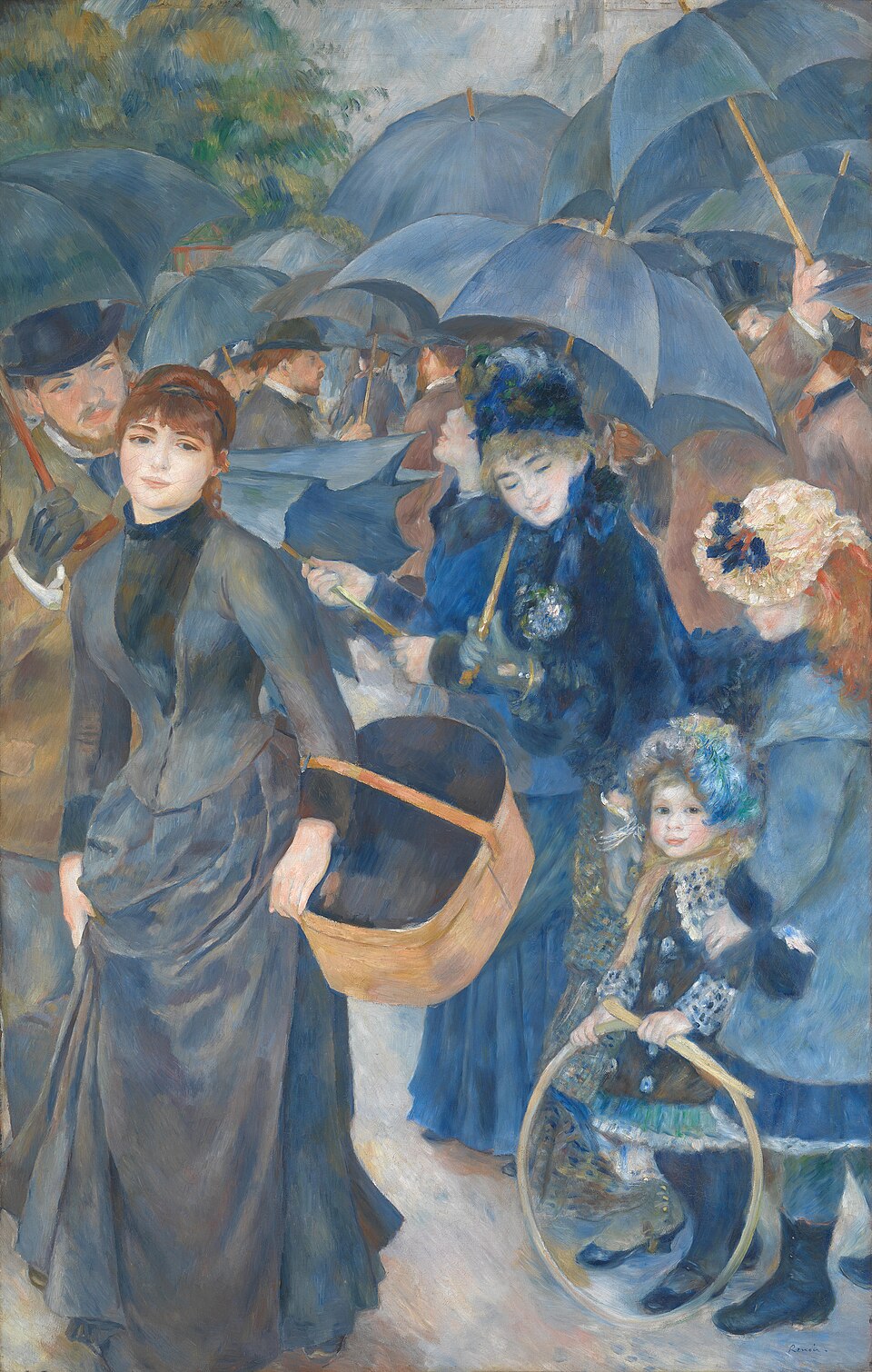
Rain, or the promise of it, on a Paris street: a canopy of blue-grey umbrellas, a mother with her girls, and a young woman with no umbrella at all. Renoir painted The Umbrellas twice over, five years apart, and both moments live in one canvas.
The story behind the painting
Renoir began The Umbrellas around 1880-81 with the loose brushwork and play of dark and bright tones typical of Impressionism. Then he set it aside. Around 1885, having lost his attachment to Impressionism and drawing on classical art he had seen in Italy and on the work of Ingres and Cézanne, he returned to it. He reworked parts in a more linear, classical style with more muted colour, especially the main female figure at the left, and added the background and the umbrellas themselves. X-rays show that this woman once wore a hat and a frilled dress with white lace, suggesting a middle-class lady; in the revised picture her simpler clothes mark her as a working woman. Changing fashions and the x-rays help date both campaigns.
What to look for
Start at the right, where the earlier Renoir lingers. A mother looks down at her two daughters, all dressed in the afternoon fashions of 1881; one girl holds a hoop and stick. Behind them a woman is caught raising or lowering her umbrella, as if the rain is just beginning or ending. Now cross to the left. A milliner's assistant, modelled by Suzanne Valadon, lifts her skirt from the mud and carries a hatbox, with no hat, coat or umbrella. A bearded young man seems about to approach her. The focus sits off-centre and many figures are cut by the frame, like a photograph. Look up: the umbrellas form careful geometric shapes in blues and greys, softened by the round hatbox and hoop.
Meaning and intent
The painting holds two Renoirs in conversation. The National Gallery's scientists found that the dresses of the mother and daughters, painted in 1881, use a vivid mixture with cobalt blue, while the later layer, painted in 1886, uses ultramarine with other pigments for a noticeably greyer blue. Read the picture with that in mind and the softer, freer right side meets the firmer, more classical left. The story inside it is gentle too: a working young woman without shelter, a gentleman perhaps offering his umbrella, and two figures, she and one of the girls, who turn to look out at us while everyone else goes about their business.
Legacy
Renoir did not exhibit The Umbrellas at once, perhaps fearing its mix of styles would challenge the public, and sold it to the dealer Paul Durand-Ruel in 1892. It passed to Sir Hugh Lane, who died in the sinking of the Lusitania in 1915 and left it to the Tate. An unwitnessed codicil suggesting he preferred Dublin was contested. The painting moved to the National Gallery in London in 1935, and from 1959 it has alternated between London and the Hugh Lane Gallery in Dublin, spending 2013 to 2019 in Dublin. It is now in London, and from March to July 2026 it was lent to the Musée d'Orsay for a Renoir retrospective.
Schon gewusst?
- Painted in two phases, about 1880-81 and about 1885
- Model for the left-hand figure: Suzanne Valadon
- Measures 180.3 x 114.9 cm
- Part of the Lane Bequest, shared between London and Dublin
Über den Künstler
Pierre-Auguste Renoir (1841-1919)
Frau · Genreszene · Mann · National Gallery · Korb · Menschenmenge · Schirm
Mehr von Pierre-Auguste Renoir
 Tanz im Moulin de la Galette - Pierre-Auguste Renoir (1876)
 Das Frühstück der Ruderer - Pierre-Auguste Renoir (1881)
 Auf der Schaukel - Pierre-Auguste Renoir (1876)
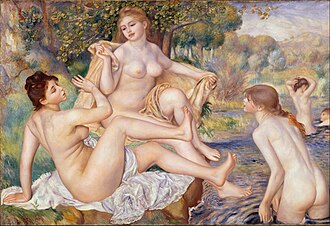 Die großen Badenden - Pierre-Auguste Renoir (1884)
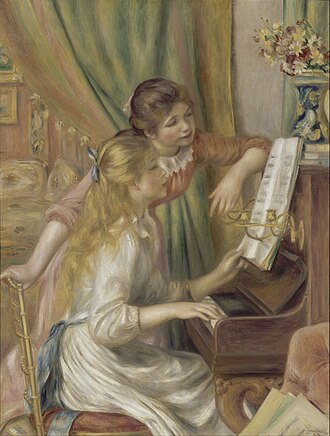 Zwei Mädchen am Klavier - Pierre-Auguste Renoir (1892)
%20(46499625955).jpg) Die Loge - Pierre-Auguste Renoir (1874)
Die Loge - Pierre-Auguste Renoir (1874)%20-%201933.455%20-%20Art%20Institute%20of%20Chicago.jpg) Auf der Terrasse - Pierre-Auguste Renoir (1881)
Auf der Terrasse - Pierre-Auguste Renoir (1881)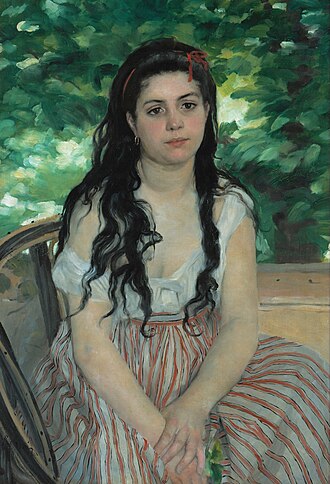 Im Sommer - Pierre-Auguste Renoir (1868)
Werke verwandter Künstler
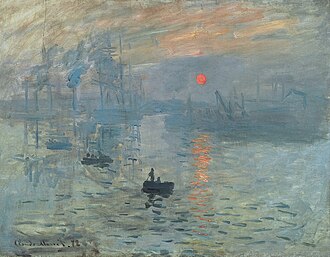 Impression, Sonnenaufgang - Claude Monet (1872)
 Seerosen - Claude Monet (1906)
 Die Sternennacht - Vincent van Gogh (1889)
.jpg) Caféterrasse am Abend - Vincent van Gogh (1888)
Caféterrasse am Abend - Vincent van Gogh (1888) Woher kommen wir? Wer sind wir? Wohin gehen wir? - Paul Gauguin (1897-1898)
%201889.jpg) Der gelbe Christus - Paul Gauguin (1889)
Der gelbe Christus - Paul Gauguin (1889) Das Frühstück im Grünen - Édouard Manet (1863)
 Olympia - Édouard Manet (1863)