Michelangelo being Shown the Belvedere Torso
Jean-Léon Gérôme · 1849
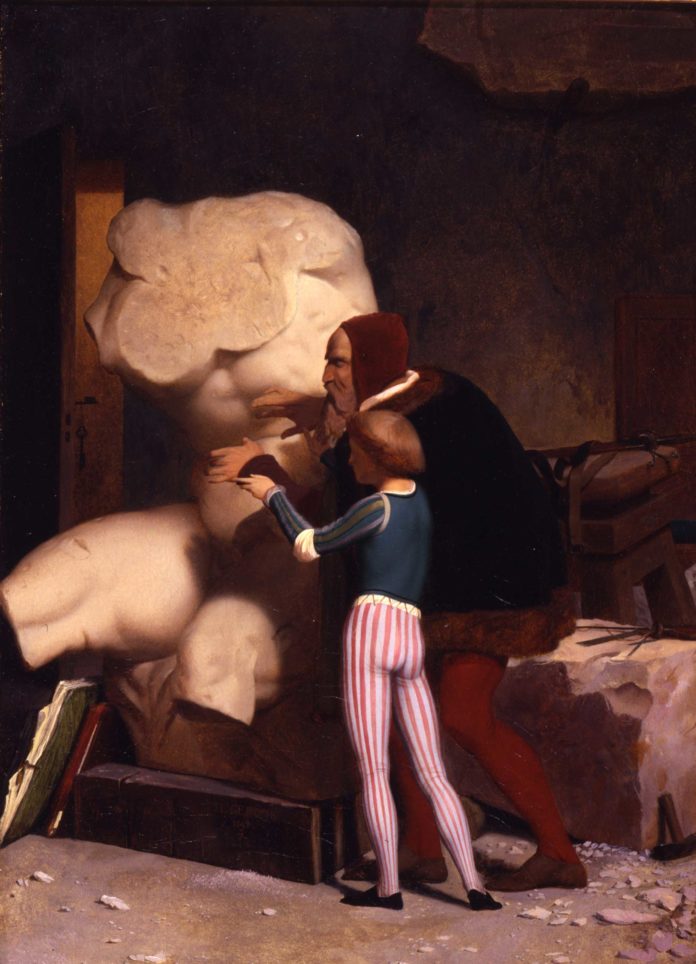
An old, blind Michelangelo is led by a boy to lay his hands on an ancient marble torso. It never happened, and the young Gérôme knew it. He painted it anyway, as a tribute to touch, memory and the art of the past.
The story behind the painting
Jean-Léon Gérôme painted this small canvas in 1849, while still a young artist; two years earlier he had made his name with The Cockfight. He worked in a shared studio building called Le Chalet, at 27 rue de Fleurus in Paris, and was strongly marked by his 1843 trip to Rome with his teacher Paul Delaroche. It was there that he saw the Belvedere Torso, which has stood in the Octagonal Court of the Belvedere Palace in the Vatican since 1530. The French title is Michelangelo in his Studio.
What to look for
The scene is inside the artist's studio. A door stands ajar, with a key hanging below the handle, and a bas-relief hangs high on the right wall. At the centre, an ageing Michelangelo is guided by a young boy to place his hands on the Torso, set on a wooden stand. Behind him sits a barely rough-hewn block of stone raised on a log. Tools lie here and there, stone chips cover the floor, and drawing folders rest beside the Torso. Gérôme signed and dated it at lower left on the wooden base, J.L. Gérôme and 1849 on two lines.
Meaning and intent
The picture is built on contrasts: young and old, white marble and coloured clothing, touch and sight, the massive Torso and the delicate figures. It is a fictional history scene. The Torso was in the Vatican from 1530, so it could not have stood in Michelangelo's studio, and Michelangelo did not end his life blind. According to Dominique de Font-Réaulx, the painting is both a homage to one of the great artists of the Renaissance and an early sign of Gérôme's interest in the theme of antiquity.
Legacy
The oil on canvas is small and vertical. Wikipedia gives 52 by 36 cm, while Wikidata lists 51.5 by 37.5 cm. It belongs to the Dahesh Museum of Art in New York, which titles it Michelangelo being Shown the Belvedere Torso. Painted early in a long career, it shows the young Gérôme already turning to the ancient world that would fill so much of his later work, imagining a master who, unable to see, still learns from sculpture with his hands.
Schon gewusst?
- Painted by Jean-Léon Gérôme in 1849.
- The scene is invented: the Torso was in the Vatican from 1530.
- Signed and dated on the wooden stand at lower left.
- Held by the Dahesh Museum of Art, New York.
Über den Künstler
Jean-Léon Gérôme (1824-1904)
Mehr von Jean-Léon Gérôme
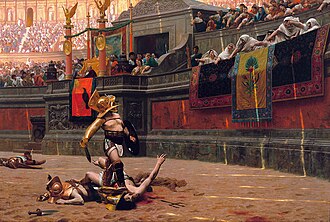 Pollice verso - Jean-Léon Gérôme (1872)
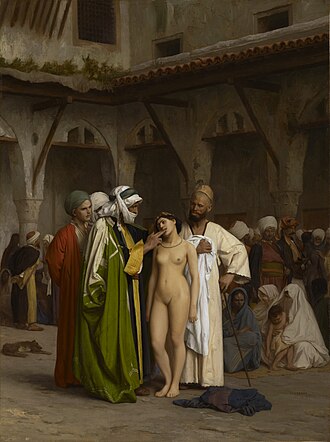 Der Sklavenmarkt - Jean-Léon Gérôme (1866)
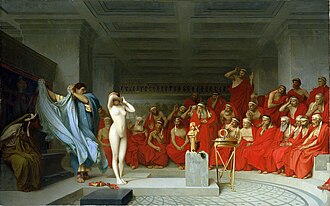 Phryne vor dem Areopag - Jean-Léon Gérôme (1861)
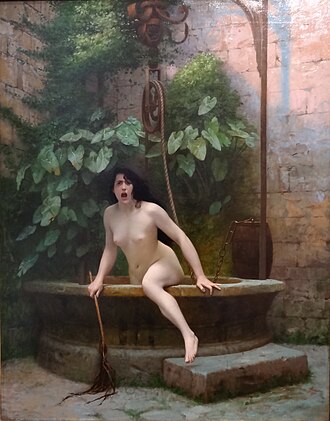 Die Wahrheit steigt aus dem Brunnen - Jean-Léon Gérôme (1896)
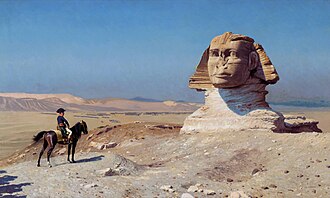 Bonaparte Before the Sphinx - Jean-Léon Gérôme (1867)
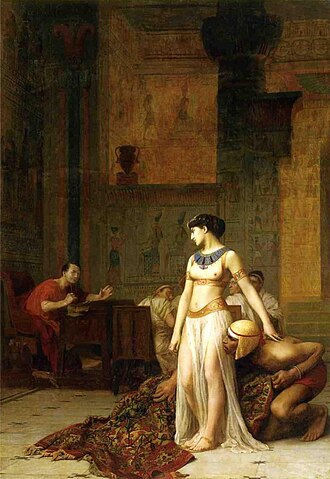 Cleopatra and Caesar - Jean-Léon Gérôme (1866)
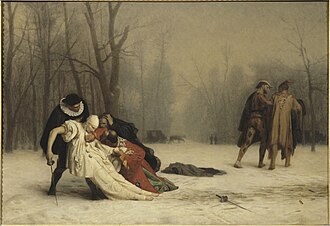 The Duel After the Masquerade - Jean-Léon Gérôme (1857)
 The Execution of Marshal Ney - Jean-Léon Gérôme (1868)
Werke verwandter Künstler
 Das Frühstück im Grünen - Édouard Manet (1863)
 Olympia - Édouard Manet (1863)
 Der Ursprung der Welt - Gustave Courbet (1866)
 Ein Begräbnis in Ornans - Gustave Courbet (2020)
 Nelke, Lilie, Lilie, Rose - John Singer Sargent (1885-1886)
 Madame X - John Singer Sargent (1884)
 Die Freiheit führt das Volk - Eugène Delacroix (1830)
 Der Tod des Sardanapal - Eugène Delacroix (1827)
 Der Tod des Sokrates - Jacques-Louis David (1787)
 Der Schwur der Horatier - Jacques-Louis David (1784)
 Die Schwestern Waldegrave - Joshua Reynolds (1780)
 Porträt des Colonel George K. H. Coussmaker vom Regiment der Garde-Grenadiere - Joshua Reynolds (1782)