Felsiges Flußtal
Gustave Courbet · 1865
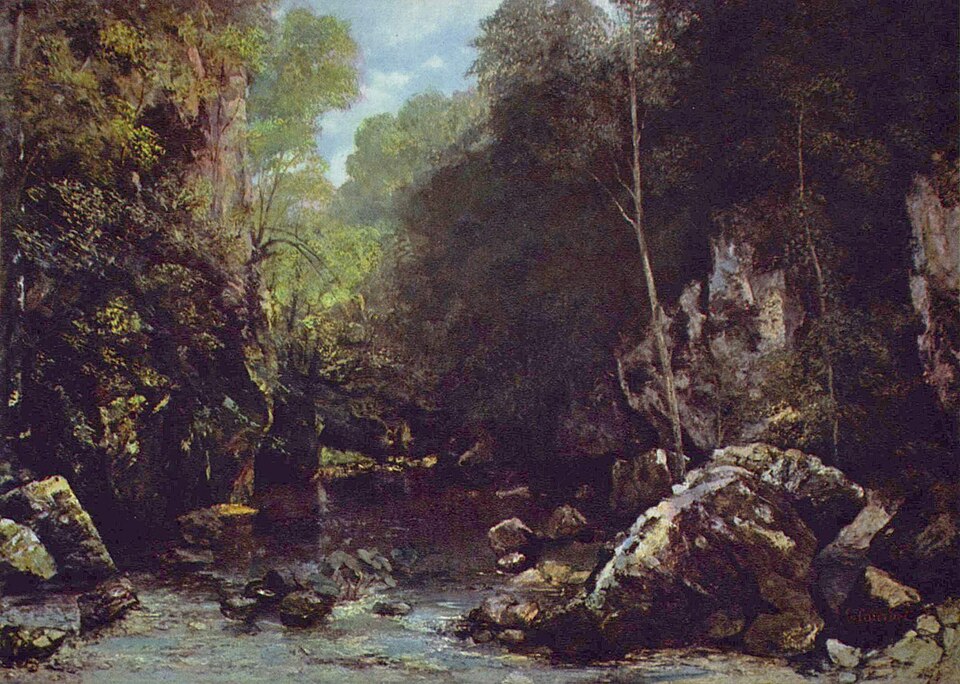
A stream winds through a dark ravine between mossy boulders, with sunlit leaves far behind. Courbet thought it might be the best picture he ever painted.
The story behind the painting
Courbet painted The Black Stream, also called Stream in a Ravine, in 1865. The water is the Loue, a capricious river that flows through Ornans, the village where he was born. He seems to have returned to this spot several times, and it can be recognised in a number of his paintings. Courbet loved to search out an unspoilt corner in these lonely gorges. Of this landscape he wrote that it was perhaps the best he had ever painted, showing the Loue walled up between vast boulders of mossy rock, with thick sunlit foliage in the background. You can feel the enthusiasm of an artist painting his home country.
What to look for
The canvas, about 93.5 by 131.5 cm, shows a gorge with a winding stream, its bed littered with rocks, between steep walls covered in wild vegetation. Look at how the paint was laid on. Courbet used the brush only in the shadows of the background; everywhere else he worked with the palette knife. He crushed his pigments and spread them diagonally with the knife, letting the lumps of paint underneath show through. This gives a transparency and depth as rich as the glazes of earlier painters. The greens are especially rich, evoking a half-aquatic world where plants run riot.
Meaning and intent
The Wikipedia article describes the damp air of these gorges as giving the impression of a strange world from which primordial waters have only just receded. The picture is not a story with figures; it is about rock, water, moss and light, and about the act of painting itself. In this work, the same source says, Courbet's technique is at its peak. The deep shade at the bottom and the bright leaves at the top pull the eye upward, out of the cool ravine and toward the sun, as if we were standing in the stream ourselves.
Legacy
The picture was shown at the Exposition Universelle of 1867 and bought from the artist that same year by the Comte de Nieuwerkerke, director of museums, for Napoleon III. It was part of the emperor's personal property until the Tribunal de la Seine assigned it to the Louvre, with other paintings, on 12 February 1879. In 1881 it was shown at the Luxembourg under the title Le puits noir, The Black Ravine, which is really the name of a different work Courbet painted in 1869. Today the landscape hangs in the Musée d'Orsay in Paris.
Schon gewusst?
- Painted in 1865; the stream is the Loue near Ornans, Courbet's birthplace.
- Mostly painted with the palette knife.
- Shown at the 1867 Exposition Universelle and bought for Napoleon III.
- Now in the Musée d'Orsay.
Über den Künstler
Gustave Courbet (1819-1877)
Landschaftsmalerei · Musée d’Orsay · Landschaft · Fließgewässer
Mehr von Gustave Courbet
 Der Ursprung der Welt - Gustave Courbet (1866)
 Ein Begräbnis in Ornans - Gustave Courbet (2020)
 Le Sommeil - Gustave Courbet (1866)
 Das Atelier des Künstlers - Gustave Courbet (1855)
 Frau mit Papagei - Gustave Courbet (1866)
 Die Steinklopfer - Gustave Courbet (1850)
 Die Begegnung, oder Bonjour, Monsieur Courbet! - Gustave Courbet (1854)
 Mädchen an der Seine - Gustave Courbet (1857)
Werke verwandter Künstler
 Impression, Sonnenaufgang - Claude Monet (1872)
 Seerosen - Claude Monet (1906)
 Das Frühstück im Grünen - Édouard Manet (1863)
 Olympia - Édouard Manet (1863)
 Es frischt auf - Winslow Homer (1873)
 Nebelwarnung - Winslow Homer (1885)
 Die Sternennacht - Vincent van Gogh (1889)
 Caféterrasse am Abend - Vincent van Gogh (1888)