Le Désespéré
Gustave Courbet · 1840
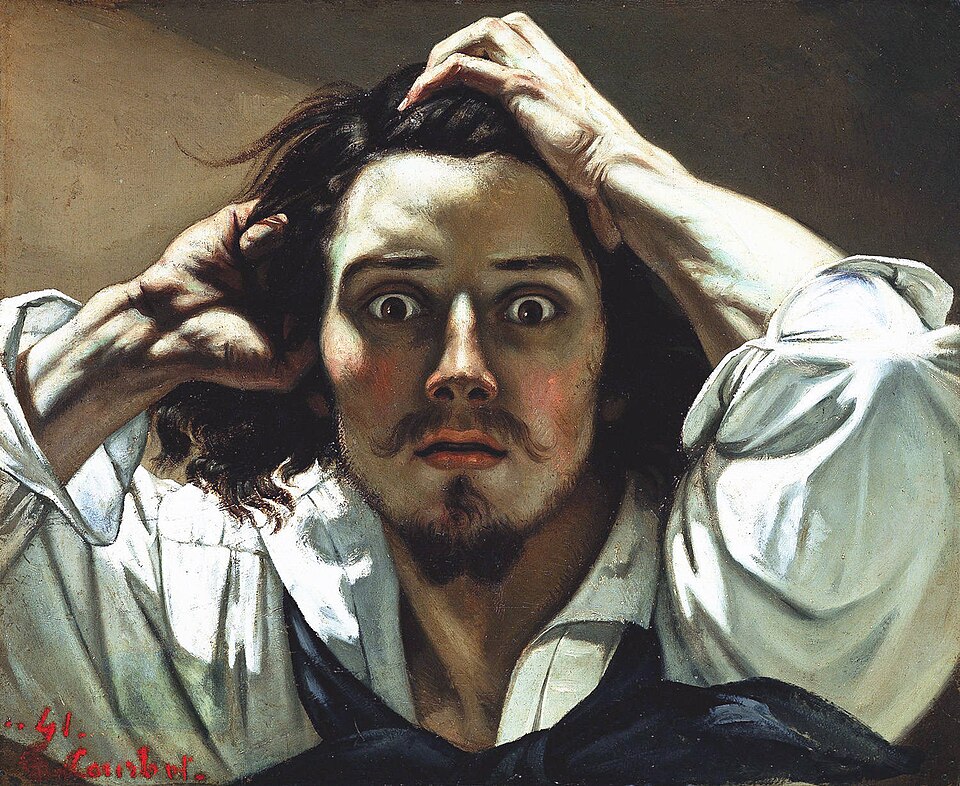
A young man stares straight at you, eyes wide, hands in his hair. Courbet painted himself in despair in his first years in Paris and kept the canvas with him even into exile.
The story behind the painting
In the 1840s, newly arrived in Paris, Courbet painted friends, clients and himself, including Self-Portrait with a Black Dog of 1842. He spent time in the Louvre copying Ribera, Zurbarán, Velázquez and Rembrandt. Researchers date Le Désespéré to between 1843 and 1845, while Wikidata gives 1840, an earlier date the article does not support. Those Spanish and Dutch masters shaped the start of his career, and for this work he broke from his usual upright format.
What to look for
Courbet shows himself frontally and close up, mouth half open, his gaze plunging into ours, both hands seemingly ready to tear out his hair. A dark blue scarf hangs loosely at his neck. The pale face contrasts with the dark hair and beard, sharpened by the white shirt, under a light falling from the upper left. Notice the format: 45 by 54 cm, wider than tall, a break with the usual upright portrait.
Meaning and intent
Romantic portraiture centred on emotion, and though Courbet never called himself a Romantic, his first paintings grew under that influence; this one also follows the stock expressions of Jacques-Louis David and the Spanish painters he studied. Nobody knows whether the title reflects his own despair or a mere exercise. To his friend Alfred Bruyas he wrote that behind the laughing mask people knew, he hid sorrow, bitterness and a sadness that gripped his heart like a vampire.
Legacy
He was attached to it, and took it into exile in Switzerland in 1873; Doctor Paul Collin later described in his studio a painting of Courbet with a desperate expression, titled Despair. Long in the private collection of BNP Paribas, it was shown in the 2007 Courbet retrospective at the Musée d'Orsay, New York and Frankfurt. On 14 October 2025 it went on display at Orsay, its first showing in France in 17 years, as Qatar Museums announced they had acquired it; it will stay five years before going to Doha.
Schon gewusst?
- Painted between 1843 and 1845; Wikidata says 1840.
- A wide, landscape-format self-portrait.
- Courbet took it into exile in Switzerland in 1873.
- Acquired by Qatar Museums, shown at Orsay from 2025.
Über den Künstler
Gustave Courbet (1819-1877)
Mann · Selbstbildnis · Gustave Courbet
Mehr von Gustave Courbet
 Der Ursprung der Welt - Gustave Courbet (1866)
 Ein Begräbnis in Ornans - Gustave Courbet (2020)
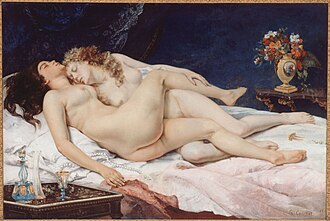 Le Sommeil - Gustave Courbet (1866)
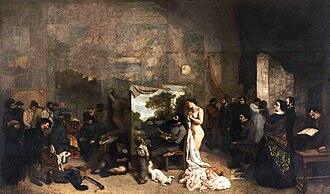 Das Atelier des Künstlers - Gustave Courbet (1855)
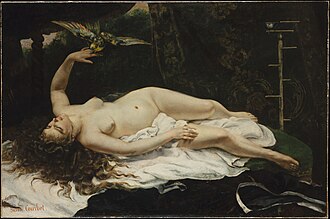 Frau mit Papagei - Gustave Courbet (1866)
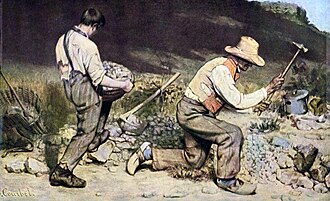 Die Steinklopfer - Gustave Courbet (1850)
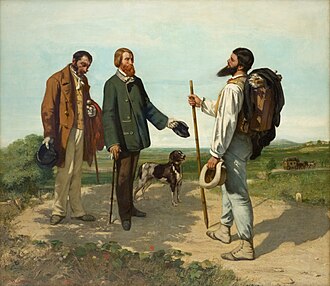 Die Begegnung, oder Bonjour, Monsieur Courbet! - Gustave Courbet (1854)
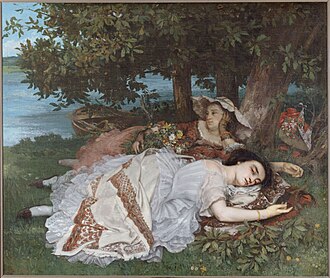 Mädchen an der Seine - Gustave Courbet (1857)
Werke verwandter Künstler
 Impression, Sonnenaufgang - Claude Monet (1872)
 Seerosen - Claude Monet (1906)
 Das Frühstück im Grünen - Édouard Manet (1863)
 Olympia - Édouard Manet (1863)
 Es frischt auf - Winslow Homer (1873)
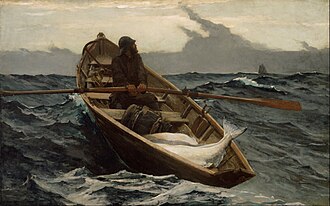 Nebelwarnung - Winslow Homer (1885)
 Die Sternennacht - Vincent van Gogh (1889)
 Caféterrasse am Abend - Vincent van Gogh (1888)