Femme nue couchée
Gustave Courbet · 1862
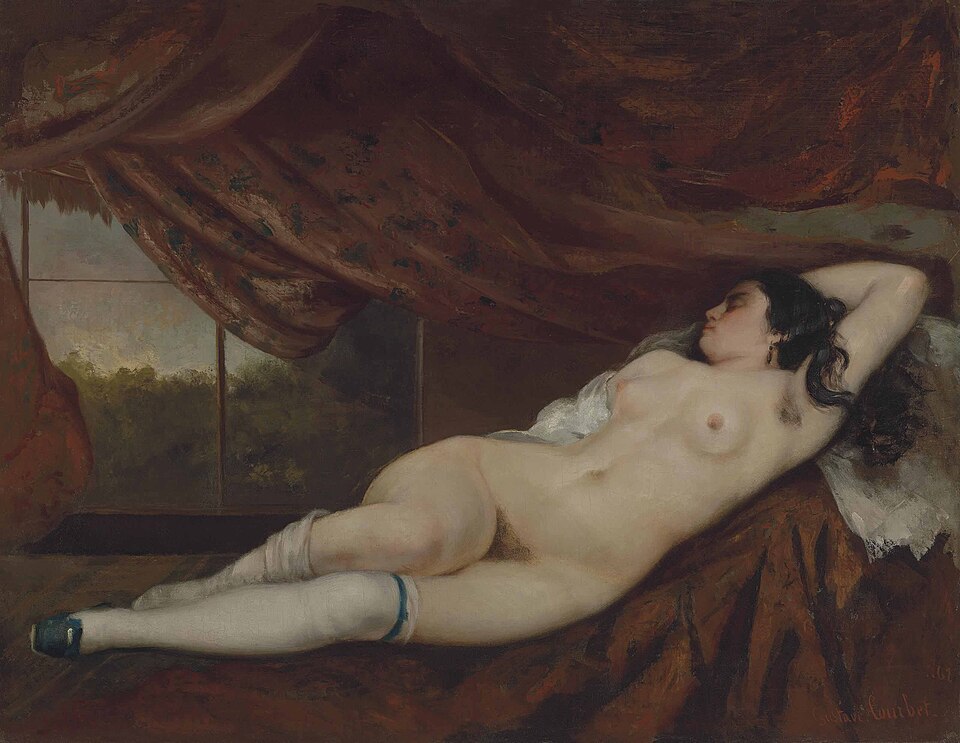
A young woman lies on a couch beneath half drawn red curtains, wearing only her shoes and stockings. Courbet painted her in 1862, and the canvas later vanished in war torn Budapest, only to resurface decades later.
The story behind the painting
Femme nue couchée, Nude Reclining Woman, was painted in 1862 by the French Realist Gustave Courbet. The work is likely influenced by Goya's La maja desnuda, the famous reclining nude painted in Spain decades earlier. The painting was first owned by Alexandre Berthier and later by Marcell Nemes. In 1913 the Hungarian collector Ferenc Hatvany bought it. Hatvany, himself a painter, once made a copy of it and, as a practical joke, sent the copy to a 1939 exhibition of French painting in Belgrade, where it was shown as the original.
What to look for
A young dark haired woman reclines on a couch, wearing nothing but a pair of shoes and stockings. Those few clothes make the scene feel present and real rather than mythological, in keeping with Courbet's Realism. Behind her, red curtains are partly drawn back to reveal a closed window and an overcast sky beyond. Notice the contrast between the warm red of the drapery and the grey light outside, and the way her body fills the couch in the foreground. Compare her pose with Goya's maja, which the painting is thought to echo.
Meaning and intent
The picture's history adds its own drama. With the rest of Hatvany's collection, it was looted from a Budapest bank vault during the Soviet capture of the city in 1945. It was briefly seen tied to the tarpaulin of a Soviet military vehicle on Buda Castle Hill, then seemed to vanish without a trace. It surfaced again in 2000 and 2003, when a Slovak man calling himself an antiques dealer offered it first to the Museum of Fine Arts and then to the Commission for Art Recovery. His affidavit stated that Soviet soldiers had given it to a village doctor near Bratislava for treating a wounded soldier.
Legacy
An examination of the craquelure, the fine network of cracks in the paint, confirmed that this was the original and not Hatvany's copy. After five years of negotiation, with Interpol involved and diplomatic exchanges between the United States and Slovakia, the Commission for Art Recovery secured the painting for Hatvany's heirs in return for a reward. In 2007 it was shown to the public for the first time since the 1930s, in a Courbet exhibition at the Grand Palais in Paris. It was sold at auction in November 2015, setting a new record for a Courbet painting.
Schon gewusst?
- Painted by Courbet in 1862.
- Likely influenced by Goya's La maja desnuda.
- Looted in Budapest in 1945 and recovered decades later.
- Shown at the Grand Palais in 2007 for the first time since the 1930s.
Über den Künstler
Gustave Courbet (1819-1877)
Frau · Akt · Nacktheit · langes Haar · Vorhang · liegend · Ohrring · Schuh · Strumpf
Mehr von Gustave Courbet
 Der Ursprung der Welt - Gustave Courbet (1866)
 Ein Begräbnis in Ornans - Gustave Courbet (2020)
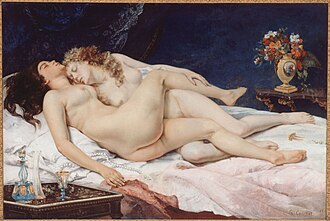 Le Sommeil - Gustave Courbet (1866)
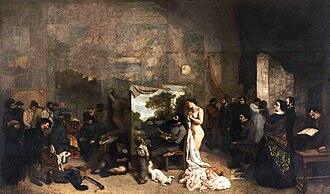 Das Atelier des Künstlers - Gustave Courbet (1855)
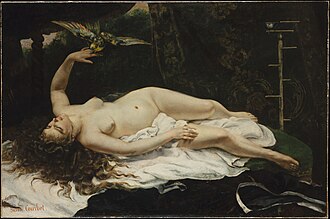 Frau mit Papagei - Gustave Courbet (1866)
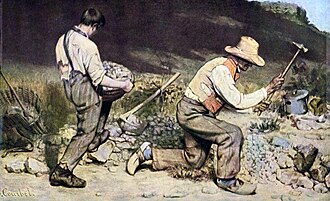 Die Steinklopfer - Gustave Courbet (1850)
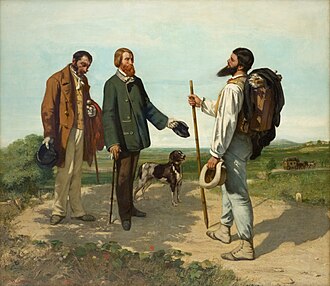 Die Begegnung, oder Bonjour, Monsieur Courbet! - Gustave Courbet (1854)
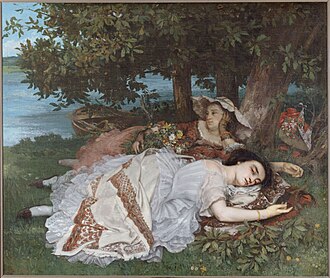 Mädchen an der Seine - Gustave Courbet (1857)
Werke verwandter Künstler
 Impression, Sonnenaufgang - Claude Monet (1872)
 Seerosen - Claude Monet (1906)
 Das Frühstück im Grünen - Édouard Manet (1863)
 Olympia - Édouard Manet (1863)
 Es frischt auf - Winslow Homer (1873)
 Nebelwarnung - Winslow Homer (1885)
 Die Sternennacht - Vincent van Gogh (1889)
 Caféterrasse am Abend - Vincent van Gogh (1888)