Diptychon des Maarten Nieuwenhove
Hans Memling · 1487
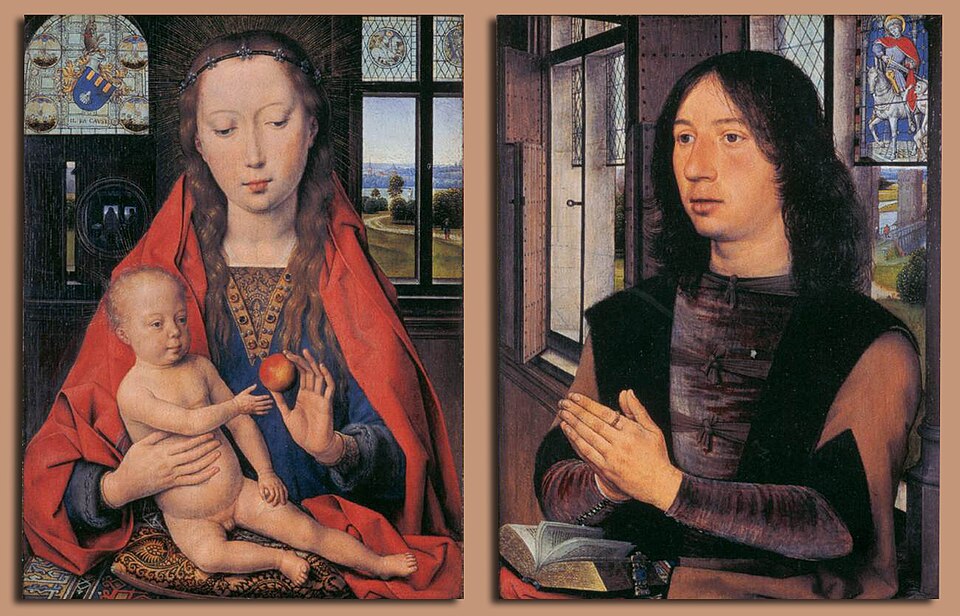
A young man of 23 kneels in prayer, and across the hinge the Virgin sits in the very same room. Memling joined the two panels with a tiny convex mirror that reflects them both.
The story behind the painting
The Diptych of Maarten van Nieuwenhove was painted in 1487 by Hans Memling. It is unsigned, but has always been attributed to Memling since the middle of the 19th century. An inscription along the bottom of the two panels tells us who ordered it and when: Maarten van Nieuwenhove had this work made in the year 1487, at the age of 23. He came from a noble Bruges family with links to the court of Burgundy, and in the 1490s he became city councillor, captain of the civic guard and, in 1498, mayor of Bruges. He died in 1500.
What to look for
On the left panel are the Virgin and Child, on the right the young donor at prayer. Unusually, both sit in one continuous room instead of against a plain background. A round mirror behind Mary shows the scene in reverse, though what it shows does not exactly match the painting; Memling added it late. The carpet beside Mary reappears under Maarten's hands. In the upper left window his coat of arms, surrounded by a hand sowing seeds, puns on his name, from the new garden. Through the open window you can see the Minnewater in Bruges.
Meaning and intent
The diptych is an early example of the Early Netherlandish devotional diptych, made for private prayer. Its new idea is to place the holy figures and the believer in the same space and time, so that devotion feels like a real visit. The stained glass reinforces this link: Saint Christopher and Saint George above the Virgin, and Saint Martin of Tours, Maarten's namesake, above him. The window with the coat of arms was first clear glass with a landscape; moving the arms there, rather than to the outer panels, makes the donor's identity unusually prominent.
Legacy
The work still keeps its original frame and hinges. It was probably meant to stand with the two panels at an angle, though how exactly is uncertain; one idea is that it hung on a wall or column with the Virgin panel fixed and the donor panel loose. Ordered in 1487, it was later kept at the Saint Julian Hospital in Bruges, and it has belonged to the Old St. John's Hospital since 1815. The hospital became a museum in 1839, and the diptych is still on view there today.
Schon gewusst?
- Painted by Hans Memling in 1487 for a 23-year-old donor.
- Both panels share one room, linked by a convex mirror.
- Keeps its original frame and hinges.
- At the Old St. John's Hospital in Bruges since 1815.
Über den Künstler
Hans Memling (1435-1494)
religiöse Kunst · Flämische Primitive · Sint-Janshospitaal
Mehr von Hans Memling
 Die Verkündigung - Hans Memling (1480s)
 Szenen der Passion Christi - Hans Memling (1470)
 Maria und Johannesaltar - Hans Memling (1479)
 Porträt der Maria Maddalena Portinari - Hans Memling (1470)
 Christus umgeben von musizierenden Engeln - Hans Memling (1480s)
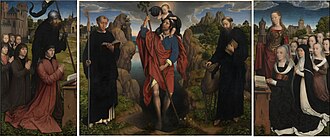 Moreel Triptychon - Hans Memling (1484)
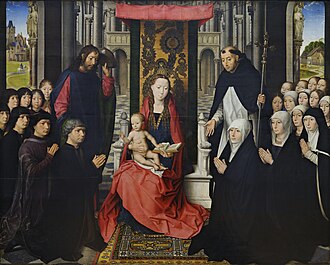 Madonna of Jacob Floreins - Hans Memling (1485)
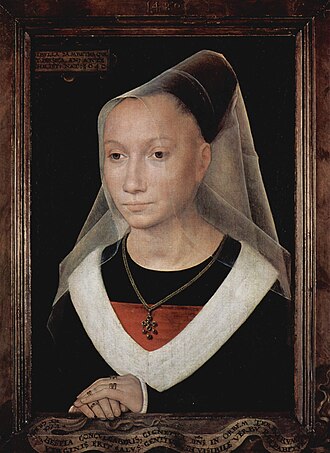 Die Sibylle Sambetha - Hans Memling (1480)
Werke verwandter Künstler
 Kreuzabnahme - Rogier van der Weyden (1440s)
 Porträt einer Dame - Rogier van der Weyden (1460)
 Arnolfini-Porträt - Jan van Eyck (1434)
 Genter Altar - Jan van Eyck (1432)
 Der Garten der Lüste - Hieronymus Bosch
 Das Narrenschiff - Hieronymus Bosch (1500s)
 Die Jäger im Schnee - Pieter Bruegel the Elder (1565)
 Die niederländischen Sprichwörter - Pieter Bruegel the Elder (1551)