Century of Augustus: Birth of Jesus Christ
Jean-Léon Gérôme · 1855
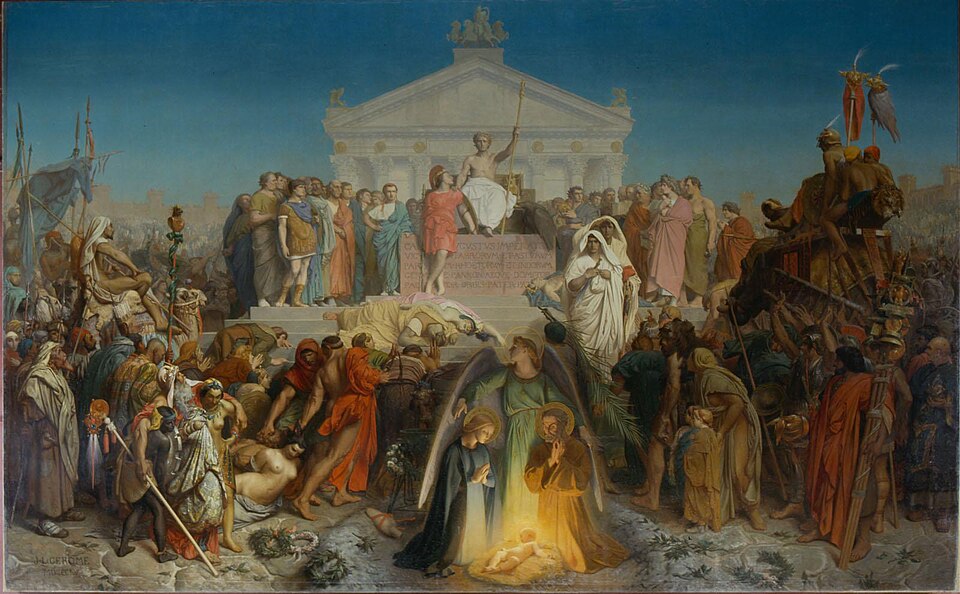
More than six metres high and ten wide, this canvas crowds a whole reign into one picture: Augustus enthroned, his enemies dead on the steps, the world bringing tribute. And at the bottom, almost hidden, a newborn child glows on straw.
The story behind the painting
Gérôme came to Paris in 1841 and studied with Paul Delaroche. After a medal at the Salon of 1847 and a work bought by Napoleon III in 1850, the State commissioned a great canvas from him in 1852 for the Exposition Universelle of 1855. He spent three years on it, and asked for an advance to fund a journey to Eastern Europe for ethnographic research. An inspection report of 8 May 1854 noted that the cartoon was finished and the final study under way. Many preparatory drawings survive, in Autun, Cambridge and the Musée Jean-Léon Gérôme in Vesoul.
What to look for
The composition is a pyramid built around Augustus on a vertical axis. At the top stands the temple of Janus under a cloudless sky, with Roman crowds beyond. Augustus, shown as Capitoline Jupiter, sits enthroned with the sceptre of the world, his hand on a standing figure of Rome. Poets and artists gather at his right, Virgil with the Aeneid, Horace, Ovid, Vitruvius with a model, and statesmen such as Agrippa and Maecenas at his left. On the steps lie the dead Caesar, Cleopatra and Mark Antony, while Brutus and Cassius walk away. Below, peoples from India, Parthia, Germania and Egypt bring tribute, and at the bottom the newborn Jesus shines orange on straw, sheltered by an angel's wings.
Meaning and intent
The picture is an allegorical summary of the reign of Augustus, from 27 BC to AD 14, and it is strongly inspired by Ingres's Apotheosis of Homer. Gérôme took his programme from Bossuet's Discourse on Universal History of 1681, which tells how the republic perished, how Augustus won at Actium and pacified the world, closed the temple of Janus, and how, with the whole universe at peace under his power, Jesus Christ came into the world. The inscription on the base lists his victories and calls him pacifier of the world and father of the country. The quiet birth set apart at the edge turns the imperial triumph into a prelude.
Legacy
The canvas was painted for the Exposition Universelle of 1855 and is signed and dated lower left, J.L. GEROME MDCCCLV. It belongs to the State and is on deposit at the Musée de Picardie in Amiens; Wikidata also lists the Musée d'Orsay, which reflects the State ownership and the deposit. The sources differ slightly on the size: Wikipedia gives 6.20 by 10.14 metres, Wikidata 620 by 1015 cm. Either way, it is one of the largest works of Gérôme's career, an early ambitious attempt by a young painter to tell history on the grandest scale.
Schon gewusst?
- Commissioned by the French State in 1852 for the Exposition Universelle of 1855.
- About 6.20 by 10.14 metres.
- Its programme follows a passage of Bossuet's Discourse on Universal History.
- On deposit at the Musée de Picardie in Amiens.
Über den Künstler
Jean-Léon Gérôme (1824-1904)
religiöse Kunst · Musée d’Orsay · Allegorie · Akademische Kunst · Menschenmenge · Weihnachtsgeschichte · Tempel
Mehr von Jean-Léon Gérôme
 Pollice verso - Jean-Léon Gérôme (1872)
 Der Sklavenmarkt - Jean-Léon Gérôme (1866)
 Phryne vor dem Areopag - Jean-Léon Gérôme (1861)
 Die Wahrheit steigt aus dem Brunnen - Jean-Léon Gérôme (1896)
 Bonaparte Before the Sphinx - Jean-Léon Gérôme (1867)
 Cleopatra and Caesar - Jean-Léon Gérôme (1866)
 The Duel After the Masquerade - Jean-Léon Gérôme (1857)
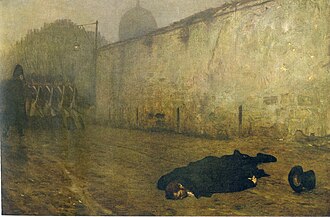 The Execution of Marshal Ney - Jean-Léon Gérôme (1868)
Werke verwandter Künstler
 Das Frühstück im Grünen - Édouard Manet (1863)
 Olympia - Édouard Manet (1863)
 Der Ursprung der Welt - Gustave Courbet (1866)
 Ein Begräbnis in Ornans - Gustave Courbet (2020)
 Nelke, Lilie, Lilie, Rose - John Singer Sargent (1885-1886)
 Madame X - John Singer Sargent (1884)
 Die Freiheit führt das Volk - Eugène Delacroix (1830)
 Der Tod des Sardanapal - Eugène Delacroix (1827)
 Der Tod des Sokrates - Jacques-Louis David (1787)
 Der Schwur der Horatier - Jacques-Louis David (1784)
 Die Schwestern Waldegrave - Joshua Reynolds (1780)
 Porträt des Colonel George K. H. Coussmaker vom Regiment der Garde-Grenadiere - Joshua Reynolds (1782)