Berthe Morisot mit Veilchenstrauß
Édouard Manet · 1872
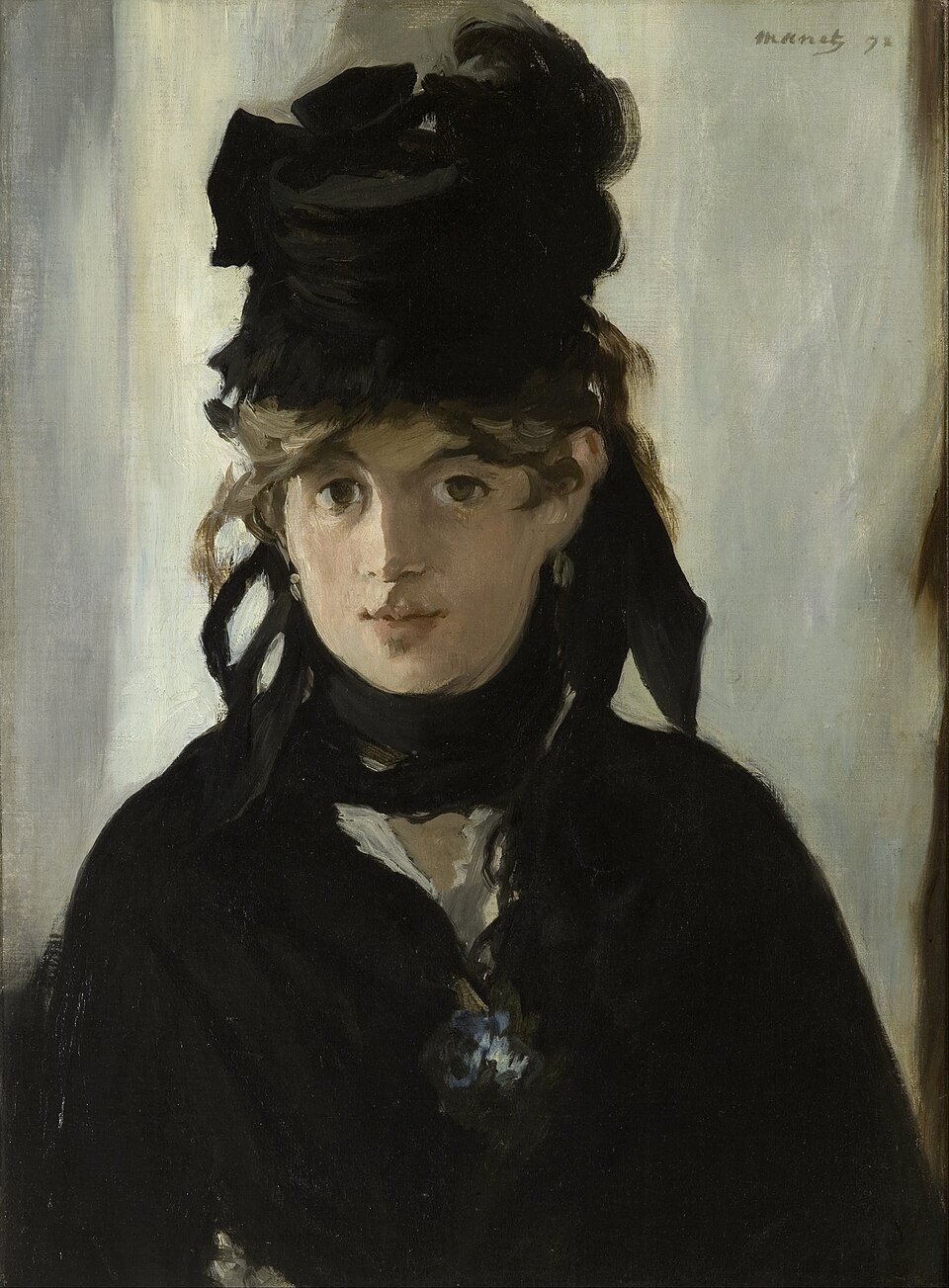
A young woman in black looks straight at us, half in light and half in shadow, a few violets almost hidden at her neckline. Manet painted his fellow artist Berthe Morisot, and made black itself sing.
The story behind the painting
Manet met Berthe Morisot in 1868. She was a painter too, a grand-niece of Fragonard, and the two influenced each other's work; he painted her many times, including in The Balcony. This portrait came in 1872, after a hard period for Manet. He had stayed in Paris during the Franco-Prussian War, serving in the Garde Nationale during the Siege of Paris, and could not paint while he served. He returned to his easel later in 1871. The painting is one of several portraits of a black-clad Morisot that he made between 1872 and 1874, showing her with a pink shoe, with a fan, or veiled. It is signed Manet 72 in the upper right corner. In 1874 Morisot married Manet's brother Eugène.
What to look for
This half-length portrait is a study in shades of black. Morisot wears a black mourning dress and hat, her face framed by black ribbons and scarves, set against a lighter background. Notice the light: unusually for Manet, who usually used an even light, she is lit from one side, so her right side is bright and her left falls into deep shadow. Look for the earring in each ear. Then search for the title's violets. They are barely perceptible, tucked where the neckline of her dress dips toward her chest. Finally, meet her eyes. Manet painted them black, although Morisot's eyes were actually green, perhaps reflecting his impression that she looked Spanish.
Meaning and intent
The painting is both a portrait of a person and a portrait of a gaze. The poet Paul Valéry, who knew the work well, wrote that he ranked nothing in Manet's work higher than this portrait, and compared it to Vermeer's Girl with a Pearl Earring. He described her look as offering a presence of absence, as if the gaze, even while giving itself, were withdrawing at the same time. The mourning dress and the hidden violets add to this sense of something held back. Manet had earlier painted his own mother in mourning, in 1863, clad in black on a dark background, and here he returns to black as a colour full of nuance rather than emptiness.
Legacy
The work was quickly considered one of Manet's masterpieces, and Valéry praised it in the catalogue for Manet's centenary retrospective at the Orangerie in 1932. Manet also made an etching and two lithographs of the same composition between 1872 and 1874. Its later life is a family story. Manet sold or gave the painting to the critic Théodore Duret, and in 1894 Morisot herself acquired it at the sale of Duret's collection. After her death in 1895 it stayed with her daughter Julie until 1966, then with her grandson Clément Rouart. In 1998 it entered the Musée d'Orsay in Paris, with support from several sponsors, where visitors can still meet that dark, unforgettable gaze.
Schon gewusst?
- Manet signed the canvas Manet 72 in the upper right corner.
- He painted Morisot's eyes black, though they were actually green.
- Morisot herself acquired the painting in 1894 at the sale of Théodore Duret's collection.
- It entered the Musée d'Orsay in 1998.
Über den Künstler
Édouard Manet (1832-1883)
Frau · Porträt · Impressionismus · Musée d’Orsay · Blick auf den Betrachter
Mehr von Édouard Manet
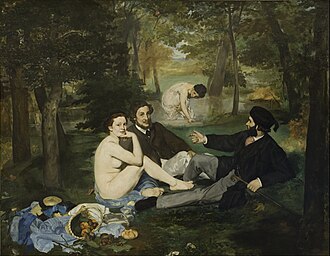 Das Frühstück im Grünen - Édouard Manet (1863)
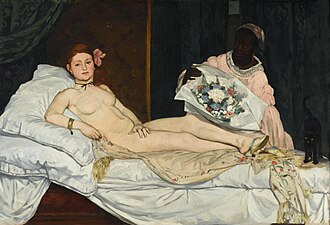 Olympia - Édouard Manet (1863)
%20(33539037428).jpg) Bar in den Folies-Bergère - Édouard Manet (1882)
Bar in den Folies-Bergère - Édouard Manet (1882)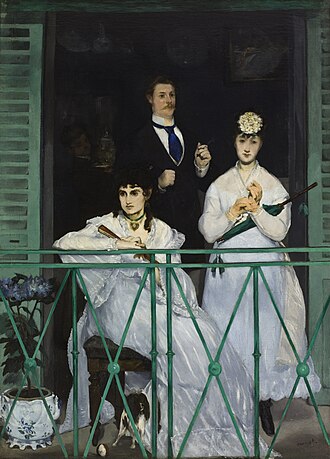 Der Balkon - Édouard Manet (1868)
.jpg) Musik im Tuileriengarten - Édouard Manet (1862)
Musik im Tuileriengarten - Édouard Manet (1862).jpg) Der Pfeifer - Édouard Manet (1866)
Der Pfeifer - Édouard Manet (1866)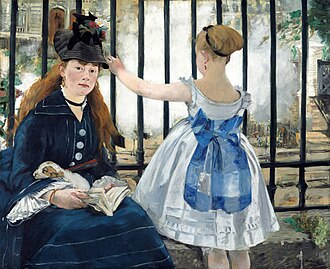 Die Eisenbahn - Édouard Manet (1873)
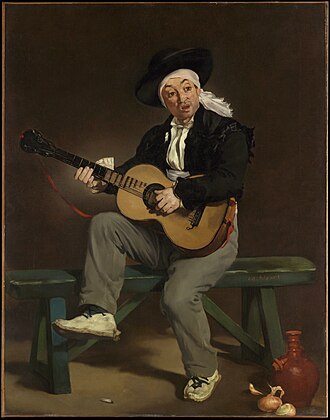 Spanischer Sänger - Édouard Manet (1860)
Werke verwandter Künstler
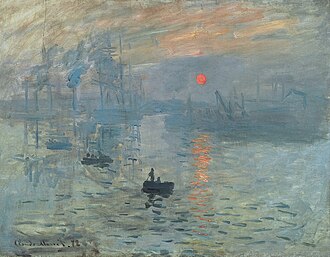 Impression, Sonnenaufgang - Claude Monet (1872)
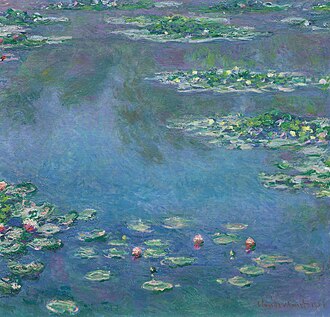 Seerosen - Claude Monet (1906)
 Tanz im Moulin de la Galette - Pierre-Auguste Renoir (1876)
 Das Frühstück der Ruderer - Pierre-Auguste Renoir (1881)
 Die Sternennacht - Vincent van Gogh (1889)
.jpg) Caféterrasse am Abend - Vincent van Gogh (1888)
Caféterrasse am Abend - Vincent van Gogh (1888)