Nana
Édouard Manet · 1877
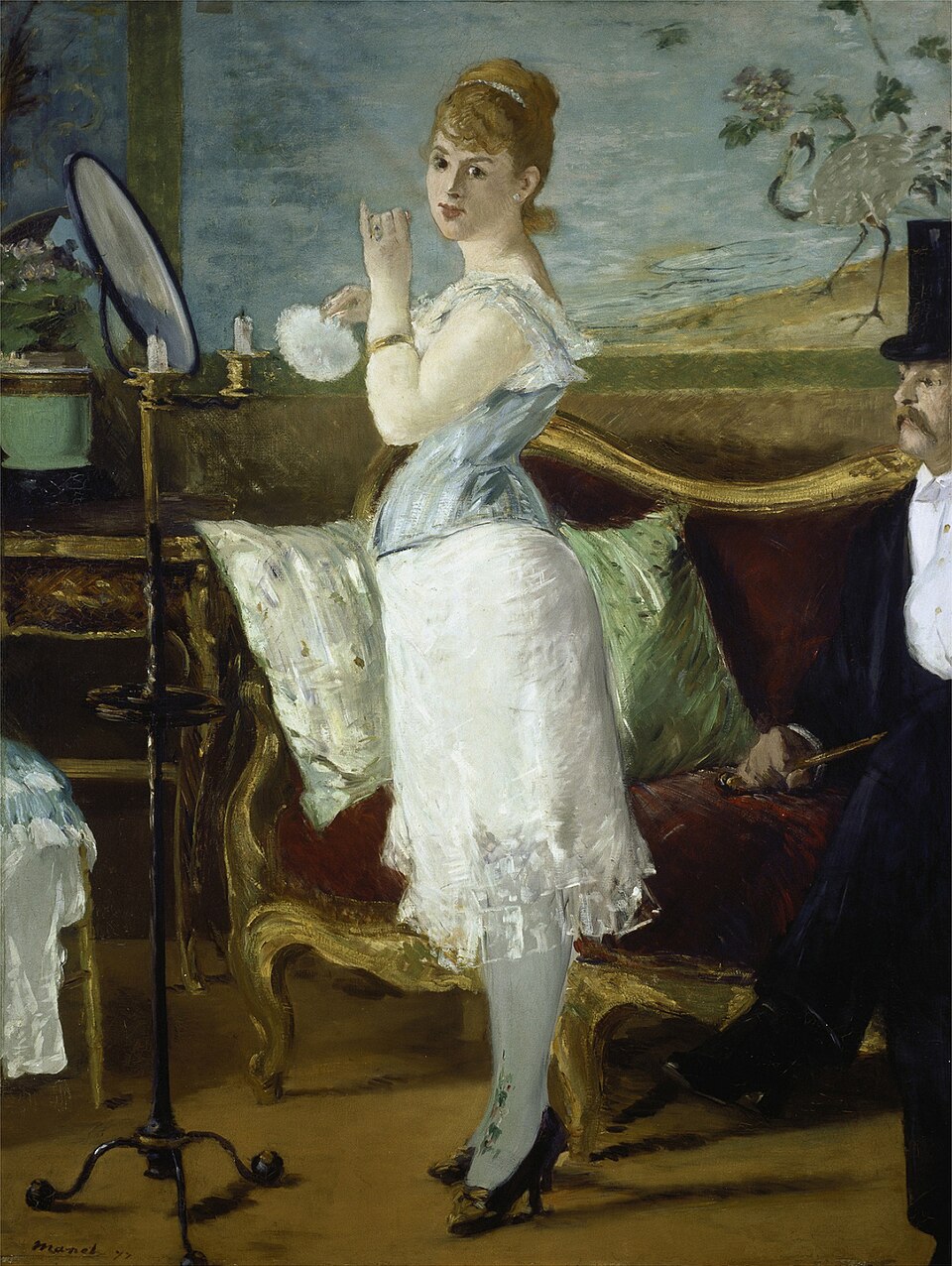
A young woman in a corset powders her face before a mirror and turns to look at us, while a man in evening dress waits on the sofa. The Salon refused Manet's Nana in 1877, so he put it in a shop window.
The story behind the painting
Manet completed Nana in 1877 and sent it to the Paris Salon that same year, but it was refused because it was judged contemptuous of the morality of the time. Manet did not hide it away. He showed the painting in the window of a shop on the Boulevard des Capucines, one of the main streets of Paris, and because of his fame it gathered attention and crowds. His model was Henriette Hauser, a well-known courtesan of the era, and the name Nana probably came from Zola's novel L'Assommoir, where a character of that name first appears.
What to look for
A young, beautiful woman stands before a mirror with two extinguished candles, her face turned to the viewer. She is only half dressed, in a white chemise, a blue corset, silk stockings and high-heeled shoes. The room suggests a boudoir. Behind her is a sofa with two pillows, and on the right, cut off by the edge of the canvas, sits an elegantly dressed man, only partly visible. On the left are a chair, a table and a flowerpot. Notice how calmly she meets our eyes while the man waits at the margin.
Meaning and intent
Both the title and the many details suggest a high-class prostitute and her client. In the second half of the nineteenth century Nana was a popular assumed name for prostitutes, and even today the French word nana can describe a frivolous woman, or simply a woman in slang. French society was not ready for such a frank image of prostitution. According to the source, critics did not see the artistic qualities of the work and focused only on the scene it showed, which is why the Salon turned it away.
Legacy
Among Manet's defenders was Emile Zola, who in 1880 published a novel called Nana, the ninth volume of his Rougon-Macquart series. The shared title is striking, but there is no clear evidence that painter and writer inspired each other, since the book appeared three years after the picture; Manet more likely took the name from L'Assommoir. The painting, about 154 by 115 cm, is now in the Hamburger Kunsthalle in Germany, where the woman at her mirror still turns to face whoever comes to look.
Schon gewusst?
- Refused by the Paris Salon in 1877.
- Shown instead in a shop window on the Boulevard des Capucines.
- The model was the courtesan Henriette Hauser.
- Now in the Hamburger Kunsthalle.
Über den Künstler
Édouard Manet (1832-1883)
Frau · Porträt · Mann · Spiegel · Kissen · Sofa · Hamburger Kunsthalle
Mehr von Édouard Manet
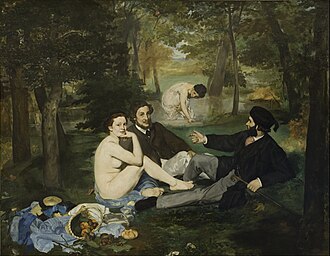 Das Frühstück im Grünen - Édouard Manet (1863)
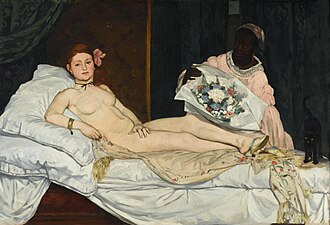 Olympia - Édouard Manet (1863)
%20(33539037428).jpg) Bar in den Folies-Bergère - Édouard Manet (1882)
Bar in den Folies-Bergère - Édouard Manet (1882)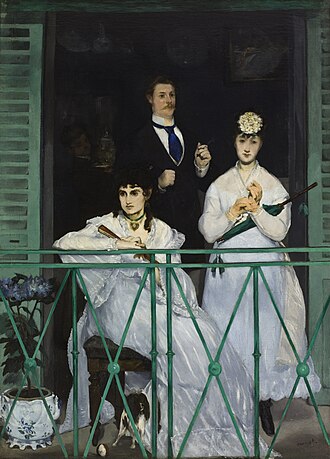 Der Balkon - Édouard Manet (1868)
.jpg) Musik im Tuileriengarten - Édouard Manet (1862)
Musik im Tuileriengarten - Édouard Manet (1862).jpg) Der Pfeifer - Édouard Manet (1866)
Der Pfeifer - Édouard Manet (1866) Die Eisenbahn - Édouard Manet (1873)
 Berthe Morisot mit Veilchenstrauß - Édouard Manet (1872)
Werke verwandter Künstler
 Impression, Sonnenaufgang - Claude Monet (1872)
 Seerosen - Claude Monet (1906)
 Tanz im Moulin de la Galette - Pierre-Auguste Renoir (1876)
 Das Frühstück der Ruderer - Pierre-Auguste Renoir (1881)
 Der Absinth - Edgar Degas (1875)
 Die Bellelli Familie - Edgar Degas (1858)
 Die Sternennacht - Vincent van Gogh (1889)
.jpg) Caféterrasse am Abend - Vincent van Gogh (1888)
Caféterrasse am Abend - Vincent van Gogh (1888) Die letzte Fahrt der Temeraire - J. M. W. Turner (1839)
 Rain, Steam and Speed - The Great Western Railway - J. M. W. Turner (1844)
 Woher kommen wir? Wer sind wir? Wohin gehen wir? - Paul Gauguin (1897-1898)
%201889.jpg) Der gelbe Christus - Paul Gauguin (1889)
Der gelbe Christus - Paul Gauguin (1889)