Frau mit zwei Männern beim Trinken und Magd
Pieter de Hooch · 1658
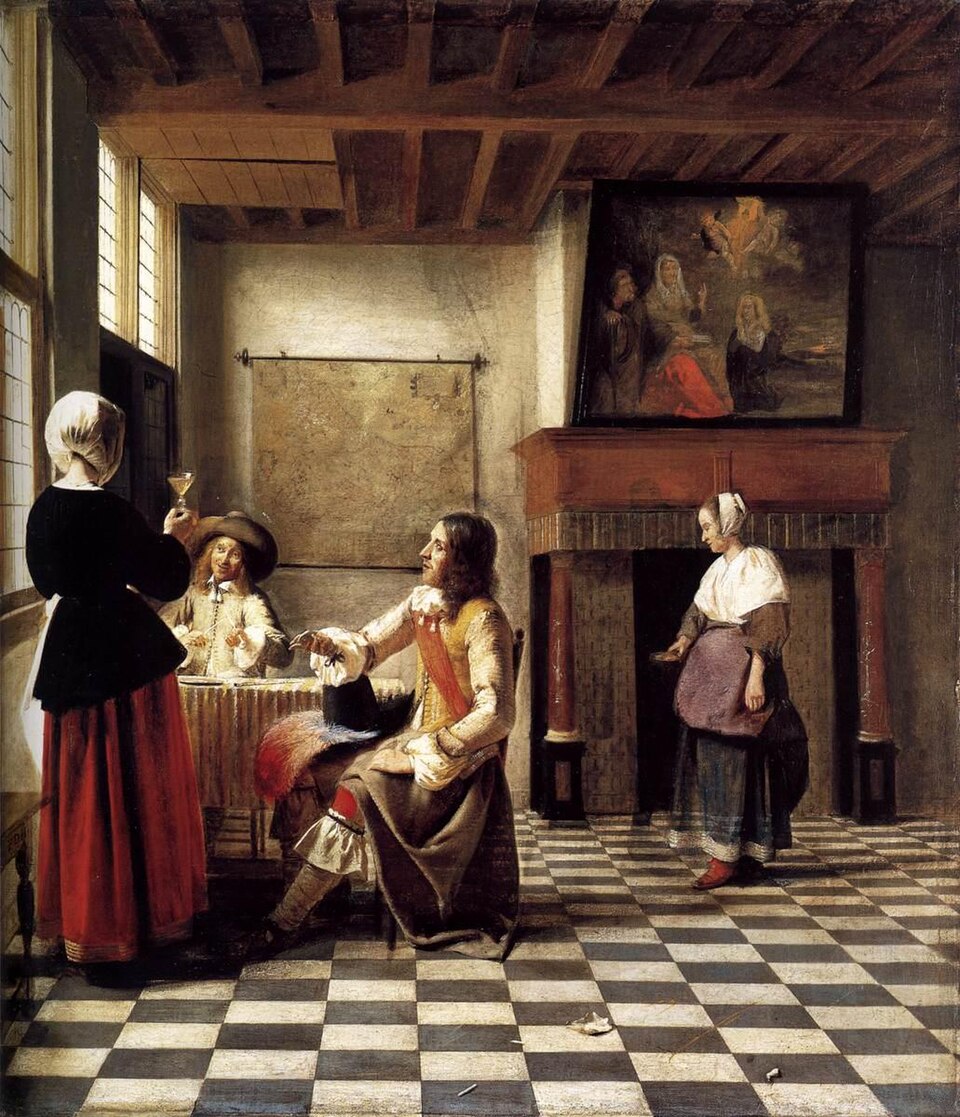
A girl lifts a glass of wine by a tall window, two gentlemen watch her, and a maid hurries in with burning peat. Pieter de Hooch turned a quiet Dutch room of 1658 into a small theatre of glances and smoke.
The story behind the painting
A Woman Drinking with Two Men is dated 1658 and is an example of Dutch Golden Age painting. The art historian Hofstede de Groot, who catalogued it in 1908 under the title Girl with Two Cavaliers, or Interior of a Dutch House, saw it as de Hooch's transformation of a painting by Ter Borch known as Gallant Conversation. In other words, de Hooch took an idea already in the air among Dutch painters of his day and rebuilt it inside one of his own carefully measured rooms, signing it with his initials P. D. H.
What to look for
Start at the broad double window on the left, where the light falls across a floor of black and white tiles under wooden rafters. At the table, one gentleman faces us, smiling, holding a pipe in each hand as if he were a fiddler. The other sits in profile, his plumed hat resting on his knee. The girl stands near the window with her back to us, raising her glass as if about to hand it to the man with the pipes. From the right a servant arrives with a pan of burning peat. Behind her stands a chimney piece with two pilasters and a large figure painting, and a map hangs on the wall.
Meaning and intent
The sources do not spell out a hidden message, so the scene is best read as what Hofstede de Groot describes: a moment of company and play. The man pretending to fiddle with two pipes, the raised glass and the girl whose face we never see all make the painting feel like a pause in a lively evening. Because the woman turns away from us, our attention moves between the faces of the men, and the room itself, with its window, map and fireplace, becomes as much the subject as the people inside it.
Legacy
The painting travelled through many collections. It was sold in Amsterdam in 1749, passed through a Paris sale in 1804, entered the Pourtales collection in Paris, and was bought in 1826 by the dealers Smith and Emmerson, who sold it to Sir Robert Peel. The writers Waagen and Charles Blanc both mentioned it. In 1871 it was purchased for the nation with the rest of the Peel collection and is now in the National Gallery in London. Much later, Hercules Brabazon Brabazon made a watercolour and gouache pastiche called Souvenir of de Hoogh, now in the Tate.
Schon gewusst?
- Painted in 1658 by Pieter de Hooch.
- Seen by Hofstede de Groot as a reworking of Ter Borch's Gallant Conversation.
- Bought for the nation with the Peel collection in 1871.
- Now in the National Gallery, London.
Über den Künstler
Pieter de Hooch (1629-1684)
Mehr von Pieter de Hooch
 Hof eines Hauses in Delft - Pieter de Hooch (1658)
 A Woman Peeling Apples - Pieter de Hooch (1663)
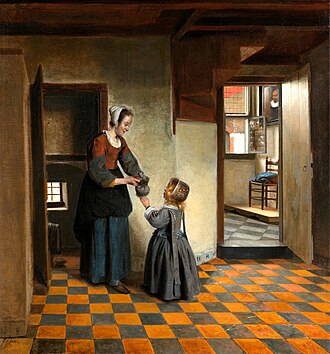 Frau mit Kind in einer Vorratskammer - Pieter de Hooch
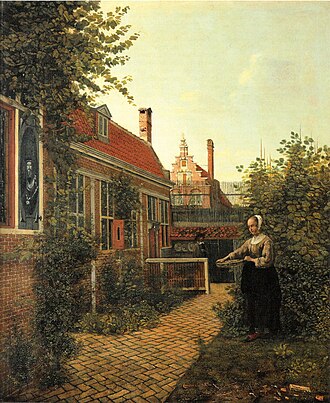 Frau mit Bohnenkorb im Gemüsegärtchen - Pieter de Hooch (1651)
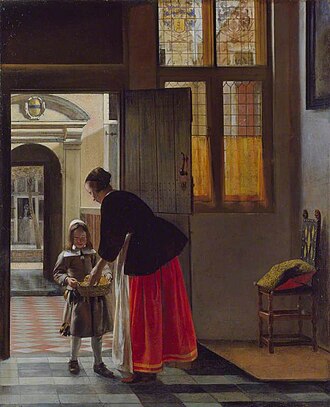 Een jonge die brood bezorgt - Pieter de Hooch (1663)
 Hof mit zwei Offizieren und trinkender Frau - Pieter de Hooch (1658)
 Kartenspieler in einem sonnendurchfluteten Raum - Pieter de Hooch (1658)
 A Woman Preparing Bread and Butter for a Boy - Pieter de Hooch (1661)