Kartenspieler in einem sonnendurchfluteten Raum
Pieter de Hooch · 1658
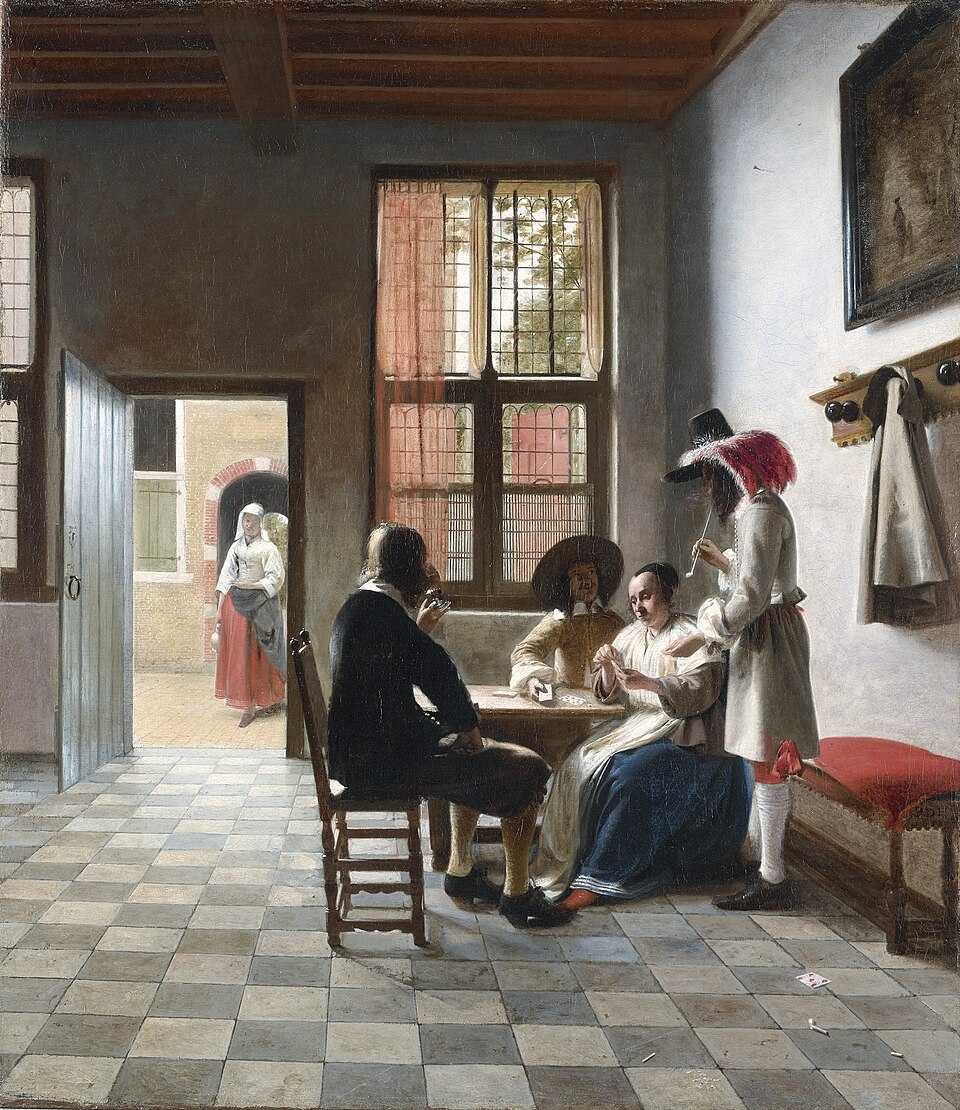
Sunlight pours across a tiled floor while men smoke, drink and play cards, and a maid crosses the courtyard with a jug of wine. In 2019 conservators found a thumbprint in the wet paint, almost certainly Pieter de Hooch's own.
The story behind the painting
De Hooch painted this canvas in 1658, in the middle of his career, while he lived and worked in Delft. His domestic scenes of everyday life share much with those of his contemporary Johannes Vermeer, and the source says de Hooch is believed to have influenced him. His development likely drew on fellow Delft painters such as Carel Fabritius, Gerard Houckgeest and Emanuel de Witte, architectural painters who explored illusion through careful perspective. Around the same time he painted A Girl Drinking with Two Soldiers, A Soldier Paying a Hostess and The Courtyard of a House in Delft, works with the same calm atmosphere.
What to look for
The room is believed to be an inn. Figures smoke, play cards and drink, calm and reflective, as if we had just interrupted their game, and the two men on the right may be partners in cheating. Through the open space behind, a maid with a jug crosses a courtyard, so the players may be waiting for a refill. Watch the sunlight on translucent curtains and glass panes, and the subdued greys mixed with white that give the picture a mother-of-pearl tone. The tiles are laid in almost casually, and under-drawing shows changes, such as a hat missing from the drinking man on the left.
Meaning and intent
De Hooch lets the people take a secondary role. The composition gently leads the eye away from them toward light and space, so the real subject is the quiet interplay of sun and interior. Unlike many Dutch paintings of the time, the work seems to carry little hidden symbolism; even the prominent picture on the wall appears to have no secret meaning. Still, the playing cards, a raised glass and a broken pipe are placed to catch our attention, and they leave room for interpretation. The archway in the background reappears as the main subject in his Courtyard of a House in Delft and Courtyard with an Arbour.
Legacy
In 2019 conservators discovered a fingerprint, probably a thumb, in the lower right corner, pressed into the wet paint before varnishing. The art historian Anita Jansen says it is almost certainly the artist's own, perhaps left as he handled the canvas. The painting passed through several Amsterdam collections in the eighteenth century, then through dealers in the early nineteenth, until Lord Farnborough bought it for King George IV in 1825. It has been in the Royal Collection at Buckingham Palace since 1841 and is shown at the King's Gallery in London. It measures about 77.3 by 67.3 cm.
Schon gewusst?
- Painted by Pieter de Hooch in 1658.
- Set in what is believed to be an inn, with light as the true subject.
- A thumbprint, likely the artist's, was found in the paint in 2019.
- Bought for George IV in 1825; in the Royal Collection.
Über den Künstler
Pieter de Hooch (1629-1684)
Mehr von Pieter de Hooch
 Hof eines Hauses in Delft - Pieter de Hooch (1658)
 A Woman Peeling Apples - Pieter de Hooch (1663)
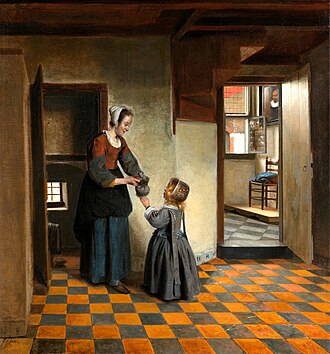 Frau mit Kind in einer Vorratskammer - Pieter de Hooch
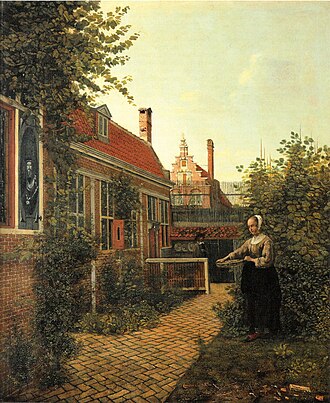 Frau mit Bohnenkorb im Gemüsegärtchen - Pieter de Hooch (1651)
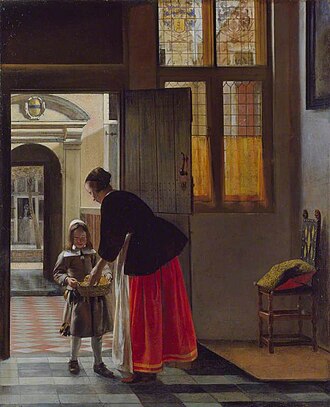 Een jonge die brood bezorgt - Pieter de Hooch (1663)
 Hof mit zwei Offizieren und trinkender Frau - Pieter de Hooch (1658)
 A Woman Preparing Bread and Butter for a Boy - Pieter de Hooch (1661)
 A Couple Walking in the Amsterdam Town Hall - Pieter de Hooch (1660s)