Pieter de Hooch
1629-1684
Pieter de Hooch, a bricklayer's son from Rotterdam, painted the quiet Dutch home as no one had before: sunlit courtyards, tidy rooms and open doorways that let the eye wander from one bright space into the next.
Origins
Pieter Hendricksz. de Hooch was baptised in Rotterdam on 20 December 1629. His father, Hendrick, was described as a master bricklayer, a skilled artisan who belonged to a guild, and his mother, Annetge Pieters, was a midwife. He was the eldest of five children and outlived all of his siblings. Little is known of his early life. His first biographer, Arnold Houbraken, says he studied in Haarlem under the landscape painter Nicolaes Berchem, at the same time as Jacob Ochtervelt, yet his work seems closer in spirit to Hendrik Sorgh, an older Rotterdam painter who loved arranging figures in interiors.
Life and turning points
From 1650 he worked as a painter and servant for Justus de la Grange, a linen merchant and collector, travelling with him and moving to Delft in 1652. He probably handed over many works in exchange for board; a later inventory listed eleven of his paintings in la Grange's hands. In 1654 he married Jannetje van der Burch, and they had seven children. He joined the Delft painters' guild in 1655, though he struggled to pay the entry fee. By 1660 the family was in Amsterdam, living at times in poor districts outside the old walls. By 1674 he earned too little to appear in the tax registers. He was last documented in 1679, and his date of death is unknown.
Style and technique
His early pictures show soldiers and peasants in stables and taverns, but his real interest was light, colour and perspective. A main group, lit directly by the sun, stands out against a dark background, often in vivid vermilion and lemon yellow with warm greens or blues in the shadows. A favourite device was the doorkijkje, a view through a doorway into another bright room, a reliable sign of his hand. In the late 1650s in Delft he turned to sunlit interiors, gardens and courtyards of the middle class, carefully composed with a sophisticated grasp of perspective. In Amsterdam his colours grew cooler, his figures more substantial and his settings more opulent.
Stories and anecdotes
For a long time it was believed that De Hooch died in 1684 in the Amsterdam dolhuis, an asylum. The records show that the man who died there was his son, also named Pieter, and that date is still often wrongly given for the father. His work is close to that of Vermeer, who lived in Delft at the same time. An x-ray of Woman Weighing Gold and Silver Coins revealed a seated man that De Hooch later painted out, which suggests his canvas may have been the model Vermeer quoted. Lacking access to aristocratic homes in Amsterdam, he used the marble halls of the new City Hall as backdrops for his elegant scenes.
Legacy
De Hooch is remembered as a master of quiet domestic scenes, and his courtyards, bleaching grounds and street views are among the first Dutch pictures to focus on the city itself, sometimes bringing the Oude Kerk or Nieuwe Kerk into a single invented view. In his lifetime his paintings sold for less than Vermeer's. Interest grew in the early nineteenth century, when English collectors such as George IV, Sir Robert Peel and the Duke of Wellington acquired his work. In 2019 and 2020 the Delft museum Het Prinsenhof and the Rijksmuseum presented an exhibition built from new research into his paintings. His open doors still invite us in.
Schon gewusst?
- His name is also spelled Hoogh or Hooghe.
- He was first recorded in Delft on 5 August 1652, as a witness to a will.
- In his later years he painted more, and often larger, canvases over 100 centimetres.
- His daughter Anna was born in Delft on 14 November 1656.
Niederländisches Goldenes Zeitalter der Malerei · Delft school
Gemälde von Pieter de Hooch
 Hof eines Hauses in Delft - Pieter de Hooch (1658)
 A Woman Peeling Apples - Pieter de Hooch (1663)
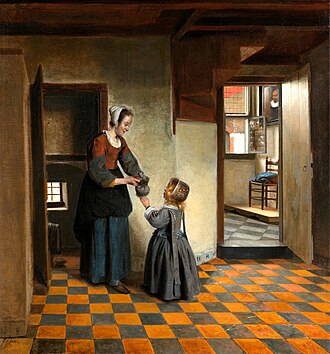 Frau mit Kind in einer Vorratskammer - Pieter de Hooch
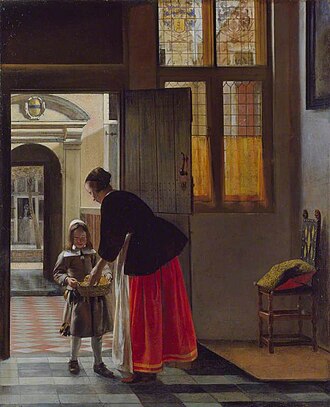 Een jonge die brood bezorgt - Pieter de Hooch (1663)
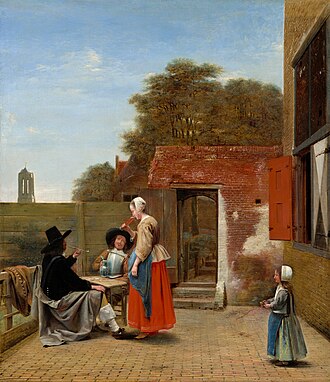 Hof mit zwei Offizieren und trinkender Frau - Pieter de Hooch (1658)
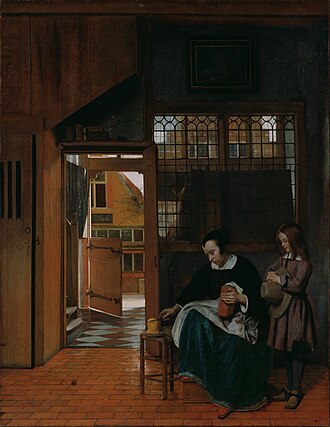 A Woman Preparing Bread and Butter for a Boy - Pieter de Hooch (1661)
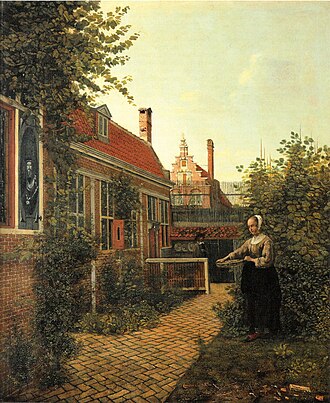 Frau mit Bohnenkorb im Gemüsegärtchen - Pieter de Hooch (1651)
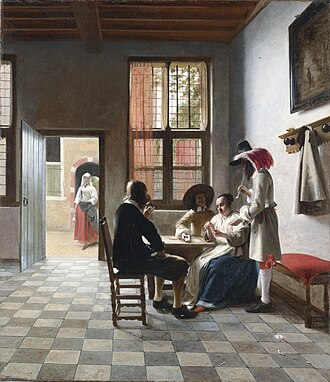 Kartenspieler in einem sonnendurchfluteten Raum - Pieter de Hooch (1658)
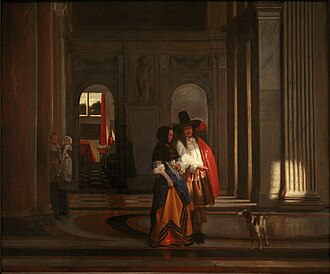 A Couple Walking in the Amsterdam Town Hall - Pieter de Hooch (1660s)
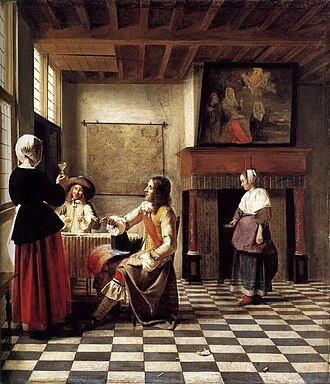 Frau mit zwei Männern beim Trinken und Magd - Pieter de Hooch (1658)
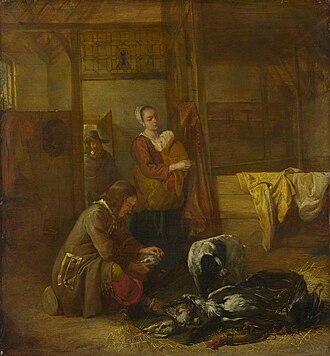 A Man with Dead Birds, and Other Figures, in a Stable - Pieter de Hooch (1655)
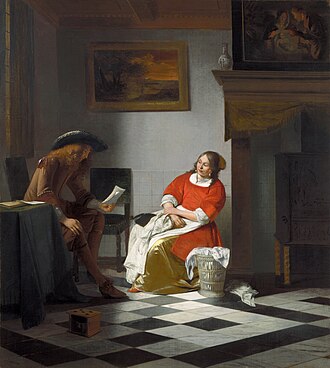 Man reading letter to a woman - Pieter de Hooch (1675)
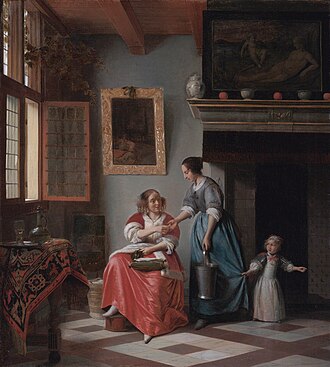 Junge Frau, die einem Dienstmädchen eine Münze gibt - Pieter de Hooch (1670)
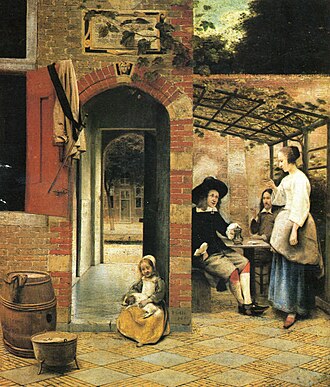 Zwei zechende Männer und eine Frau unter einer Gartenlaube im Hof - Pieter de Hooch (1658)
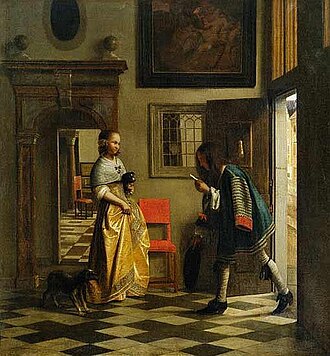 Der Liebesbote - Pieter de Hooch (1669)