Een jonge die brood bezorgt
Pieter de Hooch · 1663
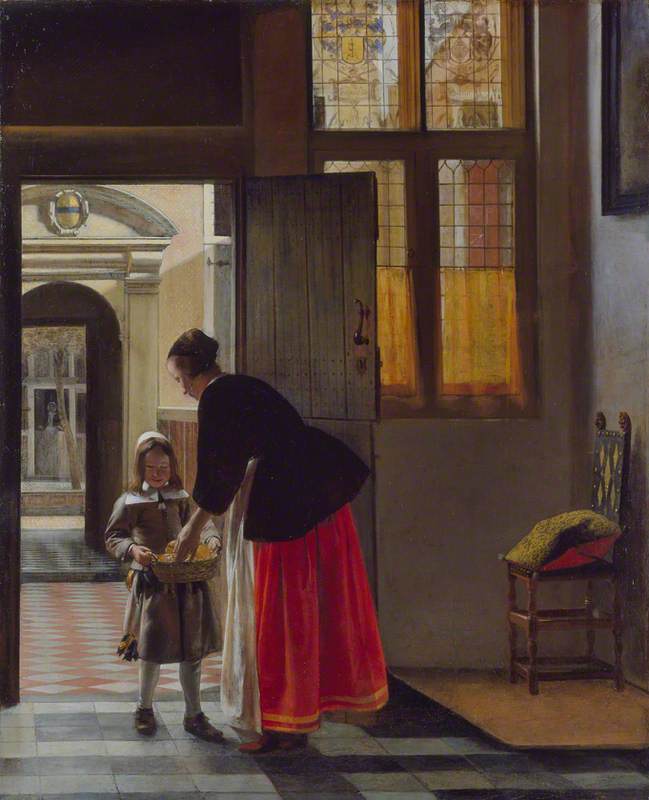
A boy in a white cap holds out a basket of bread at a doorway, and far behind him, across a canal, a woman watches. Pieter de Hooch turned an ordinary delivery into a quiet journey for the eye.
The story behind the painting
Pieter de Hooch painted A Boy Bringing Bread around 1663, probably soon after he moved from Delft to Amsterdam in the early 1660s. It is an oil on canvas of about 74.5 by 59 cm, an example of Dutch Golden Age painting. De Hooch specialised in views that pass through several spaces of a home, giving a window into the daily lives of Dutch families in the seventeenth century. Here the moment is simple: bread arriving at the door of a row house.
What to look for
The boy, in a white cap and grey jacket with coloured ribbons, offers his basket to a lady in the doorway of the street-facing room. Her black velvet jacket and red silk skirt dominate the colours of the scene. Behind them a tiled courtyard runs to a passage, and across a canal a second woman, perhaps the boy's mother, looks on. Look closely at the door jamb at the far left: a small hole is visible there, left by the pin De Hooch placed at the vanishing point to draw his perspective lines.
Meaning and intent
The main lines of the composition converge on that pinhole, pulling the eye deep into the picture. The painting first showed a girl reading in the doorway, but she was later painted out in favour of the woman and the boy. The boy becomes a narrative link: the viewer follows him from the basket to the distant woman across the water. Above the doorway is a coat of arms, and the window carries family monograms and inscriptions read as Cornelis Jansz or Jac. on one side and Marnie or Maerti on the other.
Legacy
Hofstede de Groot documented the painting in 1908, describing the coat of arms and the monograms. Its first recorded sale was in 1803 in Amsterdam, by Maria Theresa Andrioli. It later belonged to Baron van Brienen van Groote Lindt, and in 1865 passed to Richard Seymour-Conway, 4th Marquess of Hertford. His collection went to his son, whose widow bequeathed it to the British nation. Today it hangs in the Wallace Collection in London, in the East Galleries, where entry is free.
Schon gewusst?
- Painted around 1663, early in De Hooch's Amsterdam years.
- A pinhole at the vanishing point is visible on the left door jamb.
- A reading girl in the doorway was painted out.
- Now in the Wallace Collection, London.
Über den Künstler
Pieter de Hooch (1629-1684)
Genreszene · Wallace Collection
Mehr von Pieter de Hooch
 Hof eines Hauses in Delft - Pieter de Hooch (1658)
 A Woman Peeling Apples - Pieter de Hooch (1663)
 Frau mit Kind in einer Vorratskammer - Pieter de Hooch
 Frau mit Bohnenkorb im Gemüsegärtchen - Pieter de Hooch (1651)
 Hof mit zwei Offizieren und trinkender Frau - Pieter de Hooch (1658)
 Kartenspieler in einem sonnendurchfluteten Raum - Pieter de Hooch (1658)
 A Woman Preparing Bread and Butter for a Boy - Pieter de Hooch (1661)
 A Couple Walking in the Amsterdam Town Hall - Pieter de Hooch (1660s)