Anthonis van Dyck
1599-1641
Anthony van Dyck, the silk merchant's son whom Rubens called the best of his pupils, gave kings and nobles a relaxed elegance that looked like nature itself. His portraits of Charles I shaped English portrait painting for more than 150 years.
Origins
Van Dyck was born in Antwerp on 22 March 1599, the seventh of twelve children of Frans van Dyck, a well-to-do silk merchant, and Maria Cupers. He was baptised on 23 March in the church that is now Antwerp Cathedral. Painting ran in the family: his grandfather had been registered as a master painter in the Antwerp Guild of Saint Luke, and there were guild artists on his mother's side too. His mother died when he was eight. At ten he began formal training with Hendrick van Balen the Elder, though nobody knows whether he stayed two years or four. His self-portrait of 1613 to 1614 shows how accomplished he already was at about fifteen. Around 1615 or 1616, perhaps because his father was in financial difficulty, he set up his own workshop, and on 18 October 1617 he became a free master of the guild.
Life and turning points
Within a few years van Dyck was chief assistant to Peter Paul Rubens, the leading painter of Northern Europe. He first went to England to work for James I; the source dates this trip to 1620 in one passage and to 1621 in another. After about four months he returned to Flanders and in late 1621 left for Italy, where he stayed six years, mostly in Genoa, building a career as a portraitist. In 1624 he was quarantined in Palermo during one of the worst plagues in the island's history. From 1627 he spent five years in Antwerp, and by 1630 he was court painter to the Archduchess Isabella. In 1632 Charles I brought him to London as principal painter, knighting him that July. He married Mary Ruthven, a lady-in-waiting to the Queen, on 27 February 1640, and they had one daughter. He died on 9 December 1641.
Style and technique
Van Dyck learned composition from Rubens, but it was seeing Titian in the Earl of Arundel's London collection that transformed his sense of colour and the subtle modelling of form. In Genoa he created a full-length portrait style, drawing on Veronese, Titian and Rubens, in which very tall, graceful figures look down at the viewer with great hauteur. Back in Antwerp his portraits grew more affable while still making patrons look as stylish as possible. In England he combined relaxed elegance with understated authority, a manner that dominated English portraiture to the end of the eighteenth century. His portrait of Charles dismounted, now in the Louvre, shows the king strolling so casually in an informal setting that he seems at first glance a natural gentleman rather than a monarch. He also painted religious and mythological subjects, drew superbly, and was an innovator in watercolour and etching.
Stories and anecdotes
Rubens is said to have called the nineteen-year-old van Dyck the best of my pupils. In Rome, the writer Giovan Pietro Bellori recalled, the young Fleming annoyed the bohemian Northern artists by behaving like a nobleman, dressed in silks and a feathered hat with gold chains across his chest and servants at his side. Trapped in Palermo by plague, he painted the city's patron saint Rosalia as a young woman with flowing blonde hair reaching down toward the threatened city, and that image became the standard way to show her. In 2020 the New York Times wrote about his Saint Rosalia at the Metropolitan Museum in the light of COVID-19. In London the King and Queen visited his Blackfriars studio so often that a special causeway was later built for them, and they hardly sat for any other painter while he lived.
Legacy
Apart from Holbein, van Dyck and his contemporary Velázquez were the first painters of the very highest talent to work mainly as court portraitists, and they changed the genre. He is estimated to have painted about forty portraits of Charles I and some thirty of the Queen, many made in several versions as diplomatic gifts. His portraits created the classic image of the Cavalier, even though many of his most important noble patrons later sided with Parliament in the Civil War that broke out soon after his death. His Iconography, a series of etched portraits of artists and famous contemporaries, was greatly admired. His Saint Rosalia images influenced Italian Baroque painters from Luca Giordano to Pietro Novelli. The Van Dyke beard still carries his name, and his burial in St Paul's Cathedral shows how highly he was regarded when he died.
Schon gewusst?
- The Van Dyke beard is named after him.
- He was quarantined in Palermo during the plague of 1624.
- A causeway was built so the King and Queen could reach his Blackfriars studio more easily.
- He is buried in St Paul's Cathedral in London.
Barock · Flämische Barockmalerei
Verwandte Künstler
Caravaggio · Diego Velázquez · Peter Paul Rubens · Rembrandt van Rijn · Johannes Vermeer
Gemälde von Anthonis van Dyck
%20-%20Google%20Art%20Project.jpg) Dreifachporträt von Karl I. - Anthony van Dyck (1635)
Dreifachporträt von Karl I. - Anthony van Dyck (1635)%20with%20M.%20de%20St%20Antoine%20-%20Google%20Art%20Project.jpg) Karl I mit M. de St. Antoine - Anthony van Dyck (1636)
Karl I mit M. de St. Antoine - Anthony van Dyck (1636)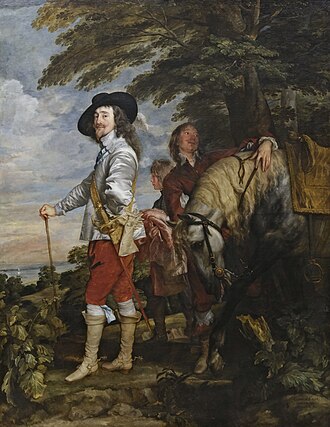 Karl I. auf der Jagd - Anthony van Dyck (1635)
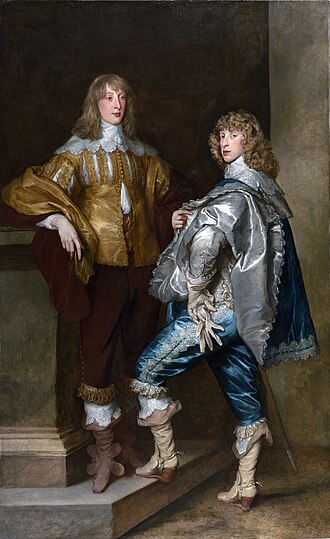 Lord John Stuart and His Brother, Lord Bernard Stuart - Anthony van Dyck (1638)
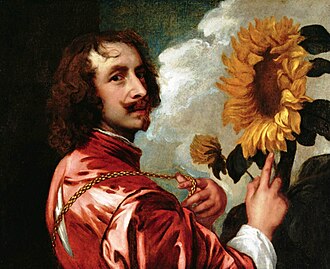 Selbstporträt - Anthony van Dyck (1632)
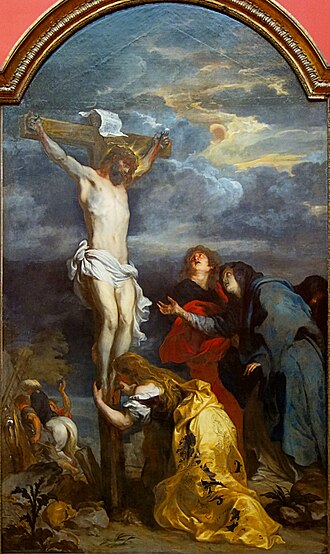 Crucifixion - Anthony van Dyck
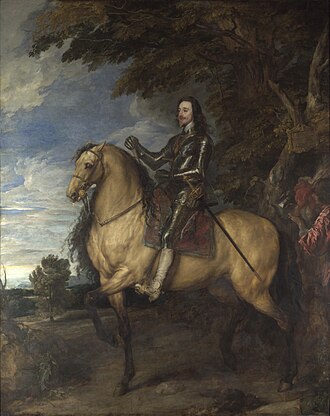 Reiterporträt Karls I - Anthony van Dyck (1637)
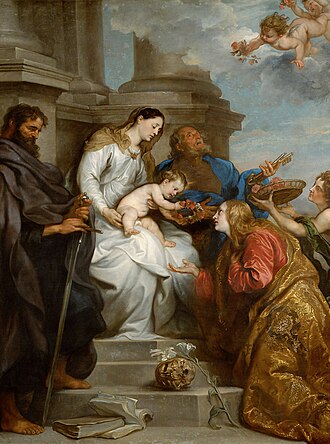 Maria mit Kind und den Hll. Rosalia, Petrus und Paulus - Anthony van Dyck (1629)
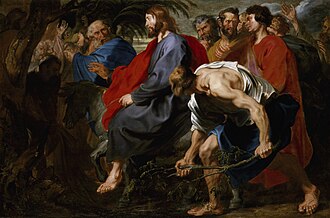 Entry of Christ into Jerusalem - Anthony van Dyck (1617)
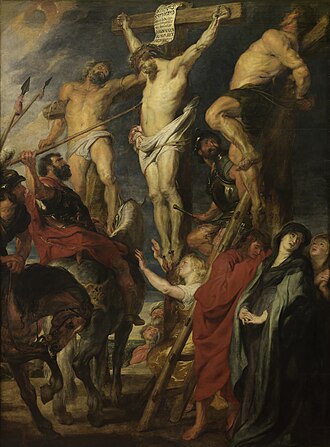 Der Lanzenstich - Anthony van Dyck (1620)