村のお嬢様たち
ギュスターヴ・クールベ · 1850s
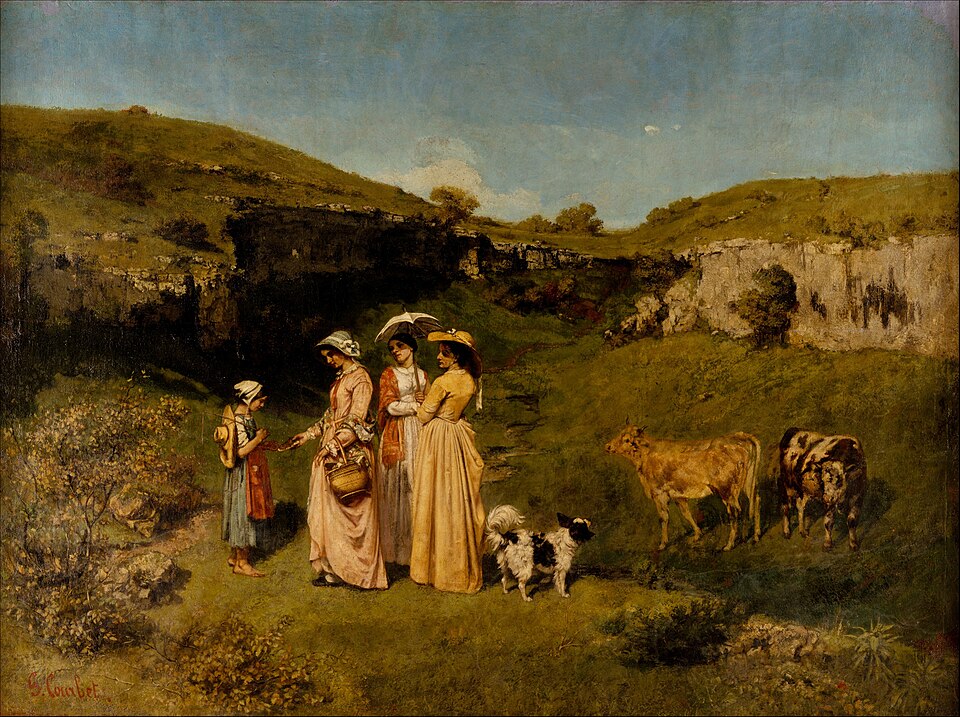
Three well-dressed sisters stop in a sunny valley to offer food to a barefoot cowherd. It looks like a gentle country scene, yet in 1852 Paris it caused an uproar.
The story behind the painting
Gustave Courbet painted Young Ladies of the Village, also called The Village Maids, in 1852 and signed it at the bottom left. Wikidata gives only "1850s". The three young women were modelled by his own sisters, Zoé, Zélie and Juliette, whom he had painted before. A preparatory sketch of 1851, now in Leeds Art Gallery, places the figures further back in a composition dominated by vegetation. Courbet showed the finished canvas at the Paris Salon in April 1852 under a longer title, The Village Maids give alms to a cowherd in a valley near Ornans. The duc de Morny bought it at once, despite a storm of criticism in the press.
What to look for
In the centre, the three sisters offer something to eat to a barefoot peasant girl. One of them holds a parasol against the sun. A small dog stands behind the trio, while to the right two cows graze in a hilly landscape of rocky outcrops under a bright blue sky. The scenery draws on real places near Ornans, Courbet's home region, which he reused in other landscapes. Notice the scale: critics complained that the women look too small beside the cattle. Also notice the gaze between the ladies' little dog and the young calves, a detail some historians have loaded with meaning.
Meaning and intent
Why did a scene of charity provoke such anger? Théophile Gautier found it under-finished, and other critics said it broke the rules of perspective and called the women "rather ugly". At the 1855 Exposition Universelle viewers were troubled by provincial women dressed in Parisian fashion. Historians link the reaction to politics: the painting showed the strongly republican Franche-Comté to wealthy Parisians at a tense moment. Some read the lapdog as the middle class and the calves as a restless peasantry. Others see simply the old theme of giving to the poor, treated in a calm, distanced way. Michael Fried counts it among Courbet's "breakthrough canvases".
Legacy
The painting stirred as much discussion as Courbet's famous Burial at Ornans. He returned to the composition in an etching of 1862 published by Cadart and Luquet. After the duc de Morny's collection, the Duchess sold it at the Hôtel Drouot in 1878. The painting reached the United States shortly before 1901, was shown by Durand-Ruel's New York branch in 1906, and after several owners was given by Harry Payne Bingham to the Metropolitan Museum of Art in 1940. Today it lets visitors see how a quiet valley near Ornans became a battleground over what art should show.
豆知識
- Courbet's three sisters Zoé, Zélie and Juliette posed for the young ladies.
- It was exhibited at the Paris Salon in April 1852 and bought immediately by the duc de Morny.
- A preparatory sketch of 1851 is in Leeds Art Gallery.
- Wikipedia dates it 1852; Wikidata gives only the 1850s.
画家について
ギュスターヴ・クールベ (1819-1877)
女性 · 風景画 · メトロポリタン美術館 · 少女 · イヌ · 籠 · 日傘
同じ画家の作品: ギュスターヴ・クールベ
 世界の起源 - Gustave Courbet (1866)
 オルナンの埋葬 - Gustave Courbet (2020)
 画家のアトリエ - Gustave Courbet (1855)
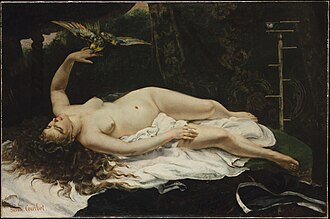 女とオウム - Gustave Courbet (1866)
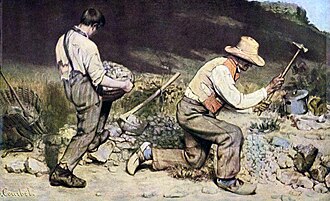 石割人夫 - Gustave Courbet (1850)
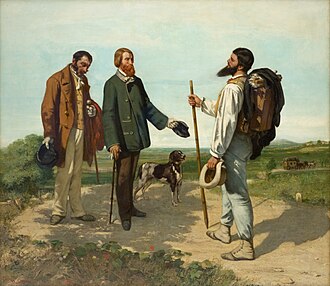 出会い または こんにちはクールベさん - Gustave Courbet (1854)
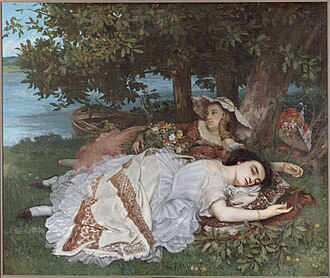 セーヌ川辺のお嬢さんたち - Gustave Courbet (1857)
.jpg) 泉 - Gustave Courbet (1862)
泉 - Gustave Courbet (1862)
 印象・日の出
 睡蓮
睡蓮 草上の昼食
草上の昼食 オランピア
オランピア 星月夜
星月夜.jpg) 夜のカフェテラス
夜のカフェテラス