石割人夫
ギュスターヴ・クールベ · 1850
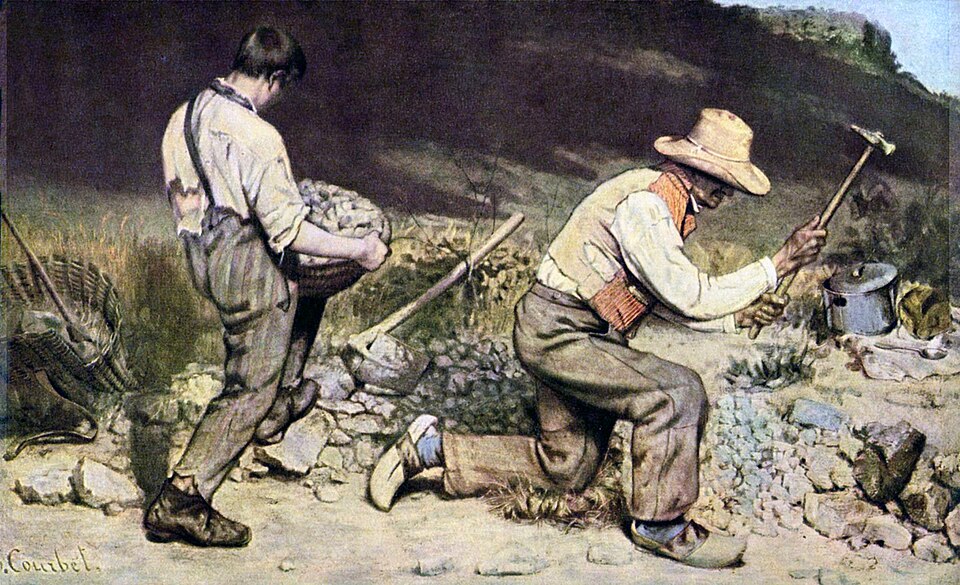
Two men break stones by a roadside, faces turned away, clothes in tatters. Courbet showed them life-size at the Salon, and the art world has argued about realism ever since. The canvas itself has been lost since the Second World War.
The story behind the painting
In November 1849 Courbet was travelling to paint a landscape when, near Maisières, he stopped to watch two men breaking stones on the road. He wrote to his friends Francis and Marie Wey that one rarely meets so complete an expression of poverty, so he asked the men to come to his studio the next morning, and painted the picture. He described the older worker as courbé, bent, perhaps a pun on his own name. Wikipedia dates the painting 1849, while Wikidata gives 1850, the year of the Salon where it was shown.
What to look for
This version, about 165 by 257 cm, was as large as Courbet's A Burial at Ornans. An old man of seventy, in Courbet's words, kneels with his hammer raised, his skin parched by the sun, his patched trousers and cracked clogs showing bare heels. A young man in a ragged shirt, his head covered in dust, a leather suspender holding up what is left of his trousers, his boots gaping with holes. Neither face is shown. The paint is thick, partly applied with a palette knife, and the light was criticised as poor. The workers are not idealised, unlike the peasants Jules Breton later painted.
Meaning and intent
Hiding the faces makes the men representatives of all common labourers, caught in repetitive, menial work. The poet Max Buchon called them the dawn and twilight of modern galley-slave existence. Critics at the Salon of 1850 to 1851 found the subject unfit for high art and the workers brutish, worn and dirty, and the painting was seen as a political statement. Pierre-Joseph Proudhon praised it as a masterpiece in its genre and a successful socialist painting. Champfleury declared that critics could now fight for or against realism in art.
Legacy
Dresden's Gemäldegalerie Alte Meister acquired the work around 1882 and called it Courbet's monumental masterpiece. In February 1945, during the bombing of Dresden, it was said to have been destroyed with 153 other paintings when a transport to Königstein Fortress was hit. In 1988 the historian Richard Raskin wrote that it was not on that transport but went missing in 1944, and the museum lists it as missing. A smaller, darker, mirror-image second version, 56 by 85 cm, survives in the Oskar Reinhart Collection in Winterthur.
豆知識
- Painted after Courbet saw two road labourers in November 1849.
- Shown at the Paris Salon of 1850-1851.
- The Dresden version is lost: reported destroyed in 1945, or missing since 1944.
- A smaller mirror-image version survives in Winterthur.
画家について
ギュスターヴ・クールベ (1819-1877)
風俗美術 · 男性 · 少年 · 直立姿勢 · ドレスデン美術館 · 岩石 · 石
同じ画家の作品: ギュスターヴ・クールベ
 世界の起源 - Gustave Courbet (1866)
 オルナンの埋葬 - Gustave Courbet (2020)
 画家のアトリエ - Gustave Courbet (1855)
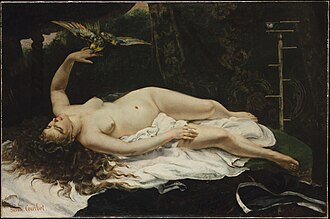 女とオウム - Gustave Courbet (1866)
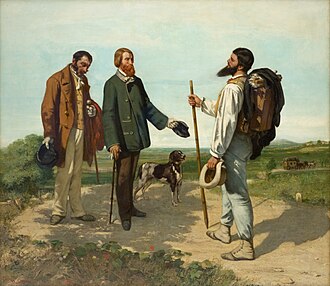 出会い または こんにちはクールベさん - Gustave Courbet (1854)
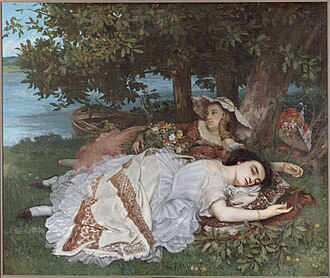 セーヌ川辺のお嬢さんたち - Gustave Courbet (1857)
.jpg) 泉 - Gustave Courbet (1862)
泉 - Gustave Courbet (1862)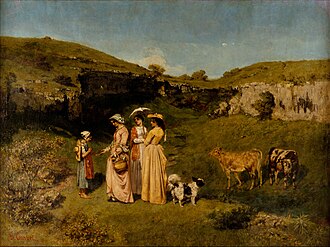 村のお嬢様たち - Gustave Courbet (1850s)
 印象・日の出
 睡蓮
睡蓮 草上の昼食
草上の昼食 オランピア
オランピア 星月夜
星月夜.jpg) 夜のカフェテラス
夜のカフェテラス