Women carrying pitchers
Francisco Goya · 1791
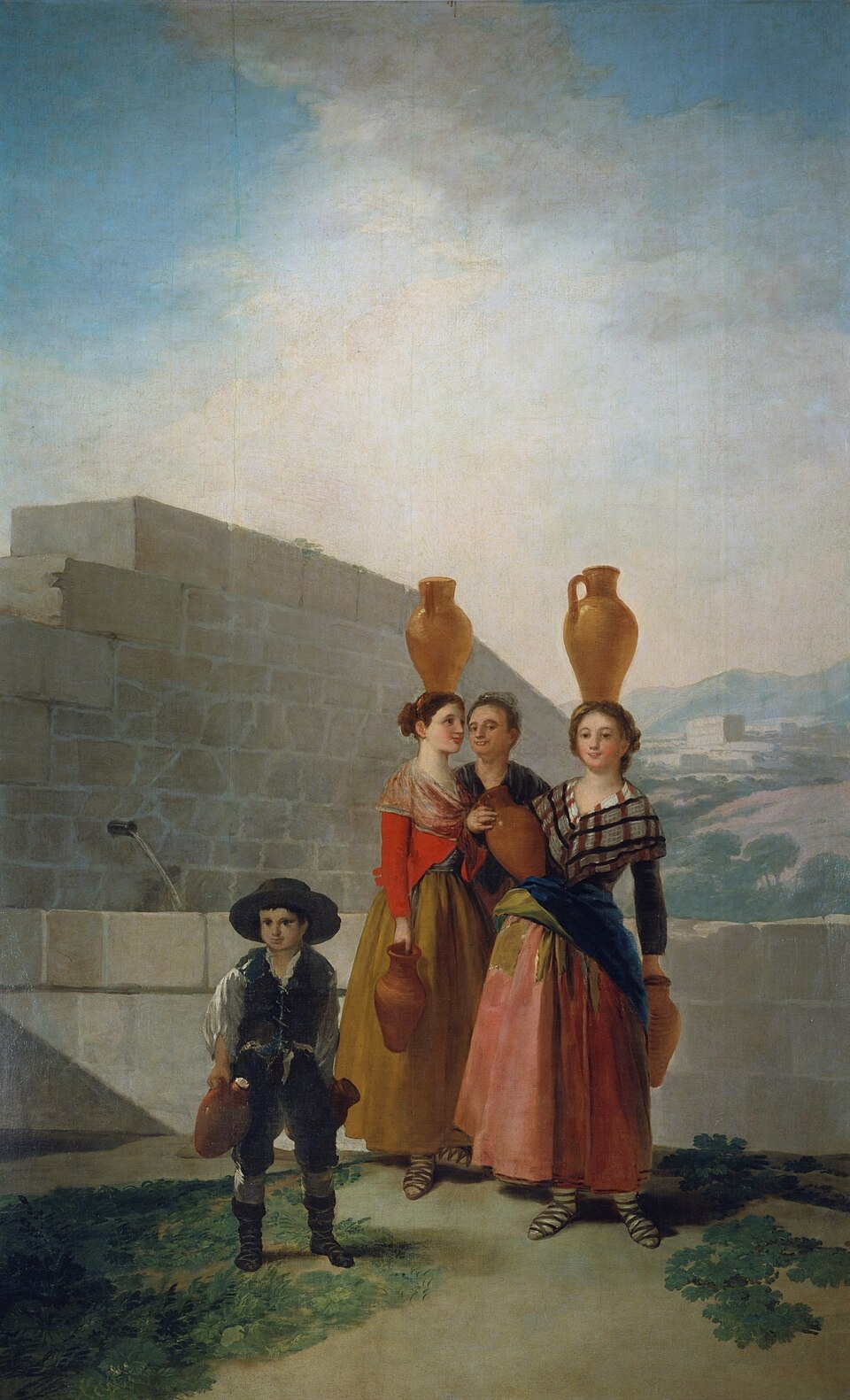
Two young women balance water jugs and glance at us with easy charm, while an older woman leans in to whisper. Goya painted them as a design for a royal tapestry, then lost track of the canvas for nearly eighty years.
The story behind the painting
Las mozas del cántaro belongs to Goya's seventh series of tapestry cartoons, full-size painted designs for tapestries meant for the study of Charles IV at the Escorial. The same king, as Prince of Asturias, had received the six earlier series. The series also included The Wedding, The Stilts, The Straw Manikin and others. The French Wikipedia dates the painting 1791 to 1792. The canvas was then considered lost until 1869, when Gregorio Cruzada Villaamil found it in the basement of the Royal Palace of Madrid. It went to the Prado in 1870.
What to look for
Three women have filled jugs at a fountain, and a boy stands in the foreground. Two young women in the middle ground carry jugs, one balanced on her head, and both turn to the viewer with a clear play of seduction, in their glance and the sway of their hips. An older, bareheaded woman stands further back. The brushstrokes are quick, especially on the older woman. Imposing architecture rises behind the group. The canvas is tall, about 262 by 160 cm, as tapestry designs often were.
Meaning and intent
A change between the sketch and the final work alters everything. In the sketch the older woman is bent over the fountain with her back turned, so the girls flirt while she is not looking. In the final version she faces us, watches the scene and speaks into a girl's ear, like the matron of Goya's later Majas on a Balcony. The jug on the head is usually read as a symbol of feminine virtue. Some critics see an allegory of seduction or prostitution, or another of Goya's scenes of women dominating men, others the three ages of life.
Legacy
The boy in the foreground does not appear in the sketch. He seems to have been added to keep the picture in harmony with other works in the series, such as The Gigantillas. Goya's figure of the matron, introduced here, became a recurring presence in his later work. Since its rediscovery the canvas has belonged to the Prado, which first listed it in its catalogue in 1876. It hangs there today in room 93, one of the many tapestry designs that show the young Goya's lively view of everyday Spanish life.
豆知識
- A cartoon for a tapestry for Charles IV's study at the Escorial.
- Painted 1791-1792.
- Lost until found in a Madrid palace basement in 1869.
- In the Prado since 1870.
画家について
Francisco Goya (1746-1828)
同じ画家の作品: Francisco Goya
 1808年5月3日 - Francisco Goya (1814)
 裸のマハ - Francisco Goya (1800)
 我が子を食らうサトゥルヌス - Francisco Goya (1819)
 カルロス4世の家族 - Francisco Goya (1800)
 着衣のマハ - Francisco Goya (1800)
 1808年5月2日、エジプト人親衛隊との戦闘 - Francisco Goya (1814)
 犬 - Francisco Goya (1819)
 魔女の夜宴 - Francisco Goya (1820s)
関連する画家の作品
 雲海の上の旅人 - Caspar David Friedrich (c. 1818)
 楡の木のある僧院 - Caspar David Friedrich (1800s)
 民衆を導く自由の女神 - Eugène Delacroix (1830)
 サルダナパールの死 - Eugène Delacroix (1827)
 戦艦テメレール号 - J. M. W. Turner (1839)
 雨、蒸気、速度 - グレート・ウェスタン鉄道 - J. M. W. Turner (1844)
 青衣の少年 - Thomas Gainsborough (1770)
 アンドリューズ夫妻 - Thomas Gainsborough (1748)