Women at the Races
Édouard Manet · 1866
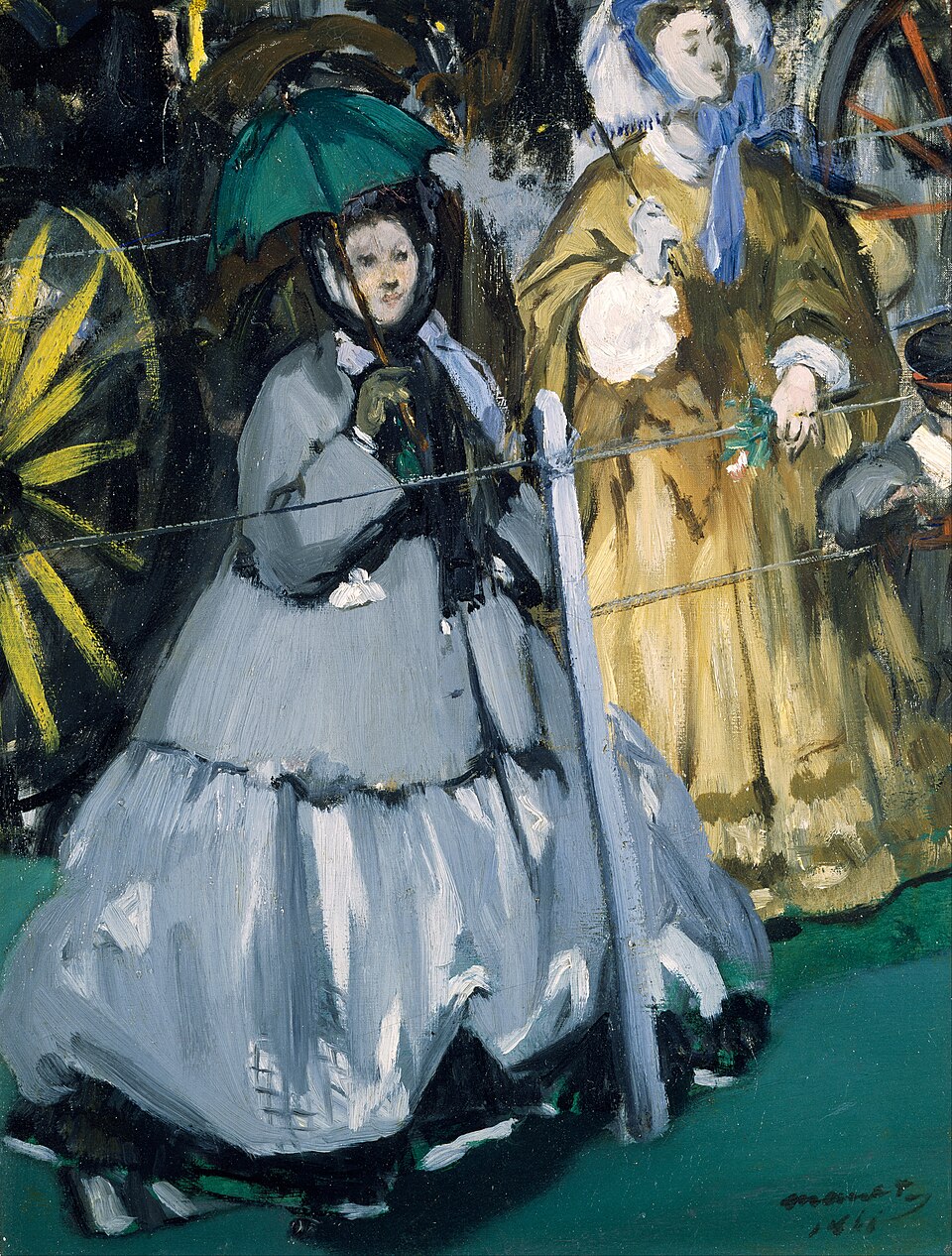
Two women in wide 1860s dresses stand at a rope by the racecourse at Longchamp, parasols in hand. The horses are nowhere to be seen. This small canvas is a surviving fragment of a bigger picture Manet cut apart himself.
The story behind the painting
Manet was a regular visitor to the Longchamp racecourse in the Bois de Boulogne, which had opened only in 1857. Degas even sketched him there. Manet made studies on the spot and a watercolour, now in the Fogg Art Museum, that served as groundwork for a large painting called Races at Longchamp. He showed it at the Galerie Martinet in Paris in February 1865. Unhappy with it, he later cut it into several pieces. Only two fragments survive: this one and Racecourse at Longchamp in a private collection. The German Wikipedia dates the work 1864 to 1865, while Wikidata gives 1866.
What to look for
Seen from slightly above, as if from horseback or a carriage, two women watch from behind a rope tied to a wooden post. The one on the left wears a blue-grey dress, a bonnet tied with a black ribbon and holds a small dark green parasol. Behind her, a woman in light brown with white collar and sleeves has a bright blue bow under her chin and lays her bare left hand on the rope, holding a flower, perhaps a rose. A small boy pushes in at the right edge. Yellow and reddish carriage wheels peek in at the corners. The paint is thin, in places leaving the canvas weave visible.
Meaning and intent
What is striking is what is missing: the race itself. The art historian Tobias G. Natter sees Manet's interest in the atmosphere around the event and the world of its visitors. Racing had become a fashionable social occasion in Paris in just a few years, where bankers, politicians, diplomats and businessmen met, and Manet was among the first painters to show it. Aaron Betsky reads the fragments as the true theme of the whole lost composition, the fashionable society of modern life. It is unclear whether the woman's flower was a gift or meant to honour a winner.
Legacy
Although only a fragment, the picture is signed Manet and dated 1865 in the lower right, a sign that he considered it a finished work. Its first known owner after Manet was the collector Paul Gallimard, then the dealers Bernheim-Jeune and Cassirer. The painter Max Liebermann bought it on 27 June 1904 and kept it until his death in 1935. After 1933 he sent it to the Kunsthaus Zürich for safekeeping, and his daughter Käthe and her husband Kurt Riezler took it to the United States in 1938. It now belongs to the Cincinnati Art Museum.
豆知識
- A fragment of Races at Longchamp, which Manet cut up after 1865.
- Signed and dated 1865; Wikidata gives 1866.
- Once owned by the painter Max Liebermann.
- Now in the Cincinnati Art Museum.
画家について
Édouard Manet (1832-1883)
同じ画家の作品: Édouard Manet
 草上の昼食 - Édouard Manet (1863)
 オランピア - Édouard Manet (1863)
 フォリー・ベルジェールのバー - Édouard Manet (1882)
 バルコニー - Édouard Manet (1868)
 テュイルリー公園の音楽会 - Édouard Manet (1862)
 笛を吹く少年 - Édouard Manet (1866)
 鉄道 - Édouard Manet (1873)
 ナナ - Édouard Manet (1877)
関連する画家の作品
 印象・日の出 - Claude Monet (1872)
 睡蓮 - Claude Monet (1906)
 ムーラン・ド・ラ・ギャレットの舞踏会 - Pierre-Auguste Renoir (1876)
 舟遊びの昼食 - Pierre-Auguste Renoir (1881)
 ゆりかご - Berthe Morisot (1872)
 Summer's Day - Berthe Morisot (1879)
 アブサントを飲む人 - Edgar Degas (1875)
 The Bellelli Family - Edgar Degas (1858)
 The Canal du Loing at Moret - Alfred Sisley (1892)
 The Watering Pond at Marly with Hoarfrost - Alfred Sisley (1876)
 パリの通り、雨 - Gustave Caillebotte (1877)
 床削り - Gustave Caillebotte (1875)