Woman with dogs
Édouard Manet · 1858
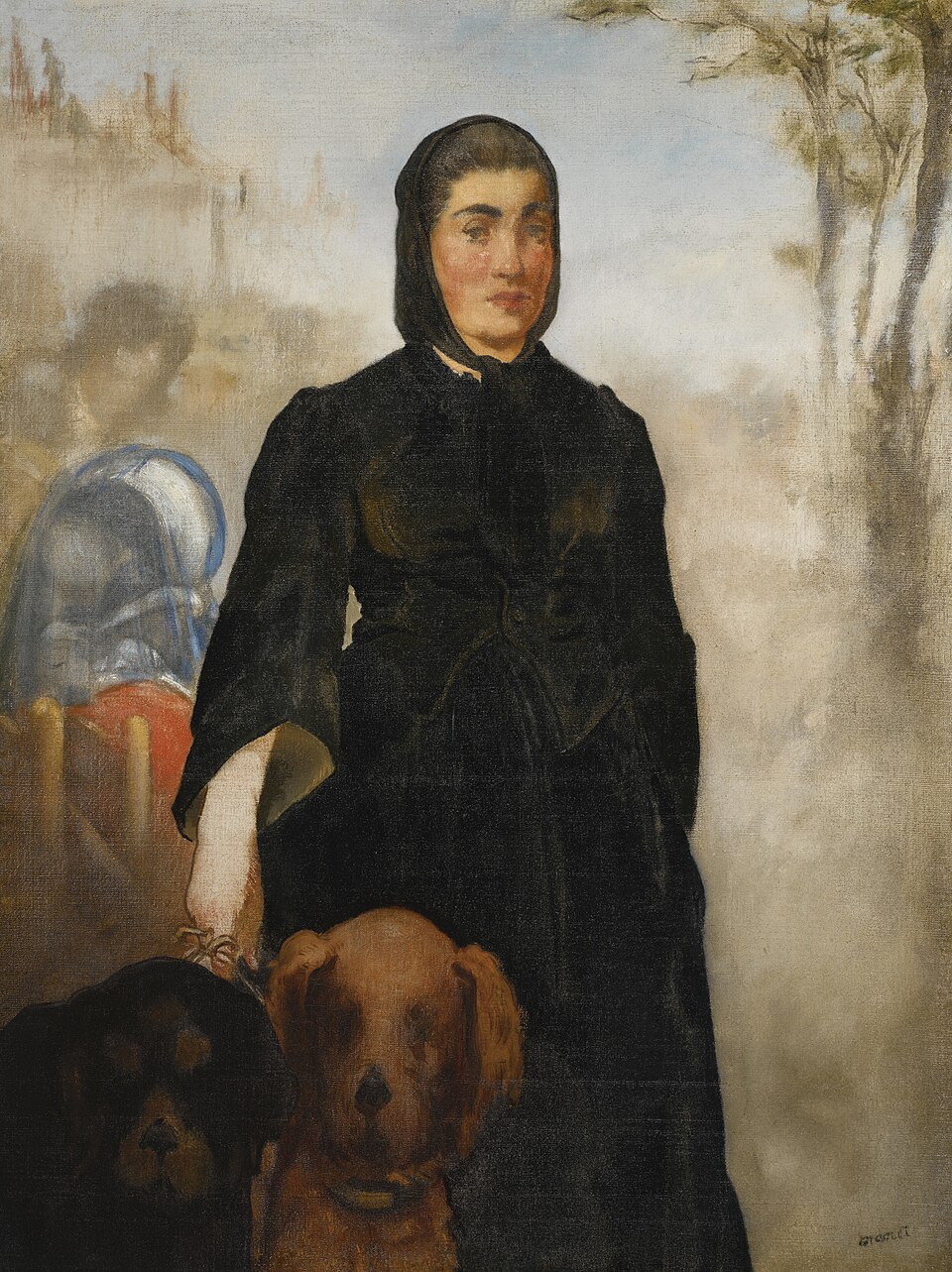
A woman dressed all in black stares straight at us, two big hounds at her side. Nobody knows who she was, and even the year Manet painted her is still argued over.
The story behind the painting
Woman with Dogs, in French La femme aux chiens, is an early work by Édouard Manet, and its exact date is unknown. Several authors, among them Françoise Cachin, dated it to 1858 without giving a reason, and Wikidata also gives 1858. The German Wikipedia article argues for around 1862, pointing to links with Manet's other paintings and with Spanish Baroque models. The sources also disagree on size: the article gives 96 by 74 cm, Wikidata 92 by 65 cm. The woman's identity is unknown; she may have come to Paris with a troupe of Spanish dancers in 1862.
What to look for
The woman stands at the centre, shown to the knees, her body turned slightly to the right, her wide open eyes on the viewer. She is all in black: long skirt, buttoned long-sleeved jacket, and a black scarf tied under her chin over dark hair combed back. Her face, with a pale complexion and reddish cheeks, is finely painted, while her right arm and the hand holding a leash are only sketched. In the lower left corner a brown and a black dog look out at us. Beside her stands a pram with a red blanket. To the right, an unfinished grey and beige area lets the canvas show through, with a tree filling the upper corner.
Meaning and intent
Under the Second Empire there was a fashion for all things Spanish, fed in part by the Spanish-born Empress Eugénie, and in 1862 a troupe from the Madrid opera ballet performed in Paris. In 1862 the French state also bought Philip IV as a Hunter, then thought to be by Velázquez and now given to his workshop. Manet admired Velázquez, and Woman with Dogs seems to turn that hunter into a female counterpart: the figure turned slightly right, left hand behind the back, right hand stretched down, dogs in the lower left, trees behind. The author Viola Hildebrand-Schat sees a gap between narrative precision and suggestion in the painting.
Legacy
The painting was in Manet's studio when he died in 1883 and was inventoried by his godson Léon Leenhoff. The signature in the lower right corner was not added by Manet but by his widow Suzanne after his death. At the estate auction at the Hôtel Drouot in February 1884 it went to the Paris dealer Gaston-Alexandre Camentron. It then passed to the J. J. Cowan collection in Edinburgh and on to the United States, where the Cleveland lawyer Frank Hadley Ginn lent it to the Cleveland Museum of Art in 1929. After further owners it is today in a private collection.
豆知識
- Dated 1858 by Cachin and Wikidata, around 1862 by the German Wikipedia article.
- Size given as 96 x 74 cm by Wikipedia, 92 x 65 cm by Wikidata.
- Seems to adapt Philip IV as a Hunter from Velázquez's workshop.
- The signature was added by Suzanne Manet after his death.
画家について
Édouard Manet (1832-1883)
同じ画家の作品: Édouard Manet
 草上の昼食 - Édouard Manet (1863)
 オランピア - Édouard Manet (1863)
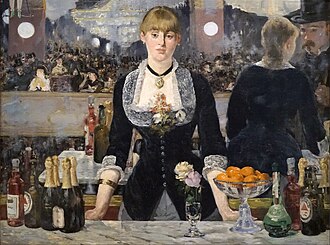 フォリー・ベルジェールのバー - Édouard Manet (1882)
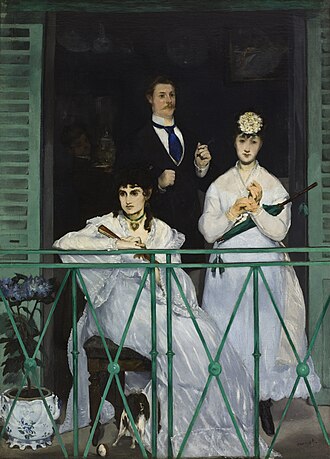 バルコニー - Édouard Manet (1868)
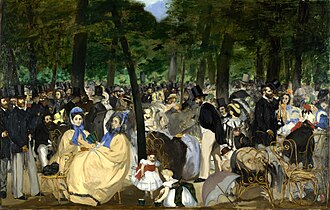 テュイルリー公園の音楽会 - Édouard Manet (1862)
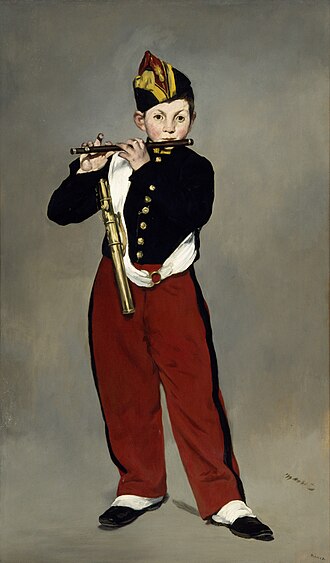 笛を吹く少年 - Édouard Manet (1866)
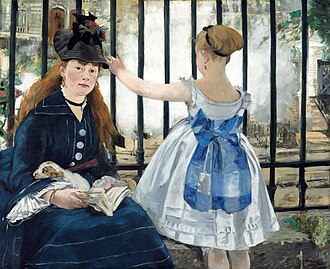 鉄道 - Édouard Manet (1873)
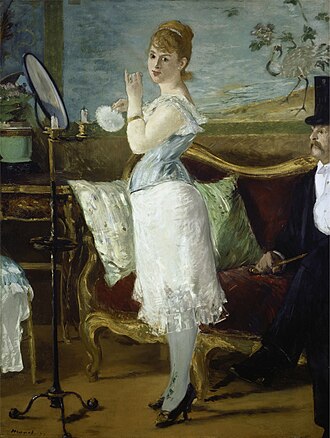 ナナ - Édouard Manet (1877)
関連する画家の作品
 印象・日の出 - Claude Monet (1872)
 睡蓮 - Claude Monet (1906)
 ムーラン・ド・ラ・ギャレットの舞踏会 - Pierre-Auguste Renoir (1876)
 舟遊びの昼食 - Pierre-Auguste Renoir (1881)
 ゆりかご - Berthe Morisot (1872)
 Summer's Day - Berthe Morisot (1879)
 アブサントを飲む人 - Edgar Degas (1875)
 The Bellelli Family - Edgar Degas (1858)
 The Canal du Loing at Moret - Alfred Sisley (1892)
 The Watering Pond at Marly with Hoarfrost - Alfred Sisley (1876)
 パリの通り、雨 - Gustave Caillebotte (1877)
 床削り - Gustave Caillebotte (1875)