トレドの景観と地図
エル・グレコ · 1610s
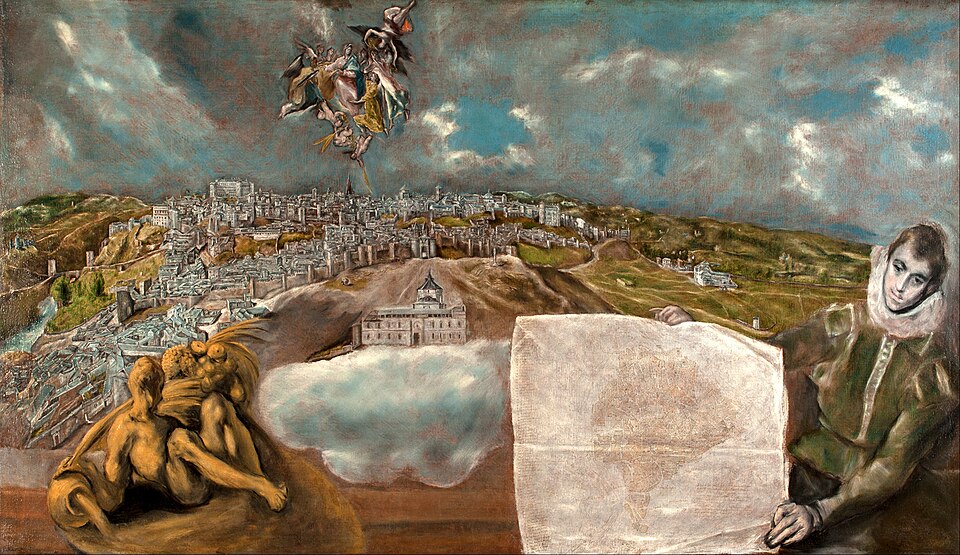
El Greco painted his adopted city twice over: once as a sweeping view, once as a map held up like a sheet of paper. Then he lifted a whole hospital onto a cloud so it would not block the city gate.
The story behind the painting
View and Plan of Toledo dates from around 1608, according to Wikipedia, while Wikidata places it in the 1610s. It was probably commissioned by Pedro Salazar de Mendoza, administrator of the Tavera Hospital and an early collector of maps and city views; an earlier idea that the city council ordered it has been set aside. Yet the painting appears in El Greco's estate inventory of 1614 and in his son Jorge Manuel's inventory of 1621, so Salazar seems to have received it only years after the painter died. It is listed in Salazar's own estate in 1629, alongside View of Toledo.
What to look for
The city is seen from the north looking south. You can pick out the Bisagra Gate, the Cathedral, the Alcazar and Saint Martin's Bridge. At lower right a trompe l'oeil map shows the streets, oriented with south at the top and keyed to a numbered list of institutions. At lower left the Tagus River reclines as an allegory, with a cornucopia and a vessel pouring water. Above the city, the Virgin places a chasuble on Saint Ildefonsus, and the Tavera Hospital floats on a cloud as a model. An inscription on the map explains both choices in El Greco's own words.
Meaning and intent
El Greco wrote that he had to show the Tavera Hospital as a model because it covered the Bisagra Gate and its dome rose above the city; moved, it showed its facade better. He made the Virgin and Ildefonsus large because they are celestial bodies, like lights that seem big from afar. The river figure speaks of farming and fertility, and of Toledo's Roman roots. Scholars read the whole picture as a statement of the city's sanctity and history, at a time when Toledo campaigned to persuade Philip II and his court to come back from Madrid.
Legacy
Most scholars accept El Greco as the painter, though some think his son Jorge Manuel penned the map, and Guillermo Santacruz Sanchez de Rojas gave him the whole work, arguing the old master could not have walked the city to measure it. Richard Kagan and Fernando Marias hold that El Greco drew the map himself, possibly having learned from the Venetian mapmaker Callapoda; others trace it to an older Toledo map in the Atlas de El Escorial. The canvas passed through the Hospital de Santiago and two monasteries and entered the El Greco Museum in Toledo in 1910.
豆知識
- Combines a panorama of Toledo with a map of its streets.
- The Tavera Hospital floats on a cloud, explained by El Greco's inscription.
- Probably made for Pedro Salazar de Mendoza.
- In the El Greco Museum in Toledo since 1910.
画家について
エル・グレコ (1541-1614)
同じ画家の作品: エル・グレコ
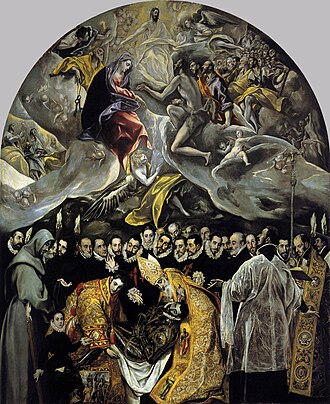 オルガス伯の埋葬 - El Greco (1586)
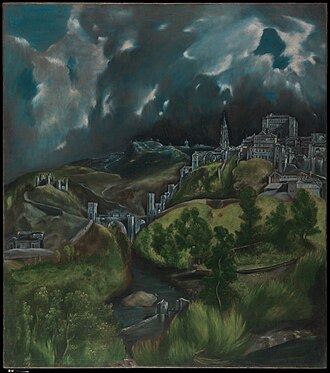 トレドの風景 - El Greco (1596)
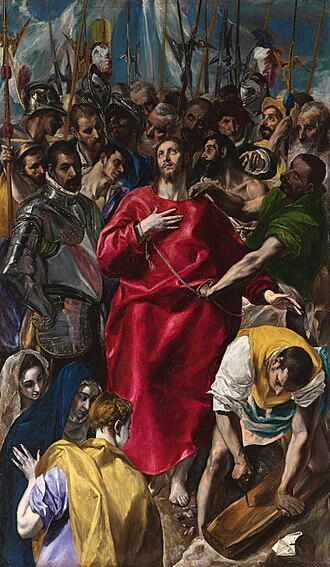 聖衣剥奪 - El Greco (1570s)
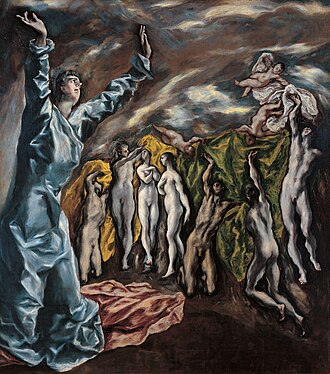 黙示録第5の封印 - El Greco (1610)
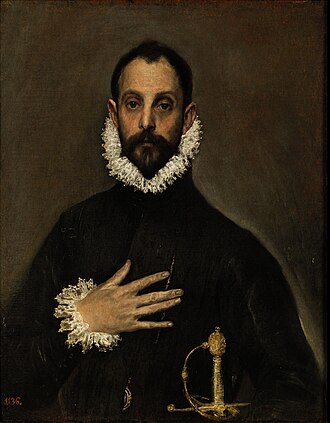 胸に手を置く騎士 - El Greco (1580)
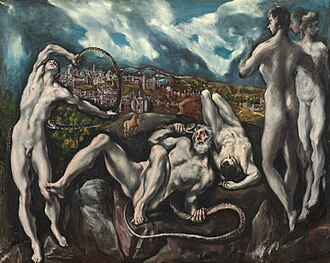 ラオコーン - El Greco (1610s)
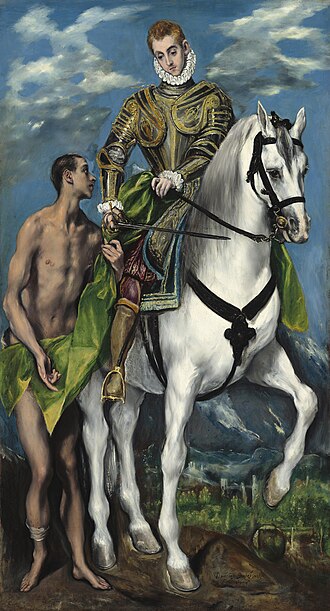 聖マルティヌスと乞食 - El Greco (1597)
 羊飼いの礼拝 - El Greco (1612)
関連する画家の作品
 カナの婚礼 - Paolo Veronese (1560s)
 レヴィ家の饗宴 - Paolo Veronese (1573)
 最後の晩餐 - Jacopo Tintoretto (1563)
 奴隷を解放する聖マルコ - Jacopo Tintoretto (1540s)
 ウルビーノのヴィーナス - Titian (1538)
 聖母被昇天 - Titian (1510s)
 エマオの晩餐 - Caravaggio (1601)
 聖マタイの召命 - Caravaggio (1609)
 大使たち - Hans Holbein the Younger (1533)
 墓の中のキリストの屍 - Hans Holbein the Younger (1520s)