二人の老人
Francisco Goya · 1819
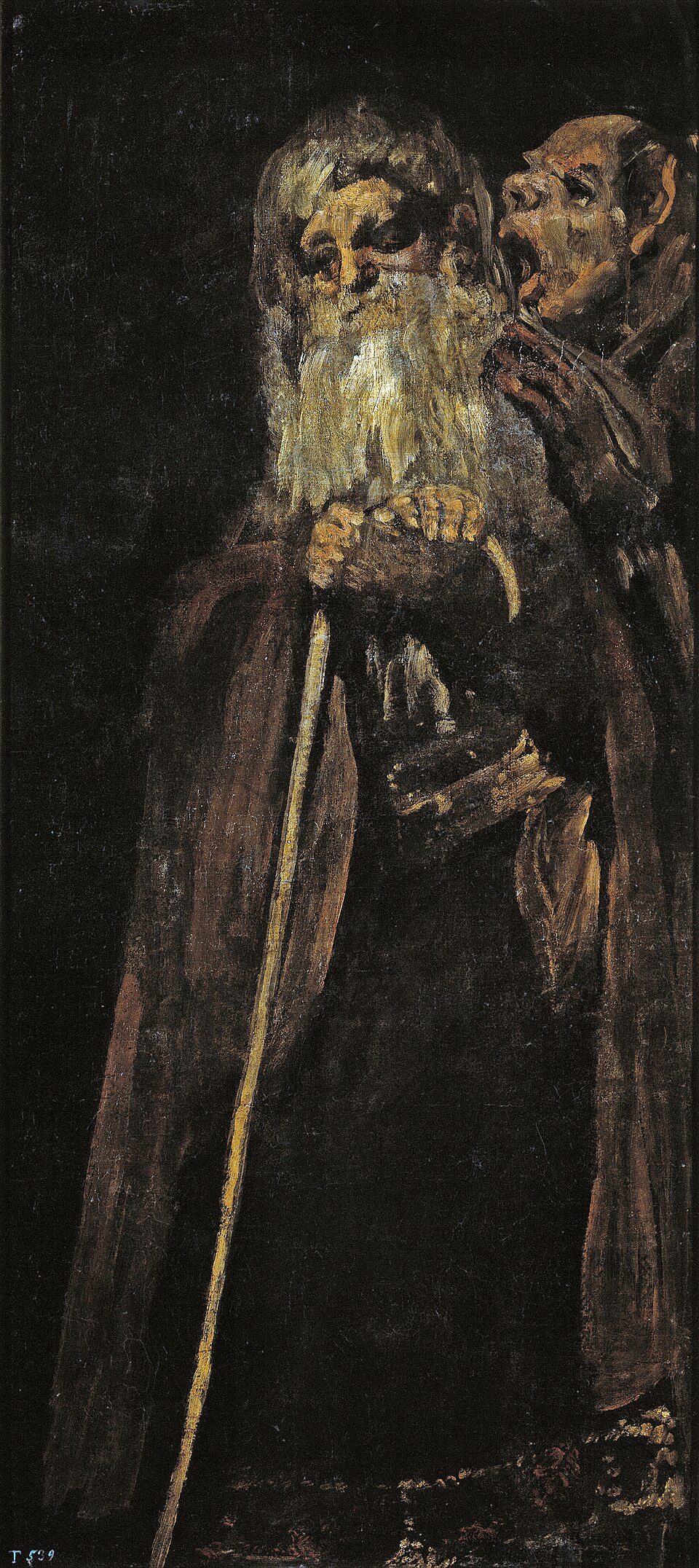
A calm old man leans on his cane while a beast-like figure shouts into his ear. Goya painted them on the wall of his own house when he was deaf, ill and in his seventies, never meaning anyone else to see.
The story behind the painting
In 1819 Goya bought a country house on seventeen acres south-west of Madrid, near the Manzanares River. By coincidence it was already known as the Quinta del Sordo, the House of the Deaf Man, after its previous owner. That same year, at seventy-three, he fell gravely ill with a mysterious disease and was saved by his friend Dr Arrieta. The illness is often cited as the trigger for the fourteen Black Paintings he made directly on the house's walls between 1819 and 1823. Two Old Men probably hung on the first floor, opposite Judith and Holofernes.
What to look for
Two old figures in friars' habits stand against a black ground. The main one, at the centre, is slightly hunched, his long grey beard framed by arms resting on a shepherd's cane, his face pensive, sad but serene. Beside him a caricatured figure with a bestial or corpse-like face seems to shout into his ear. Compare the two treatments: the bearded man recalls the philosophers of Velázquez that Goya had copied, while his companion recalls the friars of Goya's Caprichos and Disparates.
Meaning and intent
There is little primary evidence for why Goya made these works or what they mean. The shouting figure may allude to the painter's deafness, or to his fear of madness, a theme he explored throughout his career. The main figure could be Chronos, the god of time, perhaps with his companion acting as a memento mori, though the source finds this less likely. One art historian called the Black Paintings as close to hermetically private as any ever made in Western art.
Legacy
Baron Frédéric Émile d'Erlanger bought the property in 1873 and paid to have the murals transferred to canvas under Salvador Martínez Cubells, a Prado curator. He gave them to the Spanish state in 1881, and they are now in the Museo del Prado. This one was in poor condition, with a large crack in the plaster at upper right. Cubells added highlights and harsh black outlines, softening the main figure's dark expression into a contemplative one and losing much of Goya's subtle modelling.
豆知識
- One of the fourteen Black Paintings, 1819-1823.
- Painted on a wall of the Quinta del Sordo near Madrid.
- Transferred to canvas and heavily restored by Salvador Martínez Cubells.
- In the Museo del Prado since the 1881 donation.
画家について
Francisco Goya (1746-1828)
同じ画家の作品: Francisco Goya
 1808年5月3日 - Francisco Goya (1814)
 裸のマハ - Francisco Goya (1800)
 我が子を食らうサトゥルヌス - Francisco Goya (1819)
 カルロス4世の家族 - Francisco Goya (1800)
 着衣のマハ - Francisco Goya (1800)
 1808年5月2日、エジプト人親衛隊との戦闘 - Francisco Goya (1814)
 犬 - Francisco Goya (1819)
 魔女の夜宴 - Francisco Goya (1820s)
関連する画家の作品
 雲海の上の旅人 - Caspar David Friedrich (c. 1818)
 楡の木のある僧院 - Caspar David Friedrich (1800s)
 民衆を導く自由の女神 - Eugène Delacroix (1830)
 サルダナパールの死 - Eugène Delacroix (1827)
 戦艦テメレール号 - J. M. W. Turner (1839)
 雨、蒸気、速度 - グレート・ウェスタン鉄道 - J. M. W. Turner (1844)
 青衣の少年 - Thomas Gainsborough (1770)
 アンドリューズ夫妻 - Thomas Gainsborough (1748)