真理、時間、歴史
Francisco Goya · 1797
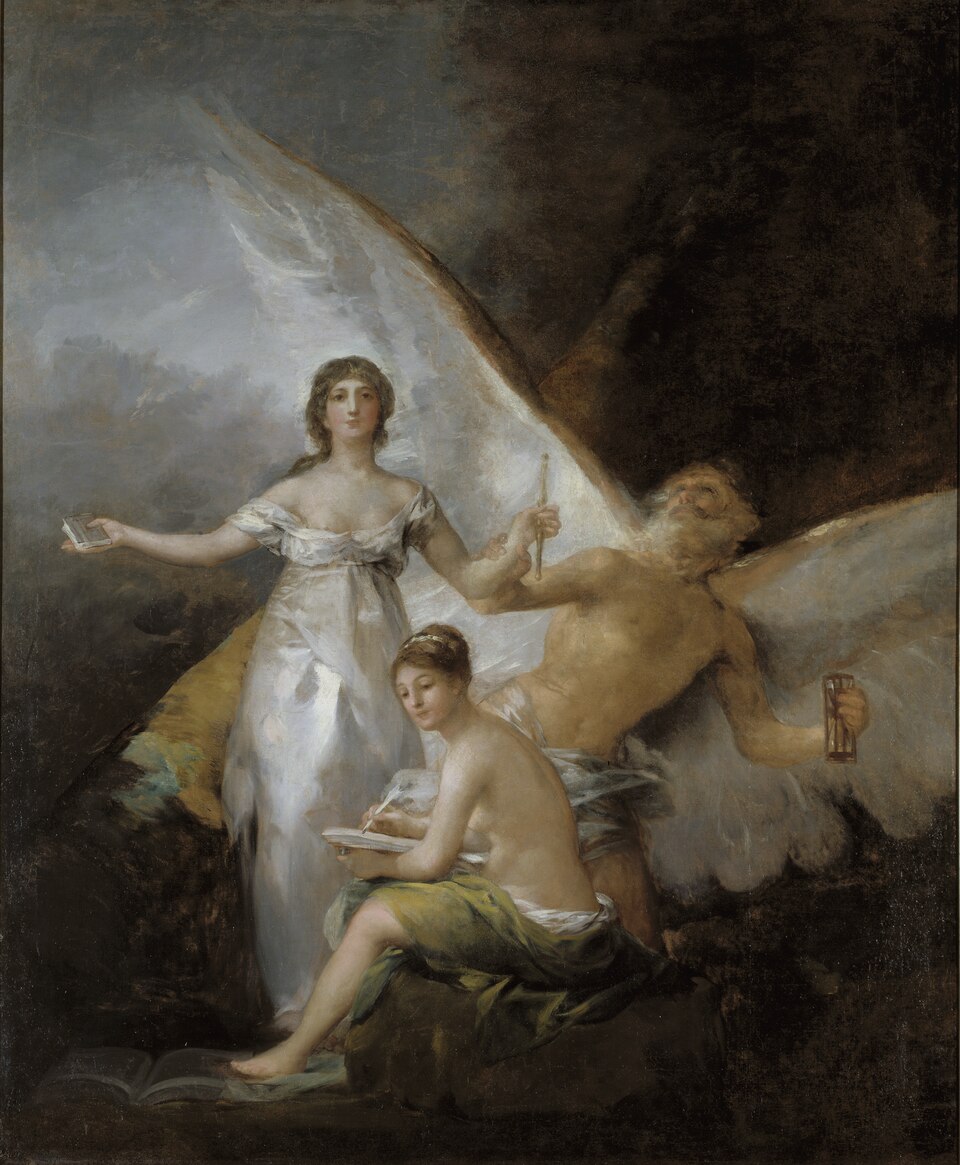
An old winged man with an hourglass pulls a woman in white into the light, while a nude figure writes in a book. Goya never explained who she is, and historians have named her Truth, Spain, Philosophy and even the law.
The story behind the painting
Goya's large canvas, about 294 by 244 cm, has been dated anywhere from 1797 to 1812, though most often between 1804 and 1808. Wikidata gives 1797. It is often thought to have been commissioned with a companion piece, Poetry, for Manuel Godoy, then First Secretary of State of Spain, perhaps to decorate his palace in Madrid. Yet the first reliable record dates only from 1867, when both works belonged to Juan Duncan Shaw, Austrian consul in Cádiz, and the historian Janis A. Tomlinson writes that they cannot be traced to Godoy's collection.
What to look for
History sits nude on a rock at the front, a white quill in her hand, an open book in her lap, a green cloth around her waist and another book open at her feet. Behind her stands Time, an old bearded man with an hourglass, his face turned upward, his huge white wings running off the canvas. He grips the arm of a woman in white who faces you, holding a scepter and a grey book. The background is light behind her and dark around Time.
Meaning and intent
Martin S. Soria called the work Spain, Time, and History, saw the influence of Cesare Ripa's Iconologia, and read the woman as Spain pulled by Time into a brighter future. Others object that Spain was then shown crowned, and Folke Nordström compares her to Philosophy, who also carries a book and scepter. Eleanor Sayre dated the painting 1812 and titled it Allegory of the Constitution of 1812, with the hourglass just turned over for a new era. Juan Luna, for the Stockholm catalogue, sees her as both Spain and Truth.
Legacy
A rough oil sketch of 1797 to 1799, or 1804 by some accounts, shows winged Time leading a nude Truth by the hand under bats and owls; it is in the Museum of Fine Arts, Boston. A red chalk drawing in the Prado, from a sketchbook Goya began in Italy, shows Time and Truth fleeing dark owls. After Shaw's death in 1878 the painting passed to Luis de Navas, then to Charles Deering, then to E. and A. Silberman Galleries, and in 1961 to the Nationalmuseum in Stockholm.
豆知識
- Also known as Spain, Time, and History or Allegory of the Constitution of 1812.
- Dated between 1797 and 1812, most often 1804-1808.
- Possibly a companion to Poetry, made for Manuel Godoy.
- In the Nationalmuseum, Stockholm, since 1961.
画家について
Francisco Goya (1746-1828)
女性 · 男性 · 座法 · 直立姿勢 · 寓意 · スウェーデン国立美術館 · 跪く
同じ画家の作品: Francisco Goya
 1808年5月3日 - Francisco Goya (1814)
 裸のマハ - Francisco Goya (1800)
 我が子を食らうサトゥルヌス - Francisco Goya (1819)
 カルロス4世の家族 - Francisco Goya (1800)
 着衣のマハ - Francisco Goya (1800)
 1808年5月2日、エジプト人親衛隊との戦闘 - Francisco Goya (1814)
 犬 - Francisco Goya (1819)
 魔女の夜宴 - Francisco Goya (1820s)
関連する画家の作品
 雲海の上の旅人 - Caspar David Friedrich (c. 1818)
 楡の木のある僧院 - Caspar David Friedrich (1800s)
 民衆を導く自由の女神 - Eugène Delacroix (1830)
 サルダナパールの死 - Eugène Delacroix (1827)
 戦艦テメレール号 - J. M. W. Turner (1839)
 雨、蒸気、速度 - グレート・ウェスタン鉄道 - J. M. W. Turner (1844)
 青衣の少年 - Thomas Gainsborough (1770)
 アンドリューズ夫妻 - Thomas Gainsborough (1748)