傷を負った石工
Francisco Goya · 1786
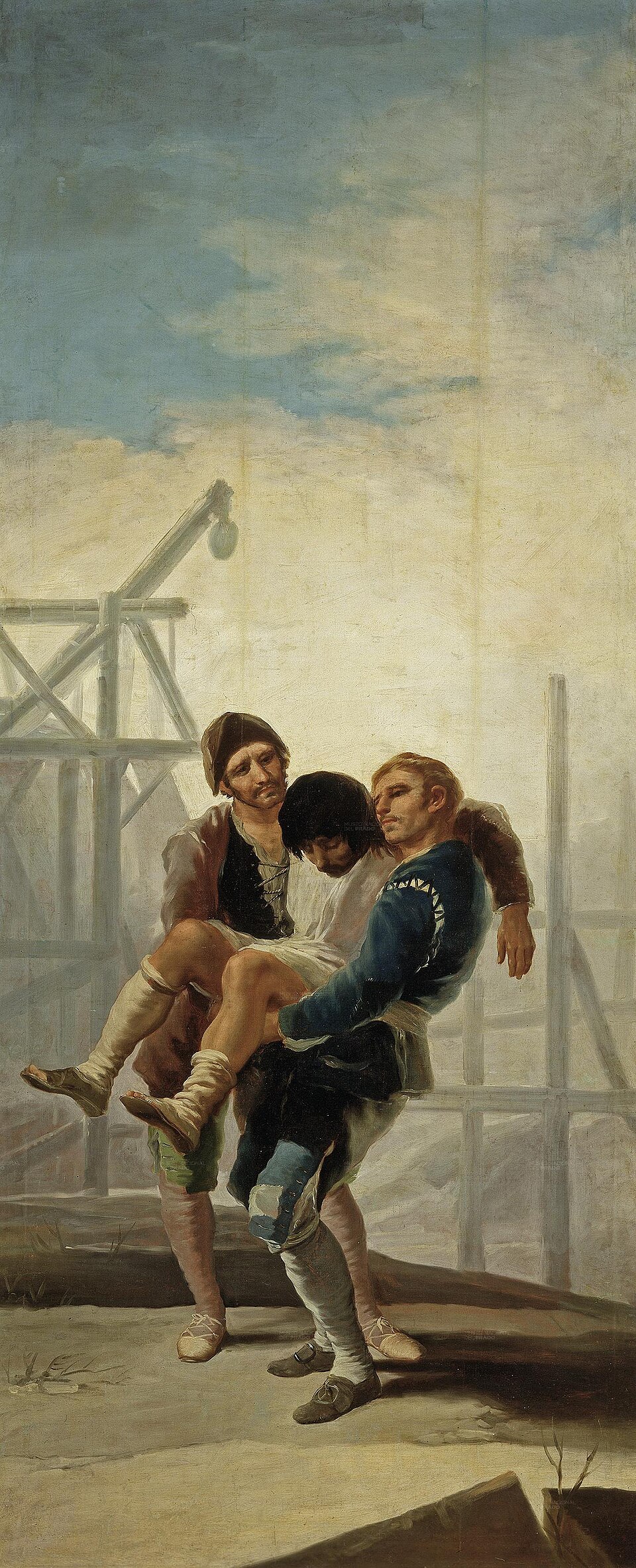
Two grieving men carry a fallen workmate away from the scaffolding. Goya first sketched the scene as a joke about a drunk mason, then turned it into one of his first images of real working-class pain.
The story behind the painting
Goya painted this picture between 1786 and 1787 as a cartoon, a full-size design for a tapestry, in his fifth series for the dining room of the Prince of Asturias, the future Charles IV, and his wife Maria Luisa of Parma, at the El Pardo palace. Its preparatory sketch was The Drunken Mason, a satirical scene, and the source suggests this version was probably made because the more controversial drunken mason was not accepted. The series also included The Flower Girls, The Threshing Floor, The Grape Harvest, The Snowstorm and The Poor at the Fountain.
What to look for
The format is very tall, 268 by 110 cm, suited to a tapestry. Two saddened men carry in their arms a colleague who has probably fallen from the scaffolding shown behind them. Look at the faces: they show gravity and concern for their companion, and the figures keep their dignity, helped by the low viewpoint that makes us look up at them. The colours are based on browns and greys, far from the picturesque scenes of Goya's earlier cartoons. Nothing here is decorative; the subject is a working accident.
Meaning and intent
The series took up the long tradition of the four seasons, popular for decorating dining rooms, but Goya turned the allegories into rural scenes of each time of year. Here he unexpectedly changed the meaning of his sketch, from satire to sympathy. The picture matches a decree by Charles III on scaffolding and building safety, which made the master builder pay compensation for scaffold accidents; it was published in 1788, with earlier editions, the nearest dated 1784. The suffering of ordinary people here is comparable to the misery of The Poor at the Fountain.
Legacy
The cartoon is unanimously recognised as marking the arrival of a clearly social style in Goya's work, and its sober colours set a precedent for the social realism of early Romanticism. For a long time it was considered lost, until in 1869 Gregorio Cruzada Villaamil found the canvas in the basement of the royal palace in Madrid. By orders of January and February 1870 it was handed over to the Museo del Prado, which first listed it in its catalogue in 1876, and it is shown there in room 94.
豆知識
- A tapestry cartoon painted in 1786-1787 for the El Pardo palace.
- Its first sketch was the satirical Drunken Mason.
- Rediscovered in a Madrid palace basement in 1869.
- In the Museo del Prado since 1870.
画家について
Francisco Goya (1746-1828)
同じ画家の作品: Francisco Goya
 1808年5月3日 - Francisco Goya (1814)
 裸のマハ - Francisco Goya (1800)
 我が子を食らうサトゥルヌス - Francisco Goya (1819)
 カルロス4世の家族 - Francisco Goya (1800)
 着衣のマハ - Francisco Goya (1800)
 1808年5月2日、エジプト人親衛隊との戦闘 - Francisco Goya (1814)
 犬 - Francisco Goya (1819)
 魔女の夜宴 - Francisco Goya (1820s)
関連する画家の作品
 雲海の上の旅人 - Caspar David Friedrich (c. 1818)
 楡の木のある僧院 - Caspar David Friedrich (1800s)
 民衆を導く自由の女神 - Eugène Delacroix (1830)
 サルダナパールの死 - Eugène Delacroix (1827)
 戦艦テメレール号 - J. M. W. Turner (1839)
 雨、蒸気、速度 - グレート・ウェスタン鉄道 - J. M. W. Turner (1844)
 青衣の少年 - Thomas Gainsborough (1770)
 アンドリューズ夫妻 - Thomas Gainsborough (1748)