the witches kitchen
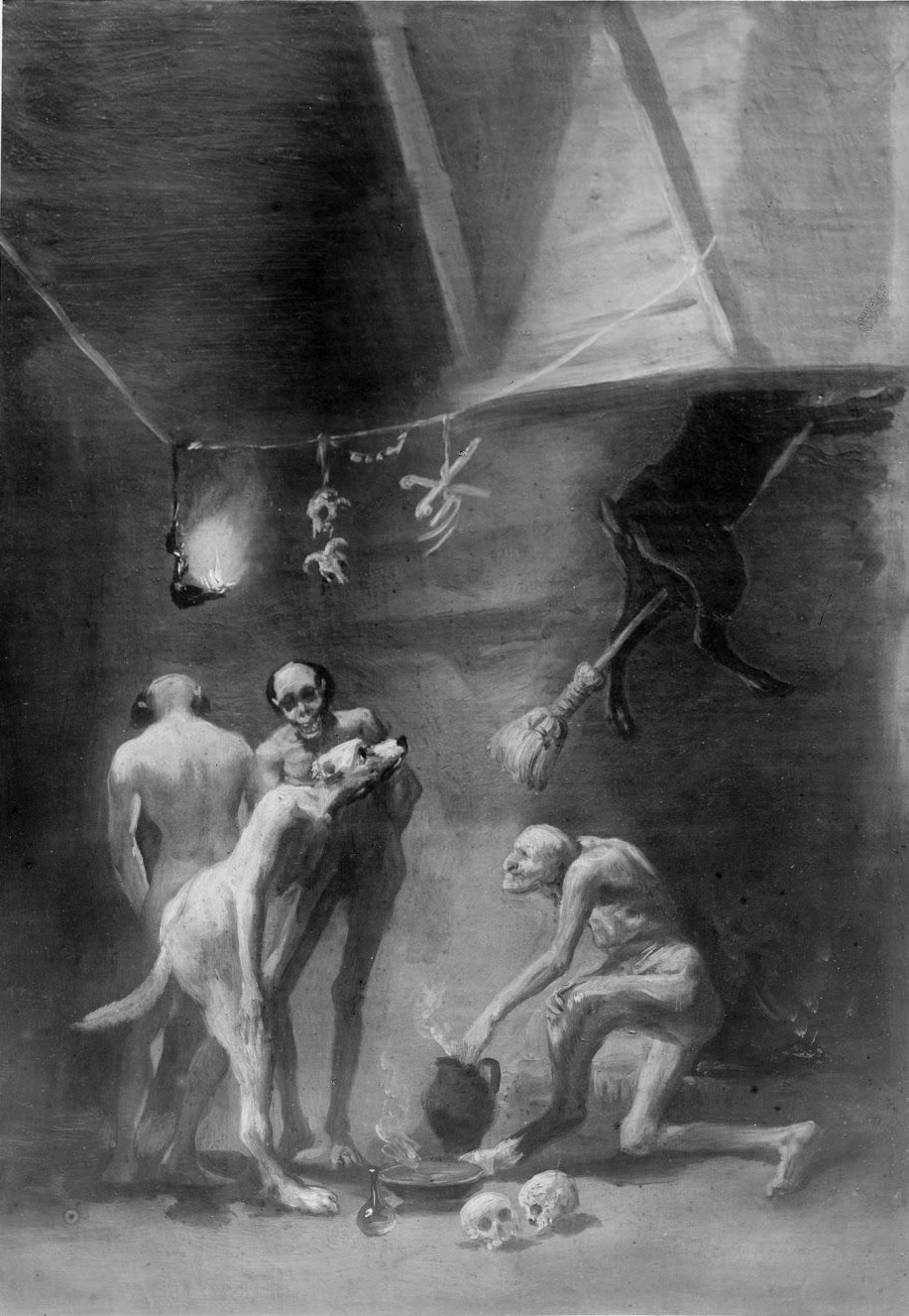
Smoke, skulls and an oil lamp, and four figures halfway between human and animal. Goya's small Witches' Kitchen shows a transformation caught in the act, painted for a duke and duchess who did not believe in witches at all.
The story behind the painting
Goya painted this small cabinet picture for the Dukes of Osuna, Pedro Téllez-Girón and María Josefa Pimentel, leading figures of the Spanish Enlightenment. It belongs to a series of six witchcraft scenes, each about 43 by 30 cm, bought to decorate their new palace at La Alameda de Osuna; a bill dated 27 June 1798 for six works on the theme of witches survives. The pictures were most likely made between 1797 and 1798, though Josep Gudiol dated the series to 1794 to 1795, after the illness that left Goya deaf. Whether the duchess suggested the theme or Goya invented it is unclear.
What to look for
An oil lamp lights a kitchen hung with bones and skulls. On the ground lie a smoking bowl, a jug, a bottle and two human skulls, while a black goat riding a broom flies up the chimney. Look at the figures: one witch watching the goat has the head, tail and one leg of a dog; another, hunched on the floor and reaching into the jug, has an old woman's face and one animal leg. They are changing into animals with the magic ointments they apply. A third has a skull-like head with sunken eyes, and the last, turned away, is urinating.
Meaning and intent
Unlike the other five paintings in the series, this one shows no conflict between humans and magic. It shows beings that mix animal and human traits. The enlightened nobles of Goya's circle did not believe in witchcraft but were fascinated by it, and Goya himself called himself a sceptic while filling his work with demons. The art historian Frank Irving Heckes argued the picture should be called Berganza and Cañizares, after Cervantes' Dialogue of Dogs, in which a witch explains to a dog how to make flying ointments. Both works show how imagination can change one's sense of reality.
Legacy
Of the six series paintings, this is the closest in style to Goya's etchings Los caprichos, a satire on Spanish society, superstition and the Inquisition that he was making at the same time; plate 67 also uses transformation into animals as satire. Manuela Mena has noted a compositional likeness to a 17th century painting from the workshop of David Teniers the Younger. According to José Luis Morales y Marín, Goya showed the series at the Royal Academy of San Fernando in 1799 as six strange caprices. Today The Witches' Kitchen is in a private collection in Mexico.
豆知識
- One of six witchcraft paintings Goya made for the Dukes of Osuna.
- Billed to the duke on 27 June 1798.
- Shows witches turning into animals.
- Now in a private collection in Mexico.
画家について
Francisco Goya (1746-1828)
同じ画家の作品: Francisco Goya
 1808年5月3日 - Francisco Goya (1814)
 裸のマハ - Francisco Goya (1800)
 我が子を食らうサトゥルヌス - Francisco Goya (1819)
 カルロス4世の家族 - Francisco Goya (1800)
 着衣のマハ - Francisco Goya (1800)
 1808年5月2日、エジプト人親衛隊との戦闘 - Francisco Goya (1814)
 犬 - Francisco Goya (1819)
 魔女の夜宴 - Francisco Goya (1820s)
関連する画家の作品
 雲海の上の旅人 - Caspar David Friedrich (c. 1818)
 楡の木のある僧院 - Caspar David Friedrich (1800s)
 民衆を導く自由の女神 - Eugène Delacroix (1830)
 サルダナパールの死 - Eugène Delacroix (1827)
 戦艦テメレール号 - J. M. W. Turner (1839)
 雨、蒸気、速度 - グレート・ウェスタン鉄道 - J. M. W. Turner (1844)
 青衣の少年 - Thomas Gainsborough (1770)
 アンドリューズ夫妻 - Thomas Gainsborough (1748)