初めてアルプスからイタリアを眺める勝利したハンニバル
Francisco Goya · 1770
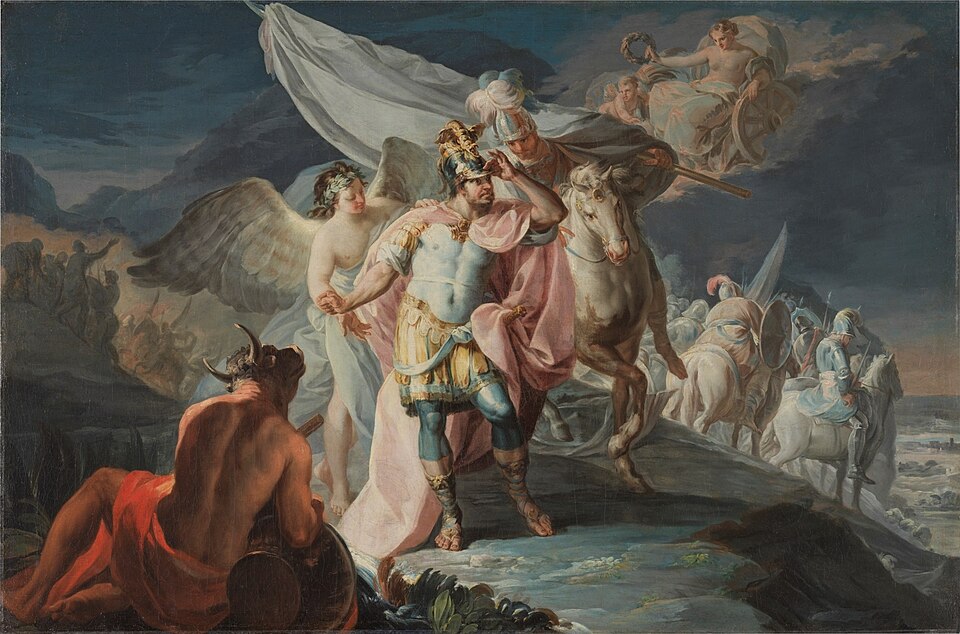
A young, unknown Goya sent this picture to a competition in Parma in 1771, signing himself a Roman. He did not win. For two centuries the canvas was credited to someone else, and only in 1993 was his name given back to it.
The story behind the painting
In 1770 and 1771 Goya was in Italy, a young painter still looking for recognition after failing twice to enter the Royal Academy of San Fernando in Madrid. In May 1770 the Academy of Fine Arts in Parma announced a competition for young artists, and Goya entered, probably helped by the diplomat José Nicolás de Azara. On 20 April 1771 he wrote from Rome to the academy's secretary, introducing himself as Francesco Goia, a Roman, pupil of the court painter Francisco Bayeu. His motto came from the Aeneid: at last we seize the shores of Italy, which ever flee us. It fitted both Hannibal and a painter trying to conquer Italy.
What to look for
The academy set the scene: Hannibal raising the visor of his helmet, turning to a winged genius who takes his hand and shows him Italy, joy and confidence in his face. Goya obeyed. Hannibal stands on a rocky outcrop, his right hand clenched, his helmet decorated with a winged dragon, the emblem of the kings of Aragon that Goya knew from Zaragoza's coat of arms. A rider leans in with a huge wind-blown flag. In the clouds Victory, also read as Fortune, arrives in her chariot with a laurel wreath, one hand on a wheel. In the foreground, back turned, a muscular figure with a bull's head pours water: the river Po.
Meaning and intent
Hannibal had just crossed the Pyrenees and the Alps, losing part of his army to cold and hard terrain. Here he sees the land he means to conquer for the first time, and his face shows awe, as if he has only now understood what he achieved. The wheel under Victory's hand may hint at the fickleness of fortune and Hannibal's tragic end, a detail borrowed from Corrado Giaquinto. Four painters competed, and the work received six positive votes and an honourable mention praising Goya's ease with the brush and Hannibal's majesty, but the jury disliked the colours and composition. The gold medal went to Paolo Borroni, a local pupil of a jury member.
Legacy
It is the oldest documented work by Goya. A preparatory sketchbook in the Prado, the Italian Notebook, holds five drawings linked to it. For a long time the canvas, in the collection of the Selgas-Fagalde Foundation, was wrongly attributed to Corrado Giaquinto; Goya's authorship was confirmed only in 1993. Since April 2021 it belongs to the Prado, and a copy is in a private collection in Barcelona. Not every critic accepts it as authentic, despite the sketches and X-ray studies. Goya's name appeared in the Diario Ordinario de Roma in 1771 and in the Mercure de France in 1772, which wrongly said he had won second prize.
豆知識
- Painted for a competition of the Parma academy in 1770-1771.
- Goya's oldest documented work.
- Attributed to Corrado Giaquinto until 1993.
- Part of the Prado collection since April 2021.
画家について
Francisco Goya (1746-1828)
同じ画家の作品: Francisco Goya
 1808年5月3日 - Francisco Goya (1814)
 裸のマハ - Francisco Goya (1800)
 我が子を食らうサトゥルヌス - Francisco Goya (1819)
 カルロス4世の家族 - Francisco Goya (1800)
 着衣のマハ - Francisco Goya (1800)
 1808年5月2日、エジプト人親衛隊との戦闘 - Francisco Goya (1814)
 犬 - Francisco Goya (1819)
 魔女の夜宴 - Francisco Goya (1820s)
関連する画家の作品
 雲海の上の旅人 - Caspar David Friedrich (c. 1818)
 楡の木のある僧院 - Caspar David Friedrich (1800s)
 民衆を導く自由の女神 - Eugène Delacroix (1830)
 サルダナパールの死 - Eugène Delacroix (1827)
 戦艦テメレール号 - J. M. W. Turner (1839)
 雨、蒸気、速度 - グレート・ウェスタン鉄道 - J. M. W. Turner (1844)
 青衣の少年 - Thomas Gainsborough (1770)
 アンドリューズ夫妻 - Thomas Gainsborough (1748)