The Veil of Veronica
エル・グレコ · 1570s
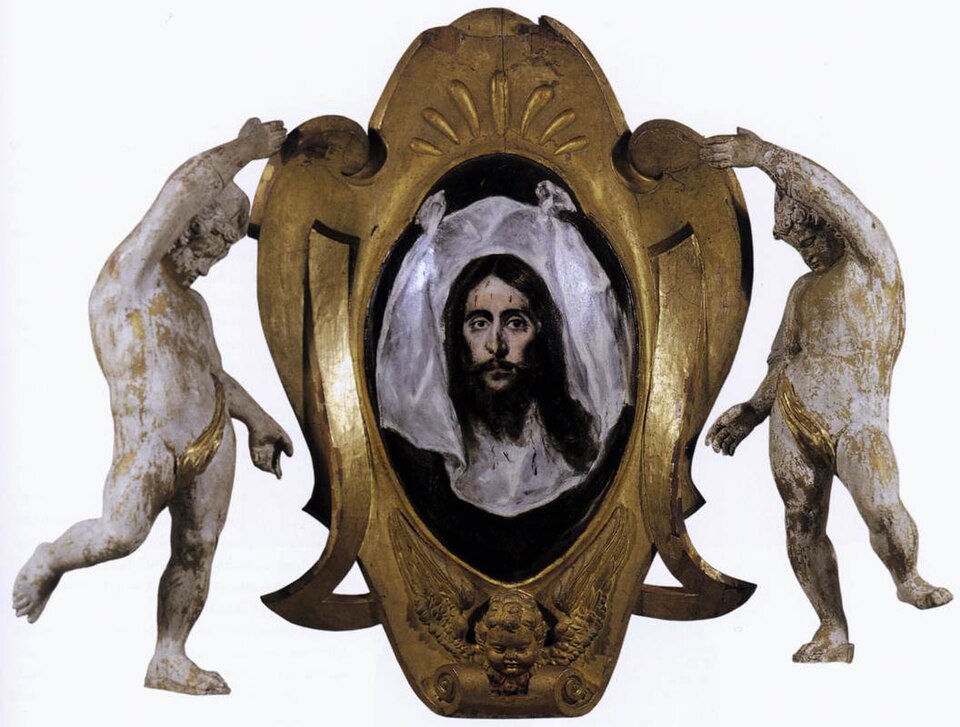
Only a white cloth, and on it the face of Christ, calm and looking straight at you. El Greco painted it for the high altar of a convent in Toledo, where it hung for nearly four centuries before the nuns sold it in 1964.
The story behind the painting
The image of the Holy Face became popular at the end of the Middle Ages. On the way to Calvary, a woman, later identified as Veronica, offered Jesus a white cloth, and his face remained fixed on it. El Greco painted this canvas between 1577 and 1579 for the main altarpiece of Santo Domingo el Antiguo in Toledo. Documents show that a coat of arms had first been planned for the top of the altarpiece instead, so the idea changed while it was being built. Here, as in two other versions, he painted only the cloth; in two more he added Veronica holding it.
What to look for
The canvas itself is oval, about 76 by 55 cm, set in a wooden frame of about 90 by 130 cm. It was painted on a medallion held by two angels, carved by Juan Bautista Monegro after El Greco's design. The face is frontal and serene, with a penetrating gaze, and it looks far more real than the cloth on which it appears. The features are rather large but beautiful and harmonious. Both the long hair and the beard are parted in two. Short, quick, light strokes over a dark ground give the sense of relief, and soft modelling of the skin still creates contrasts and shadows.
Meaning and intent
The Holy Face sat at the geometric centre of the high altar, between The Assumption of the Virgin below and The Trinity above. Some theologians of the time held that the Virgin contemplated the Passion of Christ as she rose to heaven. The Spanish article suggests that this face may illustrate that idea, perhaps taking the place of a Crucifixion, which would help explain Mary's gesture and gaze in the Assumption below it. The work also shows how El Greco could join his Byzantine background, archaic and spiritual, with the naturalism and expressiveness of the Christian West of his day.
Legacy
The painting stayed in the convent for close to four centuries. In 1961 the wooden cartouches on which the image was painted were removed, and in 1964 the nuns sold it. A copy took its place in the altarpiece, so visitors to Santo Domingo el Antiguo today see a replacement where the original once hung. The work is catalogued as number 6 A in Harold Wethey's catalogue raisonné of El Greco and as 23 B in Tiziana Frati's. Wikidata gives its size as 90 by 130 cm, which matches the frame; the oval canvas inside is smaller.
豆知識
- Painted between 1577 and 1579 for Santo Domingo el Antiguo, Toledo.
- Shows only the cloth, without the figure of Veronica.
- Sold by the nuns in 1964 and replaced by a copy.
- The oval canvas measures about 76 by 55 cm.
Wikipedia (Spanish) · Wikidata
画家について
エル・グレコ (1541-1614)
同じ画家の作品: エル・グレコ
 オルガス伯の埋葬 - El Greco (1586)
 トレドの風景 - El Greco (1596)
 聖衣剥奪 - El Greco (1570s)
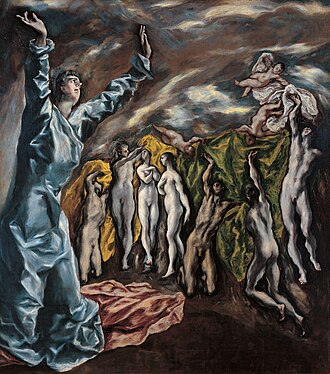 黙示録第5の封印 - El Greco (1610)
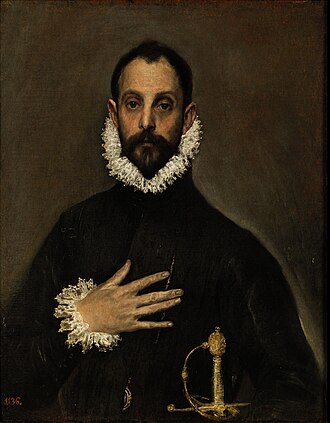 胸に手を置く騎士 - El Greco (1580)
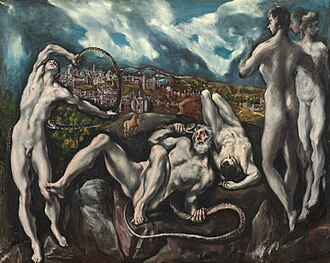 ラオコーン - El Greco (1610s)
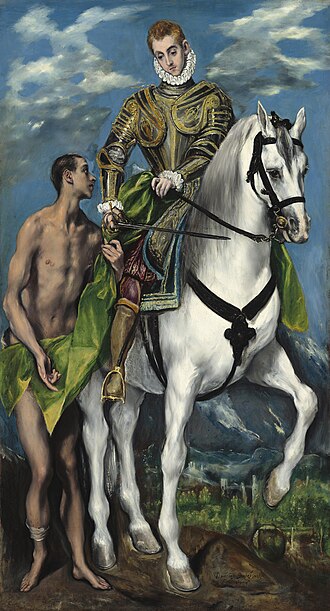 聖マルティヌスと乞食 - El Greco (1597)
 羊飼いの礼拝 - El Greco (1612)
関連する画家の作品
 カナの婚礼 - Paolo Veronese (1560s)
 レヴィ家の饗宴 - Paolo Veronese (1573)
 最後の晩餐 - Jacopo Tintoretto (1563)
 奴隷を解放する聖マルコ - Jacopo Tintoretto (1540s)
 ウルビーノのヴィーナス - Titian (1538)
 聖母被昇天 - Titian (1510s)
 エマオの晩餐 - Caravaggio (1601)
 聖マタイの召命 - Caravaggio (1609)
 大使たち - Hans Holbein the Younger (1533)
 墓の中のキリストの屍 - Hans Holbein the Younger (1520s)