The Two Foscari
ウジェーヌ・ドラクロワ · 1855
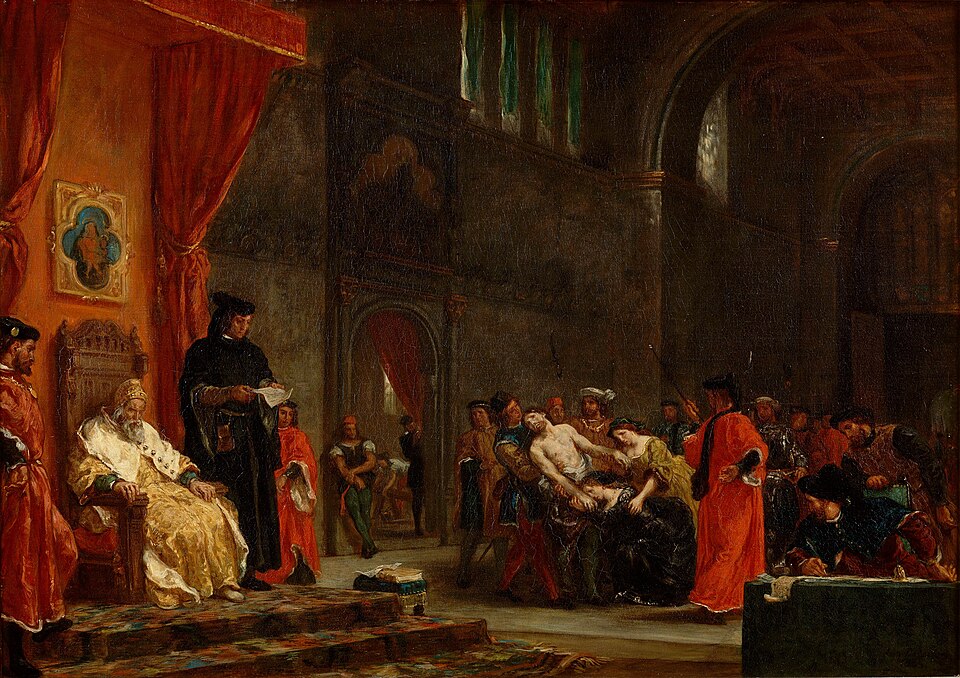
An old doge must sit and hear his last son sentenced to exile, the young man bare-chested, his wife thrown at his feet. Delacroix struggled with this Venetian tragedy for eight years before he could write that he was avenged.
The story behind the painting
Delacroix's Journal mentions the work as early as 1847: in February he notes the composition is clarified, and he tries various sketches until March. Then there is no trace until 13 May 1854, when he asks Adrien Dauzats to help him with the picture; Dauzats may have worked on the architecture. On 7 February 1855 Delacroix wrote that in less than two weeks he had worked enormously, and that he was now avenged of the Foscari. The painting was shown at the Exposition Universelle of 1855, where critics praised it, notably Eugène Loudun. The canvas measures about 93 by 132 cm.
What to look for
The scene comes from the story of Francesco Foscari, Doge of Venice from 1423 to 1457. After many wars, three of his sons died in battle. His last son was convicted of treason, confessed under torture in 1445, and was condemned to perpetual banishment. The painting shows the moment when the doge must attend the reading of the sentence in a great hall of the Doge's Palace. Look for the son standing before his father, bare-chested, and his wife rushing to throw herself at his feet. To the right of the condemned man stand men of law and soldiers, the cold machinery of the state around a family's grief.
Meaning and intent
The heart of the picture is a father bound by his office. The doge is the head of the very state that punishes his son, and he can only sit and listen. The subject was a famous tragedy in the nineteenth century: Lord Byron wrote a drama on it in 1821 while in Italy, Giuseppe Verdi made it into his opera I due Foscari, first performed in 1844, and Francesco Hayez painted the same theme in 1852, a work now in the Palazzo Pitti. Delacroix's version joins this chain of retellings, and his long struggle with it, ending in that cry of revenge in his Journal, shows how much it cost him.
Legacy
After the exhibition the painting entered the Schwabacher collection, then that of Jean-Baptiste Faure. When part of Faure's collection was sold in June 1873, it was acquired by the Duke of Aumale. He first hung it in the Tribune room at the Château de Chantilly, facing his collection of works by Ingres. It was lent exceptionally in 1885 to the Delacroix retrospective organised by Ernest Meissonier at the École des Beaux-Arts. It was then installed permanently in the Grande Galerie of the Musée Condé in Chantilly, where it remains today.
豆知識
- First mentioned in Delacroix's Journal in 1847, finished in 1855.
- Shown at the Exposition Universelle of 1855.
- Shows Doge Francesco Foscari hearing his son's sentence.
- In the Musée Condé, Chantilly, since the Duke of Aumale bought it in 1873.
画家について
ウジェーヌ・ドラクロワ (1798-1863)
男性 · 歴史画 · ロマン主義 · 集団 · コンデ美術館 · 男性の上半身裸 · 玉座
同じ画家の作品: ウジェーヌ・ドラクロワ
 民衆を導く自由の女神 - Eugène Delacroix (1830)
 サルダナパールの死 - Eugène Delacroix (1827)
 キオス島の虐殺 - Eugène Delacroix (1824)
 ダンテの小舟 - Eugène Delacroix (1822)
 アルジェの女たち - Eugène Delacroix (1834)
 ミソロンギの廃墟に立つギリシア - Eugène Delacroix (1826)
 Portrait of Frédéric Chopin and George Sand - Eugène Delacroix (1837)
 メディア - Eugène Delacroix (1836)
関連する画家の作品
 1808年5月3日 - Francisco Goya (1814)
 裸のマハ - Francisco Goya (1800)
 雲海の上の旅人 - Caspar David Friedrich (c. 1818)
 楡の木のある僧院 - Caspar David Friedrich (1800s)
 戦艦テメレール号 - J. M. W. Turner (1839)
 雨、蒸気、速度 - グレート・ウェスタン鉄道 - J. M. W. Turner (1844)
 青衣の少年 - Thomas Gainsborough (1770)
 アンドリューズ夫妻 - Thomas Gainsborough (1748)