The Stream at Puits-Noir
ギュスターヴ・クールベ · 1860s
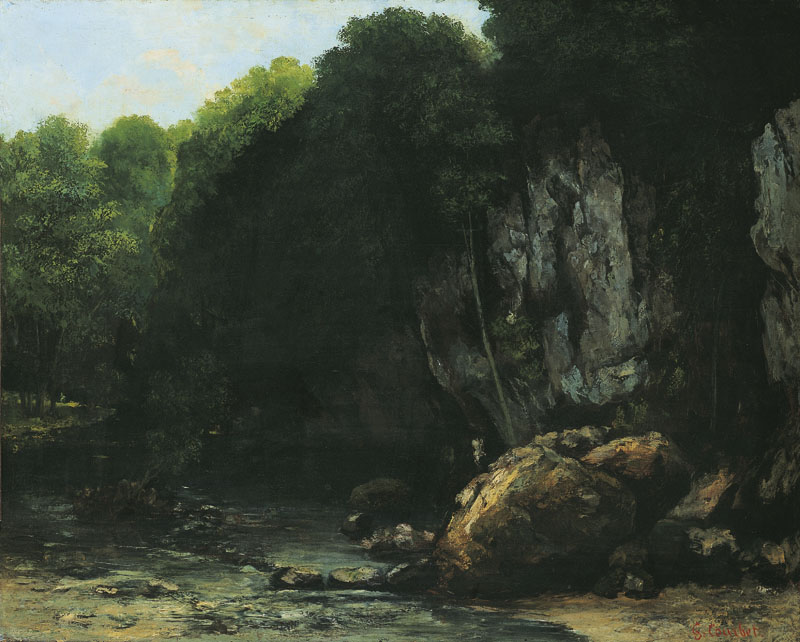
A dark stream slips through a narrow gorge near Ornans, under a cliff so massive it almost hides the sky. Courbet painted this place again and again, and here he closes the view on purpose.
The story behind the painting
Courbet is best known for his large realist compositions and his role in the Paris Commune, yet landscapes make up nearly two thirds of his work. This canvas belongs to his long series on his home region, Franche-Comté. It was painted during a prosperous stretch of his career, between 1856 and 1870, when he showed regularly at the Salon and his landscapes found real success. The Puits-Noir is a site near Ornans in the Doubs, where the Brême stream runs through a dark, narrow hollow amid thick vegetation. Courbet painted it more than fifteen times. Part of his work was done on the spot, with his donkey Gérôme carrying his materials.
What to look for
The Brême fills the foreground, overhung by an imposing cliff that takes up most of the canvas and leaves only a small corner of sky at the upper left. The palette is reduced to shades of green and grey, laid directly with the palette knife and the brush in thick touches over a dark ground. The dense, layered paint makes the colours opaque and gives weight to the rock and the lush plants. The horizon is blocked by the front of the cliff, so there is no depth to escape into, and light struggles to filter through. The signature, G. Courbet, is in red at the lower right.
Meaning and intent
Courbet broke with the illusionist rules of his teachers and of the Barbizon painters he was close to, to render his own sense of the place. The central opacity draws the viewer in while screening the gaze. Officially the father of realism, he also wanted to show a communion with nature, a Romantic legacy of his teacher Antoine-Jean Gros. Pierre Georgel wrote that the Puits-Noir held an irrational pull on Courbet, and wondered whether it reminded him of the blind, enclosed space of the womb. The source links these secret landscapes with his nudes, and compares their structure with The Origin of the World, painted in 1866.
Legacy
Henri Béraldi gave the painting to the Musée des Augustins in Toulouse in 1912, explaining that his father in law had bought it in 1871, after the Commune. It was first hung in the great gallery under the title Landscape: the Puits Noir, and is now in the Red Room with nineteenth and early twentieth century paintings. It was relined and cleaned in September 1969. Other versions of the site are in the National Gallery of Art in Washington, the Musée d'Orsay, Vienna, Montpellier, Baltimore, Chicago, the Rijksmuseum and Besançon. Cézanne praised Courbet for bringing into painting the smell of wet leaves and the mossy walls of the forest.
豆知識
- Courbet painted the Puits-Noir site near Ornans more than fifteen times.
- Painted with the palette knife and brush in greens and greys over a dark ground.
- Given to the Musée des Augustins, Toulouse, by Henri Béraldi in 1912.
- Bought by Béraldi's father in law in 1871, after the Commune.
画家について
ギュスターヴ・クールベ (1819-1877)
ランドスケープ · 広葉樹 · オーギュスタン美術館 · 流れ
同じ画家の作品: ギュスターヴ・クールベ
 世界の起源 - Gustave Courbet (1866)
 オルナンの埋葬 - Gustave Courbet (2020)
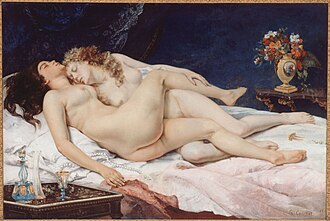 眠り - Gustave Courbet (1866)
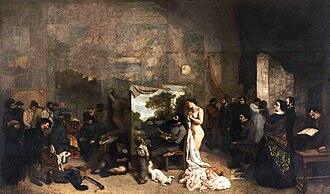 画家のアトリエ - Gustave Courbet (1855)
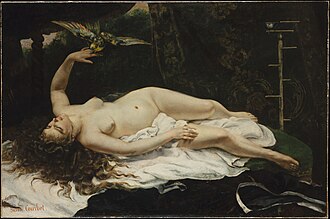 女とオウム - Gustave Courbet (1866)
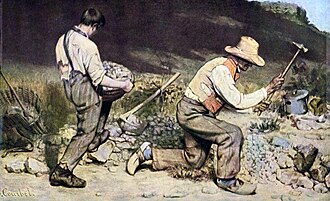 石割人夫 - Gustave Courbet (1850)
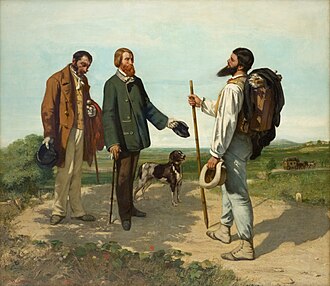 出会い または こんにちはクールベさん - Gustave Courbet (1854)
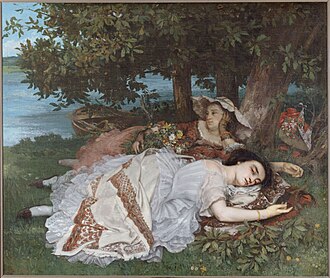 セーヌ川辺のお嬢さんたち - Gustave Courbet (1857)
 印象・日の出
 睡蓮
 草上の昼食
 オランピア
 風が強まる
 濃霧警報
 星月夜
 夜のカフェテラス