The Poor at the Fountain
Francisco Goya · 1786
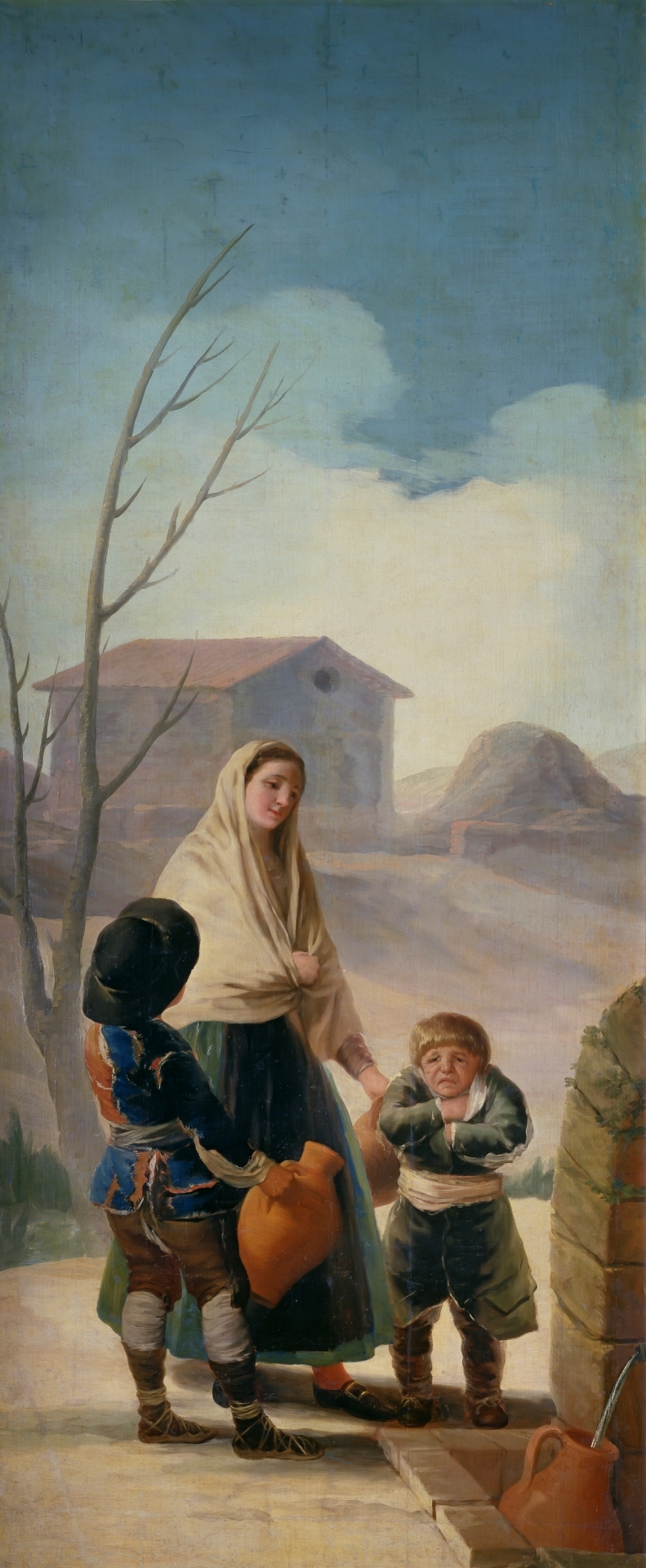
On a cold winter day a woman and two children gather at a fountain with their water jugs, and the smallest child is crying. Goya painted this tall, quiet scene as a design for a royal tapestry, then it vanished for decades.
The story behind the painting
Goya painted The Poor at the Fountain between 1786 and 1787 as part of his fifth series of tapestry cartoons. All the works in this series were meant for the dining room of the Prince of Asturias, the future Charles IV, and his wife Maria Luisa of Parma, at the Palace of El Pardo. The series also included The Flower Girls, The Threshing Floor, The Grape Harvest, The Snowstorm and The Injured Mason, among others. Wikidata gives the date as 1786, while the French Wikipedia says 1786 to 1787.
What to look for
A woman and two children have come with their jugs to fetch water at a fountain. A small house in the background hints that a town is near. The scene is set in winter: the shadows are weak, the tree is bare and the little child seems to be cold. The tall, narrow canvas measures 277 by 115 cm. Look at the crying child, the best-realised figure, and the sketched tree without branches that tells us the season. The loose brushstrokes and coloured shadows seem to look ahead to Impressionism.
Meaning and intent
The title was given during the Romantic period, but nothing shows that these people are poor. The woman wears a shawl and stockings with silver buckles, and the crying child may simply be having a tantrum about carrying a jug. The same feeling of cold appears in The Injured Mason, of similar size; the two scenes are so alike that some suggest the figures belong to the same family. This is not a warm folk scene, but it fits the social measures King Charles III had adopted to protect poor workers. It was also hung beside The Snowstorm, with which it can be compared.
Legacy
The canvas was considered lost until 1869, when Gregorio Cruzada Villaamil found it in the basement of the Royal Palace of Madrid. Orders of 19 January and 9 February 1870 sent it to the Museo del Prado, and it first appeared in the museum's catalogue in 1876. It is displayed in room 94. The source praises Goya's masterly solution to this composition and the delicacy of its figures, which make it one of his most convincing pictures of real life.
豆知識
- Painted in 1786 to 1787 for the Palace of El Pardo.
- Part of Goya's fifth series of tapestry cartoons.
- Rediscovered in the Royal Palace basement in 1869.
- In the Museo del Prado since 1870.
画家について
Francisco Goya (1746-1828)
同じ画家の作品: Francisco Goya
 1808年5月3日 - Francisco Goya (1814)
 裸のマハ - Francisco Goya (1800)
 我が子を食らうサトゥルヌス - Francisco Goya (1819)
 カルロス4世の家族 - Francisco Goya (1800)
 着衣のマハ - Francisco Goya (1800)
 1808年5月2日、エジプト人親衛隊との戦闘 - Francisco Goya (1814)
 犬 - Francisco Goya (1819)
 魔女の夜宴 - Francisco Goya (1820s)
関連する画家の作品
 雲海の上の旅人 - Caspar David Friedrich (c. 1818)
 楡の木のある僧院 - Caspar David Friedrich (1800s)
 民衆を導く自由の女神 - Eugène Delacroix (1830)
 サルダナパールの死 - Eugène Delacroix (1827)
 戦艦テメレール号 - J. M. W. Turner (1839)
 雨、蒸気、速度 - グレート・ウェスタン鉄道 - J. M. W. Turner (1844)
 青衣の少年 - Thomas Gainsborough (1770)
 アンドリューズ夫妻 - Thomas Gainsborough (1748)