ポンテホス侯爵夫人
Francisco Goya · 1786
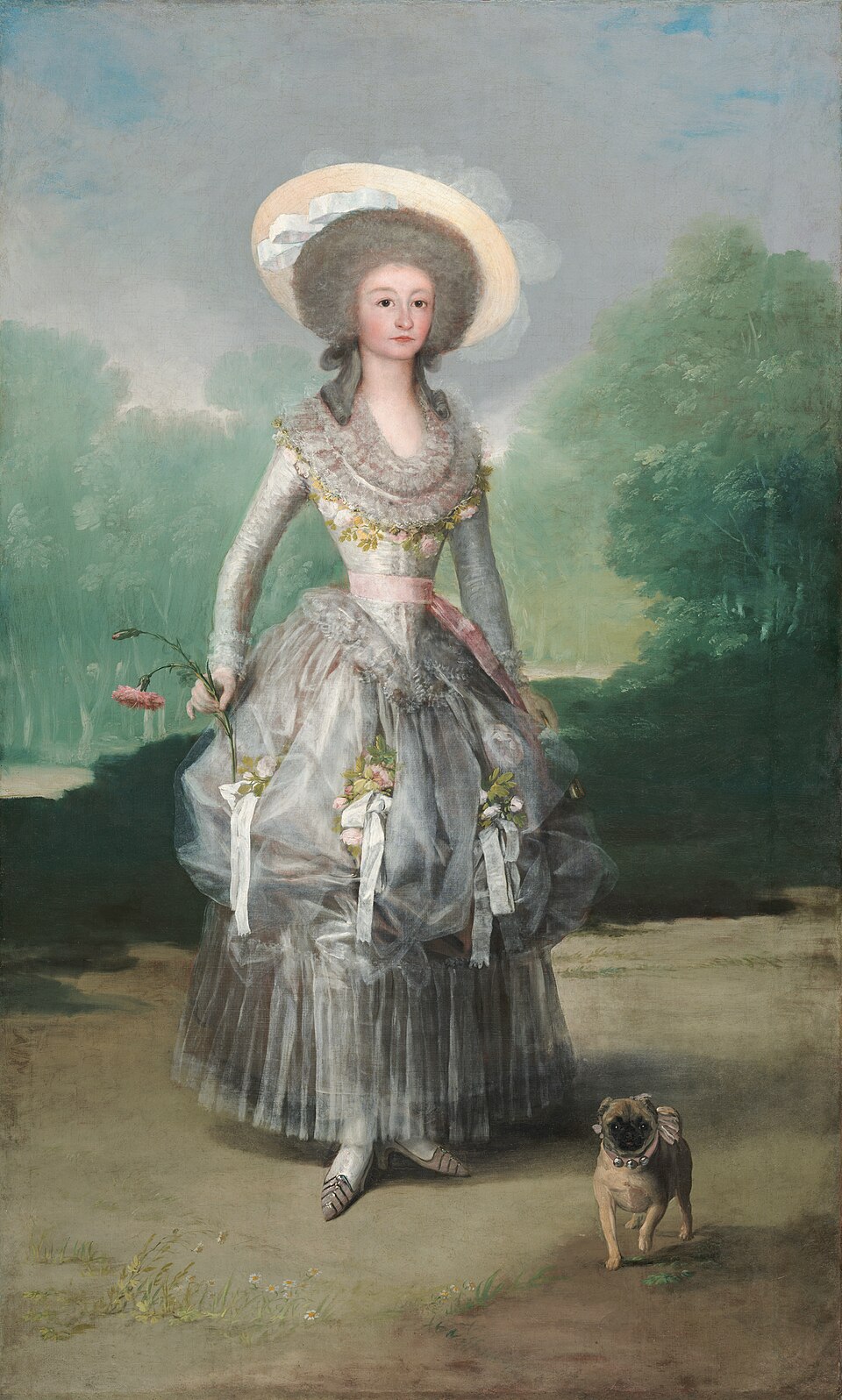
A young noblewoman dressed as a shepherdess stands life-size in a soft landscape, a pink carnation in her hand, while a little dog with bells marches straight toward us. Goya painted her around 1786, shortly after her wedding.
The story behind the painting
María Ana de Pontejos y Sandoval was born in 1762 and died on 18 July 1834, and she was a patron of Goya. In 1786, at twenty-four, she married the brother of the Count of Floridablanca, a minister at the court of Charles III, and her husband was then Spain's ambassador to Portugal. The portrait was made soon after the marriage. That same year Goya had become a painter to the court of Charles III, and later worked for Charles IV. According to the French Wikipedia article, the portrait was commissioned without any contact between the sitter and the painter.
What to look for
The young woman walks through a landscape in a tight dress with a pink sash at the very centre of the canvas, which draws the eye straight to her. The intricate skirt is lined with a filmy petticoat that lets her legs be guessed at. Her face is still, like an actor's mask, framed by an elaborate hairstyle and a round hat whose feathers melt into the clouds. The grey tones of the dress, alternating dark and light, play against the delicate colours of the clear sky. Look at the background: quick, fleeting brushstrokes, while the figure is carefully prepared and glazed.
Meaning and intent
The carnation she holds was a popular emblem of love in the eighteenth century and also a symbol of the married wife, fitting for a new bride. The shepherdess portrait belonged to the Rococo fashion inspired in part by Marie Antoinette, and the hair, round hat and flowered dress seem drawn from French taste. Goya used colours close to those of his tapestry cartoons of the time, such as The Straw Manikin. The stillness of the marquesa, like a tapestry, is set against the little dog with a pink bow and bells, heading decisively toward the viewer.
Legacy
Small lapdogs had gradually entered princely courts in the seventeenth century, and by the eighteenth they were in vogue, especially in France. Many noble portraits across Europe include one, for example the portrait of Anna Amalia of Brunswick, where the dog serves as an accessory. Goya's mastery here, mixing loose and meticulous painting, recalls the English painter Thomas Gainsborough. He went on to paint a series in the same style, such as The Family of the Duke of Osuna of 1789. The portrait is now in the National Gallery of Art in Washington, part of the Andrew W. Mellon collection.
豆知識
- Painted around 1786, soon after the sitter's marriage.
- The sitter, María Ana de Pontejos, was a patron of Goya.
- The pink carnation was an emblem of love and of the married wife.
- Now in the National Gallery of Art, Washington.
画家について
Francisco Goya (1746-1828)
肖像 · ナショナル・ギャラリー・オブ・アート · Andrew W. Mellon collection
同じ画家の作品: Francisco Goya
 1808年5月3日 - Francisco Goya (1814)
 裸のマハ - Francisco Goya (1800)
 我が子を食らうサトゥルヌス - Francisco Goya (1819)
 カルロス4世の家族 - Francisco Goya (1800)
 着衣のマハ - Francisco Goya (1800)
 1808年5月2日、エジプト人親衛隊との戦闘 - Francisco Goya (1814)
 犬 - Francisco Goya (1819)
 魔女の夜宴 - Francisco Goya (1820s)
関連する画家の作品
 雲海の上の旅人 - Caspar David Friedrich (c. 1818)
 楡の木のある僧院 - Caspar David Friedrich (1800s)
 民衆を導く自由の女神 - Eugène Delacroix (1830)
 サルダナパールの死 - Eugène Delacroix (1827)
 戦艦テメレール号 - J. M. W. Turner (1839)
 雨、蒸気、速度 - グレート・ウェスタン鉄道 - J. M. W. Turner (1844)
 青衣の少年 - Thomas Gainsborough (1770)
 アンドリューズ夫妻 - Thomas Gainsborough (1748)