昼食
Claude Monet · 1873
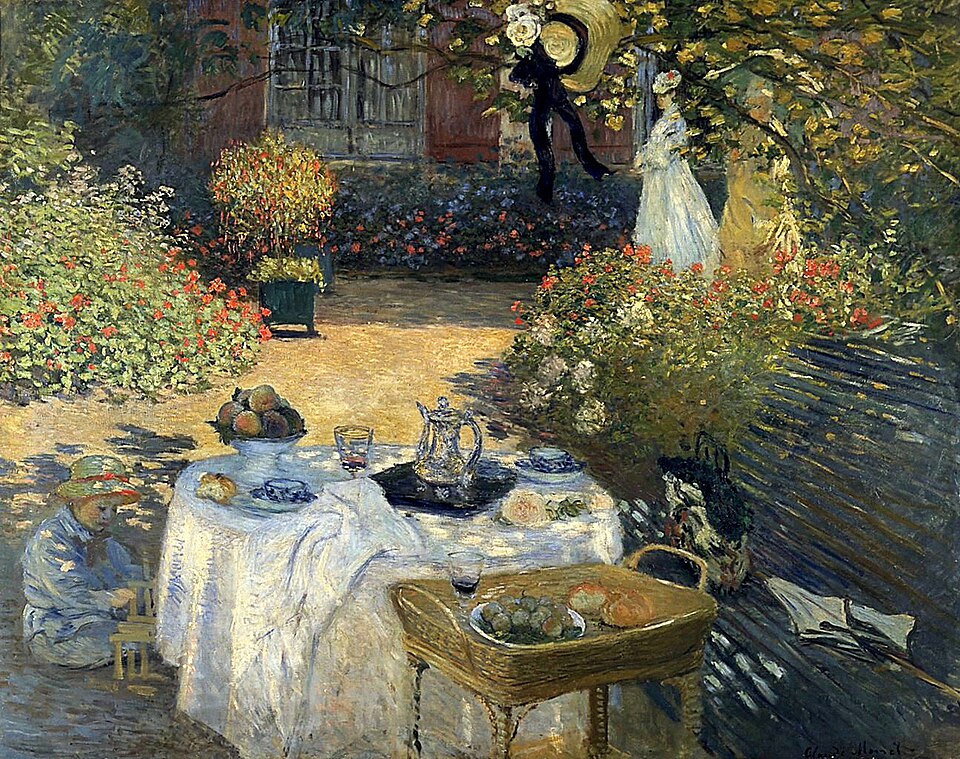
Lunch is over, but nobody has cleared the table. A little boy plays in the shade, a hat hangs in a tree, a parasol lies forgotten on a bench. Monet turned an ordinary family afternoon into a garden full of light.
The story behind the painting
After 1870 many Parisians began planting flower gardens, a pastime once reserved for the rich aristocracy, and several Impressionist painters joined them. In 1871 Monet rented a house with a garden at Argenteuil, northwest of Paris, through Manet's connections. He would paint his own gardens for the rest of his life, long after many colleagues had dropped the theme, and this canvas is one of the earliest examples. French Wikipedia dates it 1873 to 1874, while Wikidata gives 1873. Unusually for him, Monet painted it not outdoors but in the studio, probably from charcoal sketches that are now lost.
What to look for
Monet's son Jean, born in 1867, sits beside the table still playing with bits of wood in the shade of the garden path. A hat hangs in the tree, a bag and a parasol have been left on the bench, and in the background two women stroll. The real subject, despite the title, is the flowering garden, built from strong contrasts of red and green. Small dabs suggest large bushes of fuchsias, geraniums and roses. Patches of early afternoon sun fall through the trees onto the women's dresses, the path, the coffee pot, the tablecloth, the slats of the bench and Jean's clothes.
Meaning and intent
The canvas, 160 by 201 cm, is one of the few large works Monet painted after 1870. It was first meant as a decorative panel for the chateau of his patron Ernest Hoschedé at Montgeron, which is why Monet showed it in 1876, at the second Impressionist exhibition, under the title Decorative Panel. The two women in the background may well be Alice, Hoschedé's wife, and Camille Doncieux, Monet's wife, who were close friends at the time. The picture is praised for creating an almost perfectly harmonious whole from lines and strokes that look random, catching the mood of a perfect afternoon moment.
Legacy
Camille died in 1879. After Ernest Hoschedé died in 1891, Monet and Alice married, so the two women walking together in the garden carry a quiet echo of the family to come. The painting belonged to the collection of Gustave Caillebotte, a fellow painter, from 1878 to 1894. Today it is shown at the Musée d'Orsay in Paris, where it has hung since 1986 on loan from the Louvre. It stands at the start of a long line of garden pictures that ends with Monet's Water Lilies at Giverny, where he settled as an owner of his own house and garden from 1890.
豆知識
- Painted in Monet's garden at Argenteuil, but in the studio.
- Shown in 1876 as Decorative Panel.
- Owned by Gustave Caillebotte from 1878 to 1894.
- At the Musée d'Orsay since 1986, on loan from the Louvre.
画家について
Claude Monet (1840-1926)
風俗美術 · 風景画 · 印象派 · オルセー美術館 · 帽子 · テーブル · 庭園 · 子供 · 日傘 · アルジャントゥイユ · ベンチ
同じ画家の作品: Claude Monet
 印象・日の出 - Claude Monet (1872)
 睡蓮 - Claude Monet (1906)
 日傘をさす女 - Claude Monet (1875)
 サン=タドレスのテラス - Claude Monet (1867)
 庭の女たち - Claude Monet (1866)
 かささぎ - Claude Monet (1868)
 庭の女 - Claude Monet (1867)
 草上の昼食 - Claude Monet (1866)
関連する画家の作品
 戦艦テメレール号 - J. M. W. Turner (1839)
 雨、蒸気、速度 - グレート・ウェスタン鉄道 - J. M. W. Turner (1844)
 世界の起源 - Gustave Courbet (1866)
 オルナンの埋葬 - Gustave Courbet (2020)
 草上の昼食 - Édouard Manet (1863)
 オランピア - Édouard Manet (1863)
 ムーラン・ド・ラ・ギャレットの舞踏会 - Pierre-Auguste Renoir (1876)
 舟遊びの昼食 - Pierre-Auguste Renoir (1881)
 星月夜 - Vincent van Gogh (1889)
.jpg) 夜のカフェテラス - Vincent van Gogh (1888)
夜のカフェテラス - Vincent van Gogh (1888) 我々はどこから来たのか 我々は何者か 我々はどこへ行くのか - Paul Gauguin (1897-1898)
%201889.jpg) 黄色いキリスト - Paul Gauguin (1889)
黄色いキリスト - Paul Gauguin (1889)