庭の女
Claude Monet · 1867
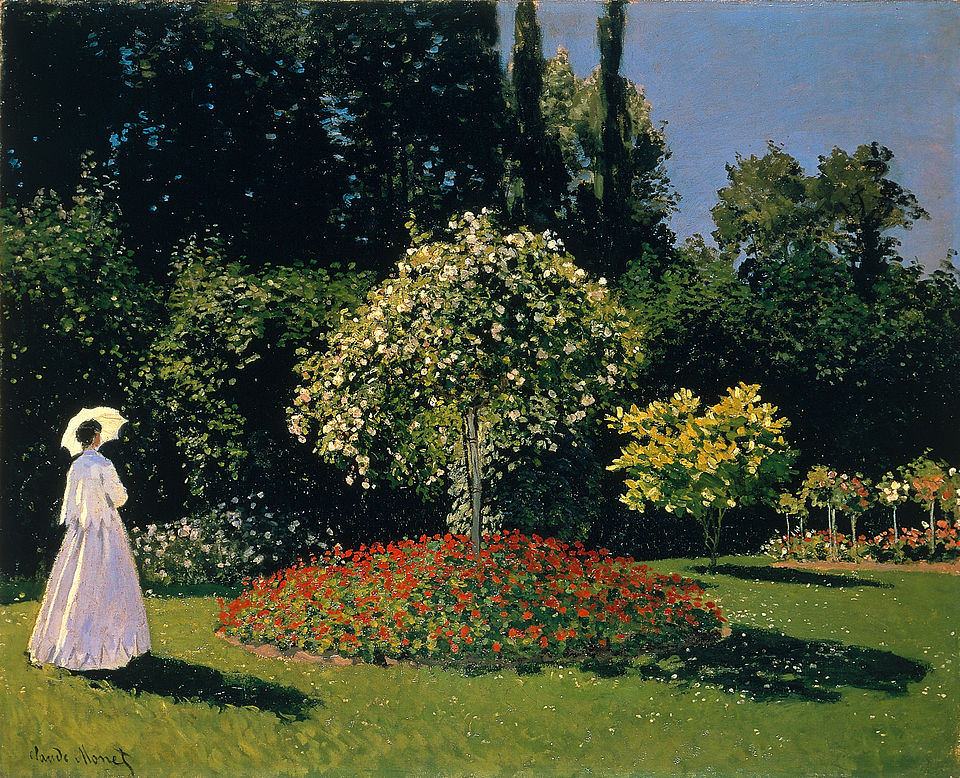
A woman in a brilliant white dress stands in a sunlit garden, framed by beds of red flowers. Painted by a 26-year-old Claude Monet, it hints at the gardens that would fill his whole life.
The story behind the painting
Monet began Woman in the Garden when he was a young man of 26. Wikipedia says the painting was begun in 1866, while Wikidata dates it to 1867, so it is best thought of as a work of those years. The woman is Jeanne-Marguerite Lecadre, young wife of Monet's well-to-do cousin Paul-Eugène Lecadre. The Lecadres lived in Le Havre and had a country house, Le Coteau, in nearby Sainte-Adresse, and it was in that garden, during a short visit, that Monet painted the picture. He worked en plein air, outdoors, in oil on a fairly large canvas of 82 by 101 cm. X-ray analysis has revealed that he painted it over an earlier picture.
What to look for
Three principal elements give the garden its order. First, find Jeanne-Marguerite herself, standing with her parasol. Then look to the center, where a flowering rose bush rises from a bed of bright red flowers. Finally, glance to the right, where another flowering bush balances the scene. Her bright white dress is the brightest note in the picture, contrasting vividly with the reds, pinks and greens of the plants and trees around her. Notice too how composed and detailed everything feels: the garden is laid out with a calm clarity, quite different from the looser, more broken style for which Monet was later celebrated.
Meaning and intent
Woman in the Garden is less a formal portrait than an image of a person within nature. Wikidata even classes it as landscape painting, listing among its subjects the dress, flowers, grass, trees, umbrella and woman. Jeanne-Marguerite is part of the garden's design, one of its three anchoring forms, and the white of her dress sets off the color all around her. The painting's subject foreshadowed Monet's lifelong passion for painting flowers and gardens in a natural setting. Seen this way, it is a small promise from a young artist: a sunny family garden at Sainte-Adresse that already points toward the gardens he would return to again and again.
Legacy
The painting is linked by Wikidata to Impressionism, the movement Monet would help to define, even though its careful, detailed style differs from his later Impressionist works. That contrast is part of its charm, letting us see Monet before his mature manner, already drawn to light, color and flowers. Woman in the Garden now belongs to the Hermitage Museum in St Petersburg, Russia. Visitors who find it there meet both a private family moment at Le Coteau and an early sign of the passion for gardens and flowers that would guide Monet's art for the rest of his life.
豆知識
- Wikipedia says it was begun in 1866; Wikidata dates it 1867.
- The sitter is Jeanne-Marguerite Lecadre, wife of Monet's cousin.
- Painted en plein air at Le Coteau in Sainte-Adresse, over an earlier picture revealed by X-ray.
- Now in the Hermitage Museum, St Petersburg.
画家について
Claude Monet (1840-1926)
女性 · 風景画 · 印象派 · 木 · ドレス · 花 · エルミタージュ美術館 · サン=タドレス · 傘
同じ画家の作品: Claude Monet
 印象・日の出 - Claude Monet (1872)
 睡蓮 - Claude Monet (1906)
 日傘をさす女 - Claude Monet (1875)
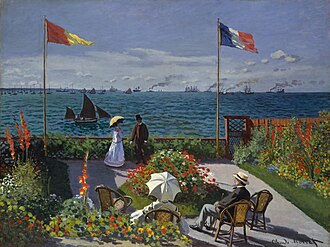 サン=タドレスのテラス - Claude Monet (1867)
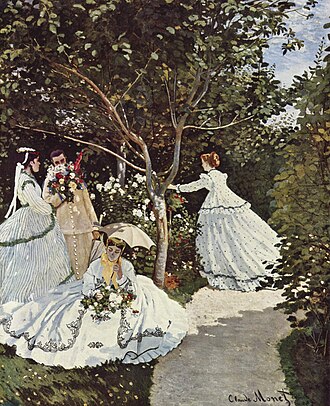 庭の女たち - Claude Monet (1866)
 かささぎ - Claude Monet (1868)
 草上の昼食 - Claude Monet (1866)
 グルヌイユの海水浴場 - Claude Monet (1869)
 草上の昼食
草上の昼食 オランピア
オランピア ムーラン・ド・ラ・ギャレットの舞踏会
 舟遊びの昼食
 星月夜
星月夜.jpg) 夜のカフェテラス
夜のカフェテラス