The incantation
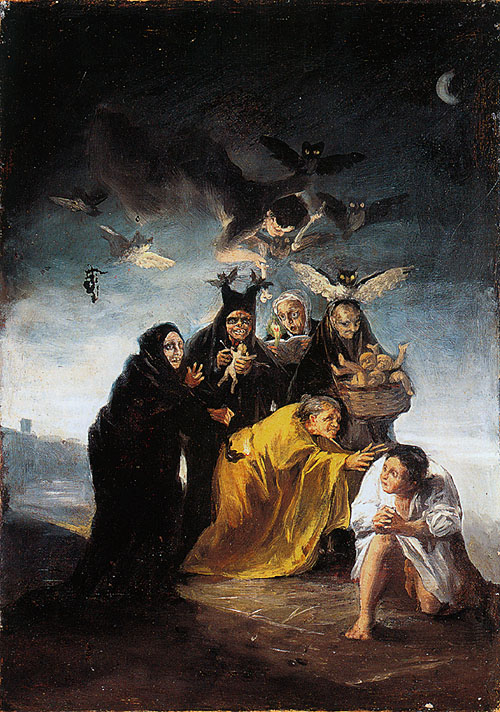
Under a rising moon, five witches close in on a terrified figure in a white nightshirt. Goya, who said he did not believe in witches, painted this nightmare for two of the most enlightened aristocrats in Spain.
The story behind the painting
The Incantation belongs to a group of six small cabinet paintings on witchcraft that Goya made for the Dukes of Osuna, Pedro Tellez-Giron and Maria Josefa Pimentel. They were leading figures of the Spanish Enlightenment and among Goya's most important patrons; between 1785 and 1817 he painted around thirty works for them. The pictures decorated their summer palace at La Alameda de Osuna, and a bill to the duke dated 27 June 1798 for six works on the theme of witches survives. They were most likely painted in 1797 and 1798, though Josep Gudiol dated the series to 1794 and 1795, after the illness that left Goya deaf. It is not known whether the duchess chose the theme or Goya proposed it.
What to look for
The canvas is about 45 by 32 cm. It is night, the pale moon is rising, and the last light lingers on a village outline at the horizon. Five old witches, some with skull-like faces and sharp teeth, surround their victim. On the left, one holds a lantern and counts to three on her fingers. The next pierces a small baby or wax doll with pins, her black hat edged with bats. A third reads a spell from a book lit by a candle, like a missal. Above them a demonic figure descends, beating bones. On the right, a witch holds a basket of three crying infants while an owl tugs off her scarf. On the ground, a figure in a white nightshirt kneels, hands clasped, eyes wide with terror.
Meaning and intent
Witches and sorcery were part of Spanish folklore, and the Inquisition's trials kept such beliefs alive. The enlightened nobles around the Osunas did not believe in witchcraft, yet they were fascinated by it; the dukes even held books on magic with special permission from the Holy Office. Goya too called himself a sceptic, while filling his work with demons. The source reads the scene closely: the witch in yellowish clothes is a procuress trying to ensnare a superstitious person with gestures and lies, the lantern and the beaten bones may announce the children's death, and in the eighteenth century such spells were believed to happen in dreams and imagination. The victim's gender is left ambiguous.
Legacy
The six paintings have no shared narrative, so each is read on its own. They share many themes with Los Caprichos, the prints Goya was making at the same time as a satire on superstition, fanaticism and the Inquisition. According to the historian Jose Luis Morales y Marin, Goya showed the series in 1799 at the Real Academia de San Fernando as six strange caprices, perhaps to promote the prints published that year. Later the pictures hung in a hallway leading to the duchess's study, though historians disagree whether that room was a library. Of the six, four are now in public collections, one is private and one is considered lost; this one is in the Lazaro Galdiano Museum in Madrid.
豆知識
- One of six witchcraft paintings Goya made for the Dukes of Osuna.
- A bill for the six works is dated 27 June 1798.
- Shares its themes with Goya's print series Los Caprichos.
- Held by the Lazaro Galdiano Museum in Madrid.
画家について
Francisco Goya (1746-1828)
同じ画家の作品: Francisco Goya
 1808年5月3日 - Francisco Goya (1814)
 裸のマハ - Francisco Goya (1800)
 我が子を食らうサトゥルヌス - Francisco Goya (1819)
 カルロス4世の家族 - Francisco Goya (1800)
 着衣のマハ - Francisco Goya (1800)
 1808年5月2日、エジプト人親衛隊との戦闘 - Francisco Goya (1814)
 犬 - Francisco Goya (1819)
 魔女の夜宴 - Francisco Goya (1820s)
関連する画家の作品
 雲海の上の旅人 - Caspar David Friedrich (c. 1818)
 楡の木のある僧院 - Caspar David Friedrich (1800s)
 民衆を導く自由の女神 - Eugène Delacroix (1830)
 サルダナパールの死 - Eugène Delacroix (1827)
 戦艦テメレール号 - J. M. W. Turner (1839)
 雨、蒸気、速度 - グレート・ウェスタン鉄道 - J. M. W. Turner (1844)
 青衣の少年 - Thomas Gainsborough (1770)
 アンドリューズ夫妻 - Thomas Gainsborough (1748)