メアリー・グレーアム夫人の肖像
トマス・ゲインズバラ · 1775
%20-%20Google%20Art%20Project.jpg)
A young bride stands full length, life size, the face that became an icon of Georgian beauty. Her husband loved her so much that after her death he could not bear to look at Gainsborough's portrait.
The story behind the painting
The sitter was born the Honourable Mary Cathcart on 1 March 1757, daughter of Charles Cathcart, 9th Lord Cathcart, who had served as British ambassador at the court of Catherine the Great. At 17 she married Thomas Graham, later Lord Lynedoch, on 26 December 1774, in a double wedding with her older sister Jane. Thomas Gainsborough painted her shortly afterwards. He made three portraits of her in all. A more conventional half length, now in the National Gallery of Art in Washington, is believed to be the one first commissioned. Wikipedia dates this full length to 1777, while Wikidata gives 1775.
What to look for
This is a large, full length canvas, about 237 by 154 cm, and has become an icon of the Scottish National Gallery. It is counted among Gainsborough's finest portraits. Mary is shown standing, life size, in the grand manner of a society portrait, and it was her looks above all that people noticed. A third, more informal portrait of her, known as the Housemaid, was rejected by her family and never finished; after Gainsborough's death it was sold to the 5th Earl of Carlisle, hung at Castle Howard, and was given to the Tate in 1913. Comparing the versions shows how carefully the public image was chosen.
Meaning and intent
When Gainsborough showed the portrait at the Royal Academy in 1777, Mary's beauty caused a stir. The painting made her an icon of contemporary beauty and helped her quickly become a figure in the fashionable society of Georgian London. She won many admirers and friends, from the poet Robert Burns to Georgiana, Duchess of Devonshire, who remembered her goodness, her sense and her sweetness. The portrait is therefore more than a likeness: it shaped how a young woman was seen by her world, and how she is still remembered, while her family connections, including her uncle Sir William Hamilton, placed her at the centre of society.
Legacy
Mary soon fell ill with tuberculosis. Her husband nursed her devotedly, taking her first to Brighton and then, as she grew worse, through revolutionary Paris to the Mediterranean in search of warmth. She died near Hyères on 26 June 1792, aged 35. Thomas Graham lived 50 more years, never remarried, and was so grief stricken that he could not look at her portrait. It was stored away and almost forgotten until it was exhibited in Manchester in 1857. Two years later his cousin and heir Robert Graham bequeathed it to the newly opened Scottish National Gallery in Edinburgh, one of its first works.
豆知識
- Painted shortly after Mary Cathcart married Thomas Graham in 1774.
- Shown at the Royal Academy in 1777; Wikidata dates it 1775.
- Her grieving husband had the portrait put away after her death.
- Bequeathed to the Scottish National Gallery in 1859.
画家について
トマス・ゲインズバラ (1727-1788)
女性 · 肖像 · スコットランド国立美術館
同じ画家の作品: トマス・ゲインズバラ
.jpg) 青衣の少年 - Thomas Gainsborough (1770)
青衣の少年 - Thomas Gainsborough (1770).jpg) アンドリューズ夫妻 - Thomas Gainsborough (1748)
アンドリューズ夫妻 - Thomas Gainsborough (1748)%20-%20WGA8418.jpg) ウィリアム・ハレット夫妻 - Thomas Gainsborough (1785)
ウィリアム・ハレット夫妻 - Thomas Gainsborough (1785)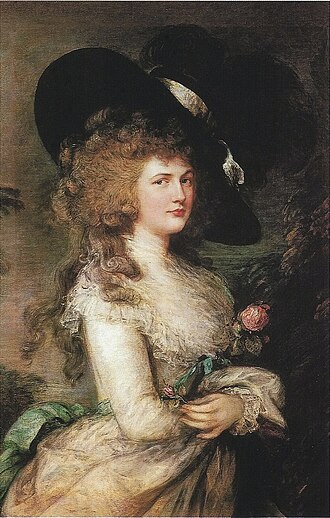 デヴォンシャー公爵夫人ジョージアナの肖像 - Thomas Gainsborough (1780s)
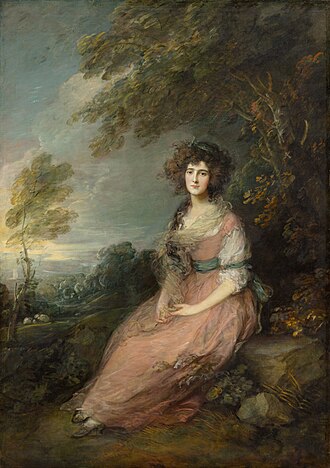 リチャード・ブリンズリー・シェリダン夫人 - Thomas Gainsborough (1785)
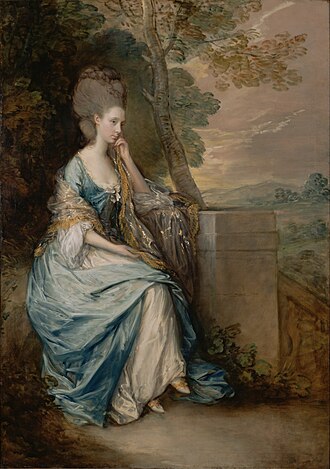 チェスターフィールド伯爵夫人アンの肖像 - Thomas Gainsborough (1770s)
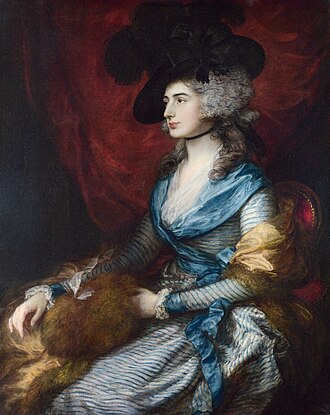 サラ・シドンズの肖像 - Thomas Gainsborough (1785)
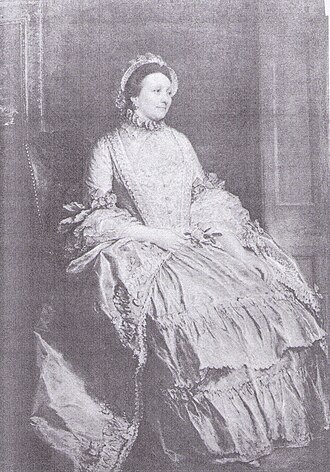 The Wife of William St Quintin - Thomas Gainsborough (1767)
関連する画家の作品
 1808年5月3日 - Francisco Goya (1814)
.jpg) 裸のマハ - Francisco Goya (1800)
裸のマハ - Francisco Goya (1800) 雲海の上の旅人 - Caspar David Friedrich (c. 1818)
 楡の木のある僧院 - Caspar David Friedrich (1800s)
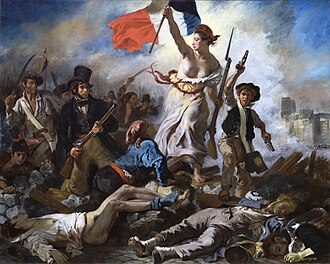 民衆を導く自由の女神 - Eugène Delacroix (1830)
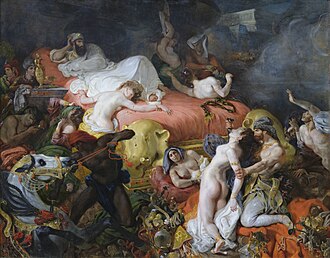 サルダナパールの死 - Eugène Delacroix (1827)
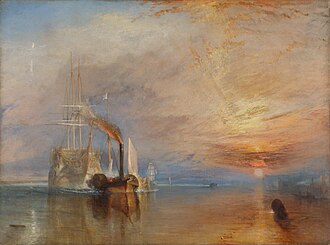 戦艦テメレール号 - J. M. W. Turner (1839)
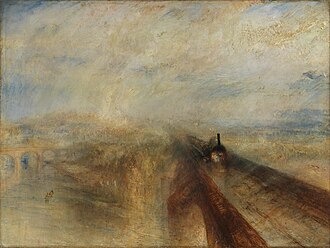 雨、蒸気、速度 - グレート・ウェスタン鉄道 - J. M. W. Turner (1844)