The Forge
Francisco Goya · 1819
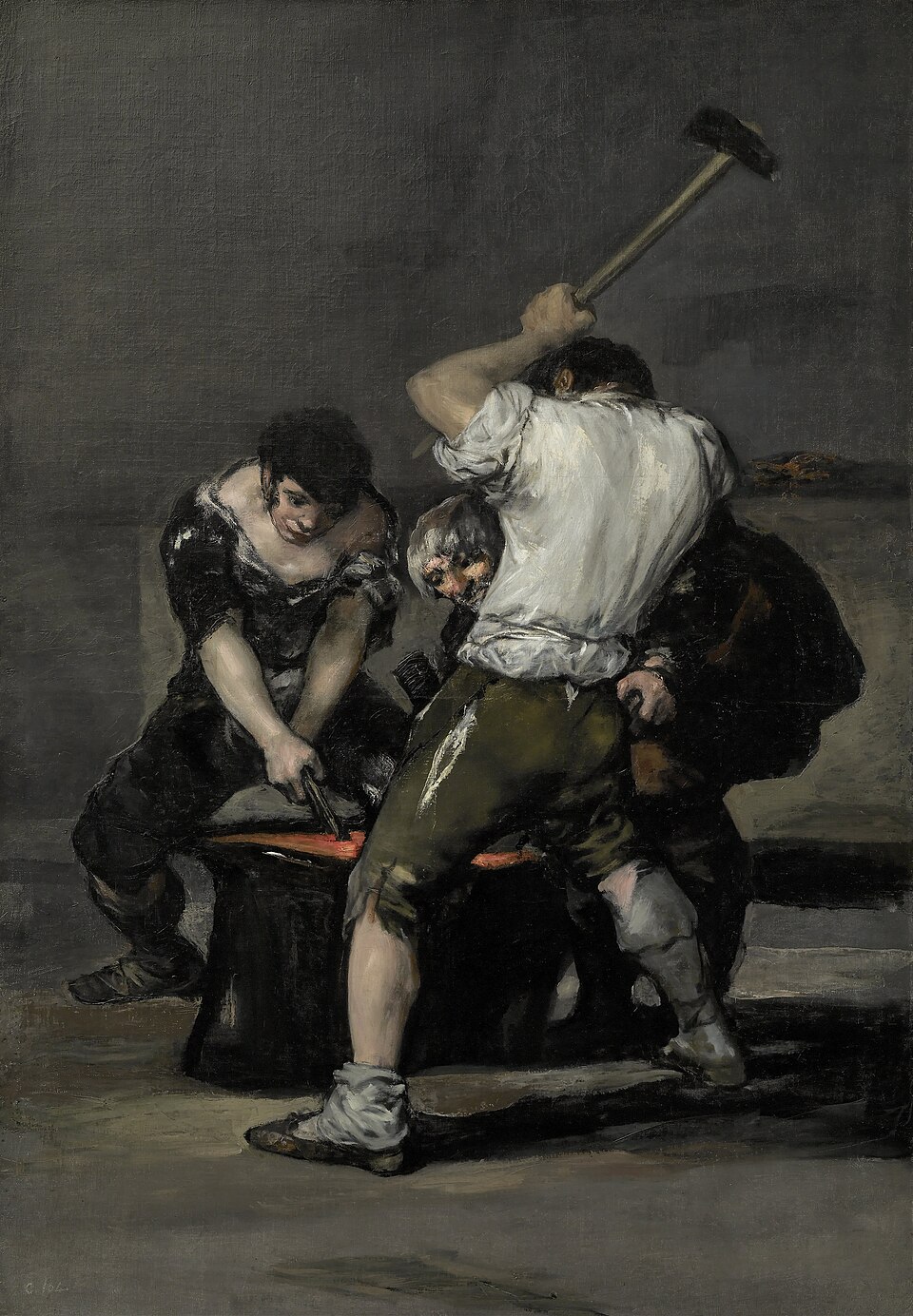
Three blacksmiths bend over an anvil, and the only bright colour is the red of the hot iron. Goya painted them for no patron and never sold the picture, yet it has been called the most complete statement of his late style.
The story behind the painting
Goya painted The Forge late in life, around 1817 according to Wikipedia, while Wikidata gives 1819; the article explains that both this painting and a related drawing are hard to date, and are placed between 1815 and 1820 because of their closeness to the Black Paintings. Like many of his pictures of ordinary Spanish people, it was not commissioned and was neither published nor sold in his lifetime. The drawing Three Men Digging may have been a preparatory study, with similar poses but farm tools and a hole instead of an anvil.
What to look for
There is no story to follow: it is almost a photograph of a single moment, set in an unclear space. The palette is greys, blues and black, broken by the blazing red of the heated metal. The men have thick arms and heavy, strong backs, drawn like classical heroes, but their faces are coarse. Their gestures balance one another. Compared with the drawing, the viewpoint is lower, which makes the figures loom larger, and two of the faces are visible. The three men stand closer together than real work would allow.
Meaning and intent
The blacksmiths may stand for the Spanish working class, hammering out the country's future in a literal version of the saying on the anvil of history. In this reading the work recalls resistance to Napoleon, a theme of Goya's earlier Knifegrinder, and perhaps the people's part in drafting the Constitution. Janis Tomlinson suggests the old man may refer to the Forge of Vulcan, linking it to Goya's The Young Ones and Time, of the same size. Michael Fried saw sexual tension in the pose of the worker seen from behind.
Legacy
After Goya's death the painting passed to his son. King Louis-Philippe acquired it for the Spanish gallery of the Louvre, where it hung from 1838 until 1851, when it was sent to England. It was sold at Christie's in London in 1853 and was bought from the dealer Knoedler in 1914 for the Frick Collection in New York, where it hangs today. Art historian Fred Licht called it undoubtedly the most complete statement of Goya's late style.
豆知識
- Painted around 1817 (Wikipedia) or 1819 (Wikidata).
- Never commissioned or sold during Goya's lifetime.
- Shown in Louis-Philippe's Spanish gallery at the Louvre, 1838 to 1851.
- In the Frick Collection, New York, since 1914.
画家について
Francisco Goya (1746-1828)
同じ画家の作品: Francisco Goya
 1808年5月3日 - Francisco Goya (1814)
 裸のマハ - Francisco Goya (1800)
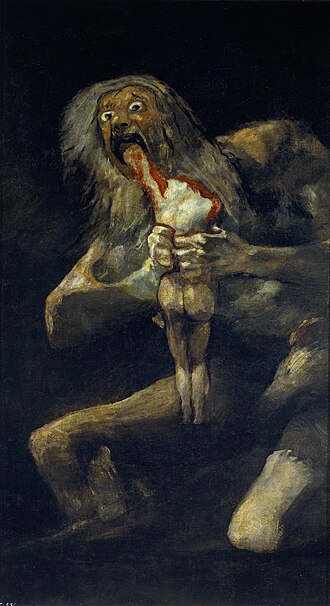 我が子を食らうサトゥルヌス - Francisco Goya (1819)
 カルロス4世の家族 - Francisco Goya (1800)
 着衣のマハ - Francisco Goya (1800)
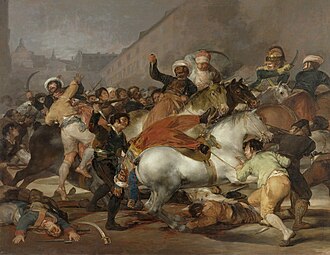 1808年5月2日、エジプト人親衛隊との戦闘 - Francisco Goya (1814)
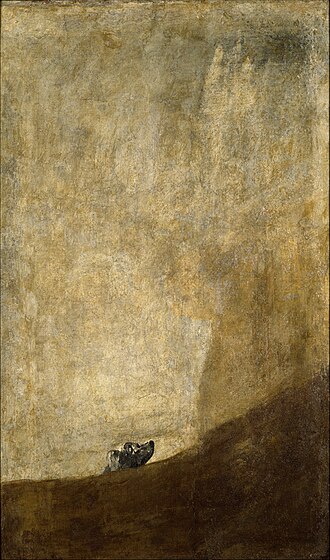 犬 - Francisco Goya (1819)
 魔女の夜宴 - Francisco Goya (1820s)
関連する画家の作品
 雲海の上の旅人 - Caspar David Friedrich (c. 1818)
 楡の木のある僧院 - Caspar David Friedrich (1800s)
 民衆を導く自由の女神 - Eugène Delacroix (1830)
 サルダナパールの死 - Eugène Delacroix (1827)
 戦艦テメレール号 - J. M. W. Turner (1839)
 雨、蒸気、速度 - グレート・ウェスタン鉄道 - J. M. W. Turner (1844)
 青衣の少年 - Thomas Gainsborough (1770)
 アンドリューズ夫妻 - Thomas Gainsborough (1748)