The Doge's Palace Seen from San Giorgio Maggiore
Claude Monet · 1908
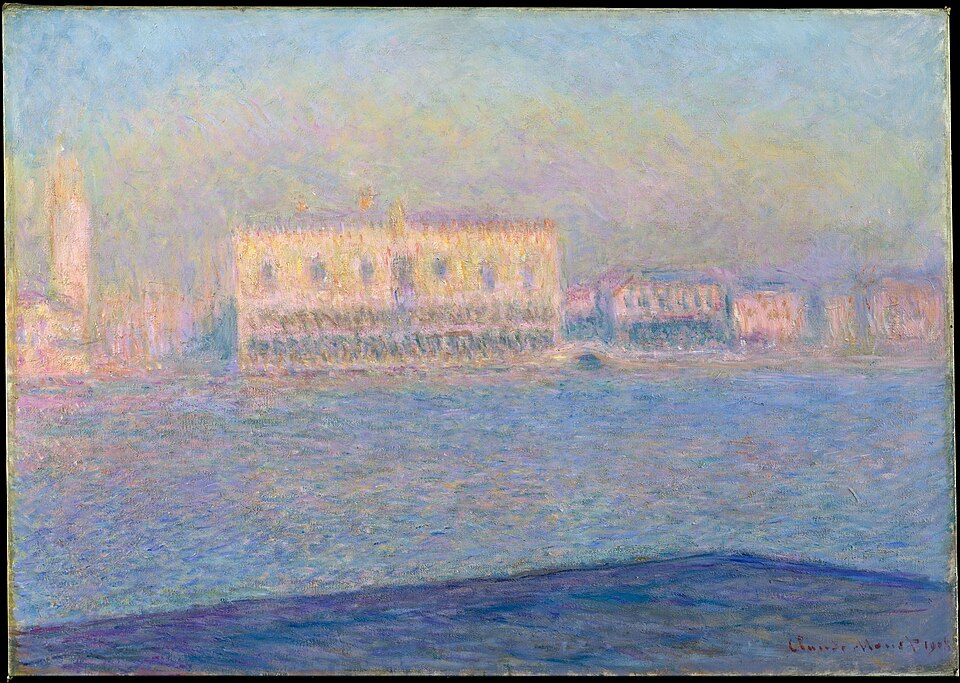
Across the wide water of the Bacino di San Marco, the Doge's Palace floats in Venetian light. Monet spent only a short time in Venice in late 1908, and finished this view and its sisters from memory back in France.
The story behind the painting
Monet painted this view during his visit to Venice in late 1908. He went home to France with many canvases still incomplete and spent a few years preparing 29 works for exhibition. In 1912 he held a successful show, Claude Monet Venise, at the Bernheim-Jeune gallery in Paris. This picture is one of six versions of the same scene he painted in 1908, catalogued W1751 to W1756 in the Wildenstein catalogue raisonné; this one is W1755. Other versions are held by the Kunsthaus Zürich and the Solomon R. Guggenheim Museum.
What to look for
The canvas, oil, measures 25 3/4 by 36 1/2 inches, about 65.4 by 92.7 cm. It shows the Doge's Palace, an icon of Venice and the historic seat of government of the Venetian Republic, together with the buildings of the Riva degli Schiavoni waterfront. Monet looked from the island of San Giorgio Maggiore across the Bacino di San Marco, choosing a viewpoint at the edge of the piazza in front of Palladio's famous abbey church.
Meaning and intent
Six versions were made to capture the changing light at different times of day. This kind of series painting went back to Monet's early career, when he and the other Impressionists turned to painting outdoors, en plein air, inspired by the shifting effects of light. By 1908 his style was long established, and Venice became one more place to watch a single motif change from hour to hour. The source speaks of the influence of the effervescent Venetian sunset on these works, so the subject is less the palace than the light passing over it.
Legacy
Opinions differ, and the source records both. One passage says this work is considered less successful because Monet spent so little time in Venice and had to finish the series from memory in Paris. Another says that the works he began in Venice, The Doge's Palace among them, are some of his most highly regarded, capturing his signature style. After the 1912 exhibition in Paris the painting travelled the world before finding its permanent home at the Metropolitan Museum of Art in New York.
豆知識
- Painted during Monet's visit to Venice in late 1908.
- One of six versions of this view (Wildenstein W1751-W1756).
- Shown at the 1912 exhibition Claude Monet Venise in Paris.
- Now in the Metropolitan Museum of Art, New York.
画家について
Claude Monet (1840-1926)
メトロポリタン美術館 · 宮殿
同じ画家の作品: Claude Monet
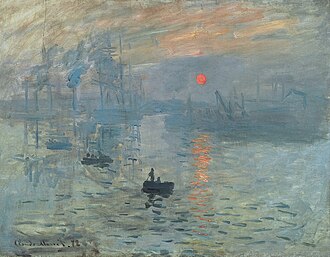 印象・日の出 - Claude Monet (1872)
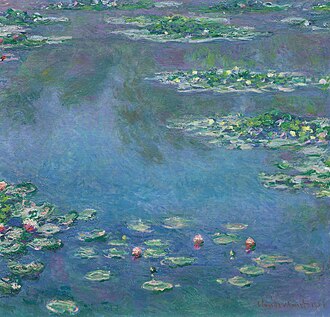 睡蓮 - Claude Monet (1906)
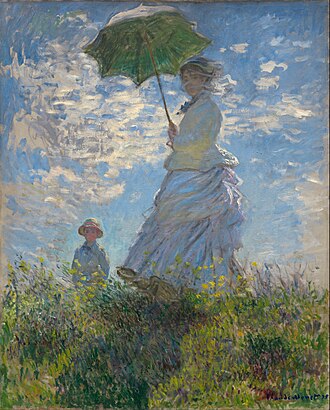 日傘をさす女 - Claude Monet (1875)
 サン=タドレスのテラス - Claude Monet (1867)
 庭の女たち - Claude Monet (1866)
 かささぎ - Claude Monet (1868)
 庭の女 - Claude Monet (1867)
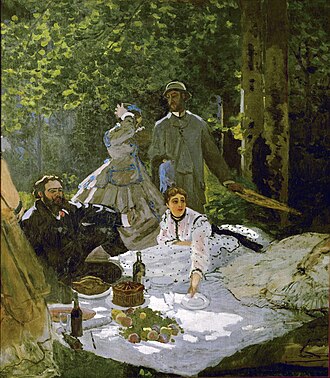 草上の昼食 - Claude Monet (1866)
関連する画家の作品
 戦艦テメレール号 - J. M. W. Turner (1839)
 雨、蒸気、速度 - グレート・ウェスタン鉄道 - J. M. W. Turner (1844)
 世界の起源 - Gustave Courbet (1866)
 オルナンの埋葬 - Gustave Courbet (2020)
 草上の昼食 - Édouard Manet (1863)
 オランピア - Édouard Manet (1863)
 ムーラン・ド・ラ・ギャレットの舞踏会 - Pierre-Auguste Renoir (1876)
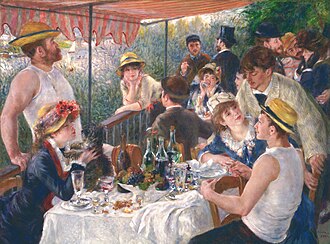 舟遊びの昼食 - Pierre-Auguste Renoir (1881)
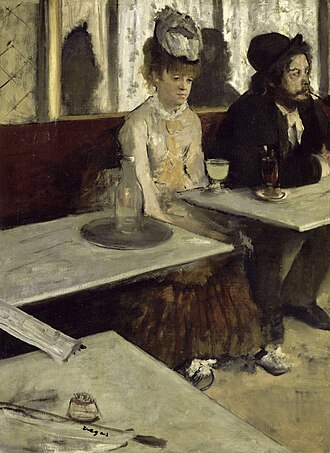 アブサントを飲む人 - Edgar Degas (1875)
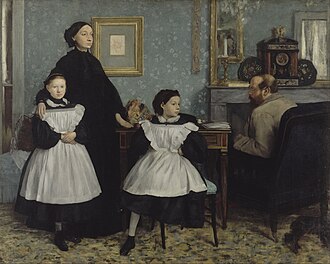 The Bellelli Family - Edgar Degas (1858)
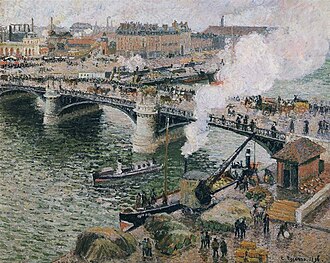 Pont Boieldieu in Rouen, Rainy Weather - Camille Pissarro (1896)
 Rue Saint-Honoré in the Afternoon. Effect of Rain - Camille Pissarro (1897)