プールヴィルの断崖の上の散歩
Claude Monet · 1882
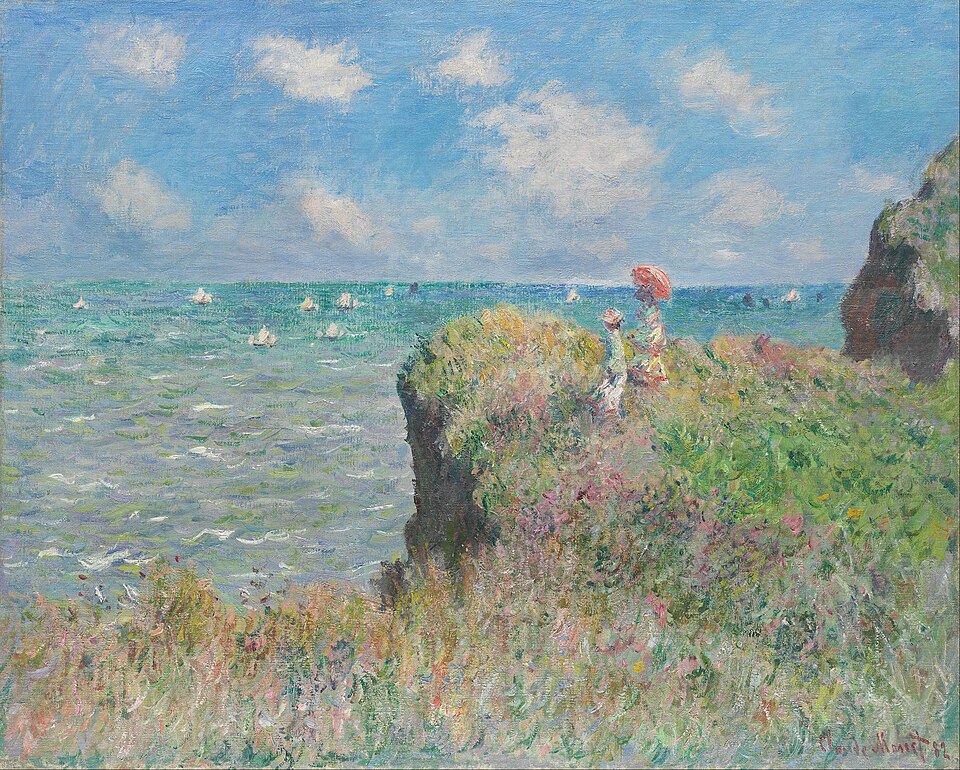
Two young women stand on a windy clifftop above the Channel, grass and skirts tossed by a summer breeze. Monet painted it in 1882, at a time when he had come to the sea to escape grief and money worries.
The story behind the painting
In 1882 Monet made an extended stay in the fishing village of Pourville in Normandy, retreating from personal and professional pressures. His wife Camille had died three years earlier, and a recession in France was hurting his sales. He settled there between February and mid-April, and wrote to Alice Hoschedé, his future wife, about how beautiful the countryside was becoming and what joy it would be to show her all its delightful corners. They came back in June. The two girls on the cliff may be Alice's daughters Marthe and Blanche, though it has also been suggested that they are Alice and Blanche. The painting belongs to a series of Normandy landscapes and is now in the Art Institute of Chicago.
What to look for
Watch the wind. Monet used dynamic, loose brushstrokes for the grass on the cliff, the girls' dresses and the distant sea, so that land, water, clothing and clouds all seem to move at once. The view is split roughly on a diagonal and looks out at about 45 degrees, so the bluff rises in steps from lower left to upper right. A second, shadowed promontory on the right balances the composition: Monet reduced its size while painting, and it may have been a late addition. Between the two shadow masses stand the two figures. An X-ray shows that he first painted a third figure and then removed it. Far out on the water, small fishing boats sit on the horizon.
Meaning and intent
Scholars read the figures in overlapping ways. One view sees a contrast between leisure and labour: the bourgeois visitors on the cliff are temporary, while the fishermen on the horizon belong to the place. Another sees a pure vacation picture of summer by the sea, with every sign of work or the city left out. Either way, the women stop us from imagining ourselves alone in the landscape and act as intermediaries between us and the view. Removing the third figure, the article notes, emphasises the solitude of the two who remain. The unified brushwork, texture and colour let Monet place them in the scene without breaking its unity.
Legacy
The painting shows how Monet developed his Impressionist style during this retreat, working through a series of views from the same coast. The art historian John House, describing similar works, wrote that Monet's cliff tops rarely show a single sweep of terrain; distance comes through breaks in space, overlapping planes and atmospheric rather than linear perspective. Most of the Pourville series looks north east, setting the uneven cliff edge against the flat sea, and this canvas, about 66.5 by 82.3 cm, is one of its clearest examples. It hangs today in the Art Institute of Chicago, where its bright summer air still seems to move.
豆知識
- Painted in 1882 during Monet's stay at Pourville, Normandy.
- The figures may be Marthe and Blanche Hoschedé, or Alice and Blanche.
- An X-ray shows a third figure that Monet painted out.
- In the Art Institute of Chicago.
画家について
Claude Monet (1840-1926)
印象派 · ランドスケープ · 海洋アート · シカゴ美術館 · 崖
同じ画家の作品: Claude Monet
 印象・日の出 - Claude Monet (1872)
 睡蓮 - Claude Monet (1906)
 日傘をさす女 - Claude Monet (1875)
 サン=タドレスのテラス - Claude Monet (1867)
 庭の女たち - Claude Monet (1866)
 かささぎ - Claude Monet (1868)
 庭の女 - Claude Monet (1867)
 草上の昼食 - Claude Monet (1866)
関連する画家の作品
 戦艦テメレール号 - J. M. W. Turner (1839)
 雨、蒸気、速度 - グレート・ウェスタン鉄道 - J. M. W. Turner (1844)
 世界の起源 - Gustave Courbet (1866)
 オルナンの埋葬 - Gustave Courbet (2020)
 草上の昼食 - Édouard Manet (1863)
 オランピア - Édouard Manet (1863)
 ムーラン・ド・ラ・ギャレットの舞踏会 - Pierre-Auguste Renoir (1876)
 舟遊びの昼食 - Pierre-Auguste Renoir (1881)
 アブサントを飲む人 - Edgar Degas (1875)
 The Bellelli Family - Edgar Degas (1858)
 星月夜 - Vincent van Gogh (1889)
.jpg) 夜のカフェテラス - Vincent van Gogh (1888)
夜のカフェテラス - Vincent van Gogh (1888)