トランプ詐欺師
Caravaggio · 1590s
%20Kimbell%20Art%20Museum.jpg)
A well-dressed boy studies his cards, unaware that his opponent hides extra ones behind his back and an older man is signalling over his shoulder. We can see the trick; he cannot.
The story behind the painting
Caravaggio painted The Cardsharps around 1596-1597, while trying to build an independent career. He had left the workshop of the Cavaliere Giuseppe Cesari d'Arpino in January 1594, where he had painted flowers and fruit for his master's large output, and began selling work through a dealer named Costantino with the help of the painter Prospero Orsi, who introduced him to collectors. The Cardsharps came to the attention of Cardinal Francesco Maria del Monte, who bought it and became Caravaggio's first important patron, giving him lodgings in the Palazzo Madama in Rome. The original is generally agreed to be the canvas acquired by the Kimbell Art Museum in Fort Worth, Texas, in 1987.
What to look for
Three figures share a table. On one side, an expensively dressed, unworldly boy concentrates on his cards. Opposite him, another boy, the cheat, has extra cards tucked into his belt behind his back, hidden from his victim but in full view of us. Behind the innocent player, an older man peers at his cards and signals to his young accomplice. Look for the small details the sources single out: the split fingers of the older man's gloves, the young cheat's anxious glance at his master, and the dagger at the cheat's side. Each figure is absorbed in his own role, yet all three are bound together in one tense little drama.
Meaning and intent
After The Fortune Teller, this was Caravaggio's second picture of this kind, and together they offered something new: realistic scenes of street life rather than saints or myths. The sources point to a subtle sadness beneath the comedy. The cheat is no older than his victim, so while one innocent is being fooled, another is being corrupted even as he cheats. The picture asks us to stand in the knowing position of the older man and see everything, and in doing so it quietly makes us witnesses to how innocence is lost on both sides of the table. It mixes, as the source puts it, brutal low-life realism with a luminous Venetian delicacy.
Legacy
The Cardsharps was much admired, and Orsi went around praising Caravaggio's new style. More than fifty copies and variants by other painters survive, and artists such as Georges de La Tour painted their own versions of the theme. The original passed from del Monte to Cardinal Antonio Barberini and then through the Colonna-Sciarra family, disappeared in the 1890s, and was rediscovered in 1987 in a private collection in Zürich. Caravaggio may have painted more than one version: the art historian Sir Denis Mahon argued that a copy he acquired in 2006 was by Caravaggio himself, though a 2015 English court ruling found the auction house had reasonably judged it unlikely to be his.
豆知識
- Painted c. 1596-1597; Wikidata gives the 1590s.
- Bought by Cardinal del Monte, Caravaggio's first important patron.
- Rediscovered in Zürich in 1987 and now at the Kimbell Art Museum; 94.2 × 130.9 cm.
画家について
Caravaggio (1571-1610)
同じ画家の作品: Caravaggio
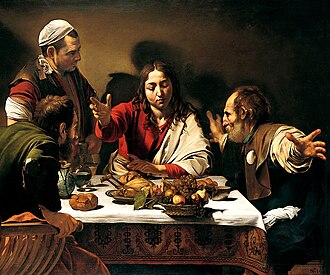 エマオの晩餐 - Caravaggio (1601)
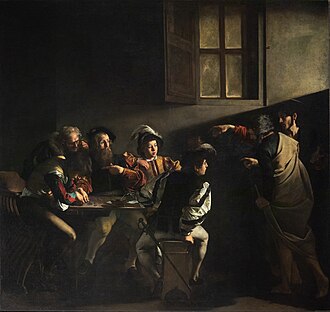 聖マタイの召命 - Caravaggio (1609)
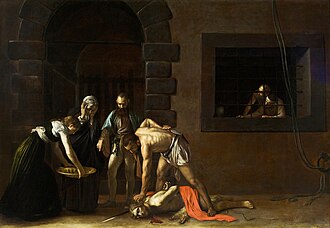 洗礼者聖ヨハネの斬首 - Caravaggio (1608)
 エマオの晩餐 - Caravaggio (1601)
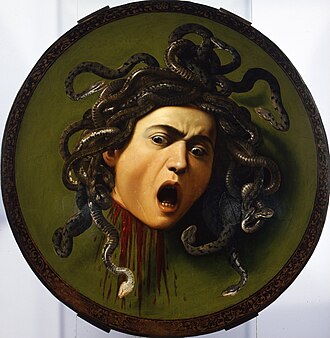 メドゥーサの首 - Caravaggio (1597)
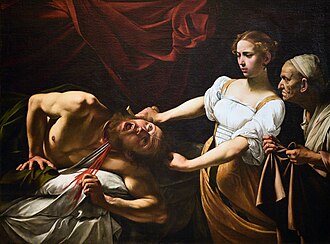 ホロフェルネスの首を斬るユーディット - Caravaggio (1598)
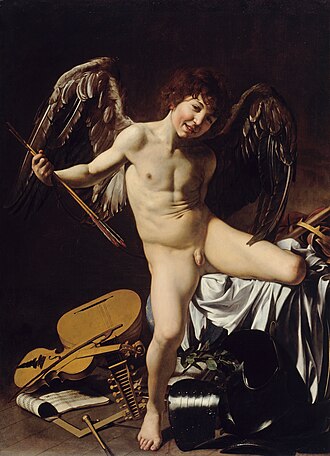 愛の勝利 - Caravaggio (1600s)
%2C%201595%20circa%2C%20534.jpg) 病めるバッカス - Caravaggio (1595)
病めるバッカス - Caravaggio (1595)
 ラス・メニーナス
 ブレダの開城
 夜警
夜警 自画像
自画像 真珠の耳飾りの少女
 牛乳を注ぐ女