盲目のギター弾き
Francisco Goya · 1778
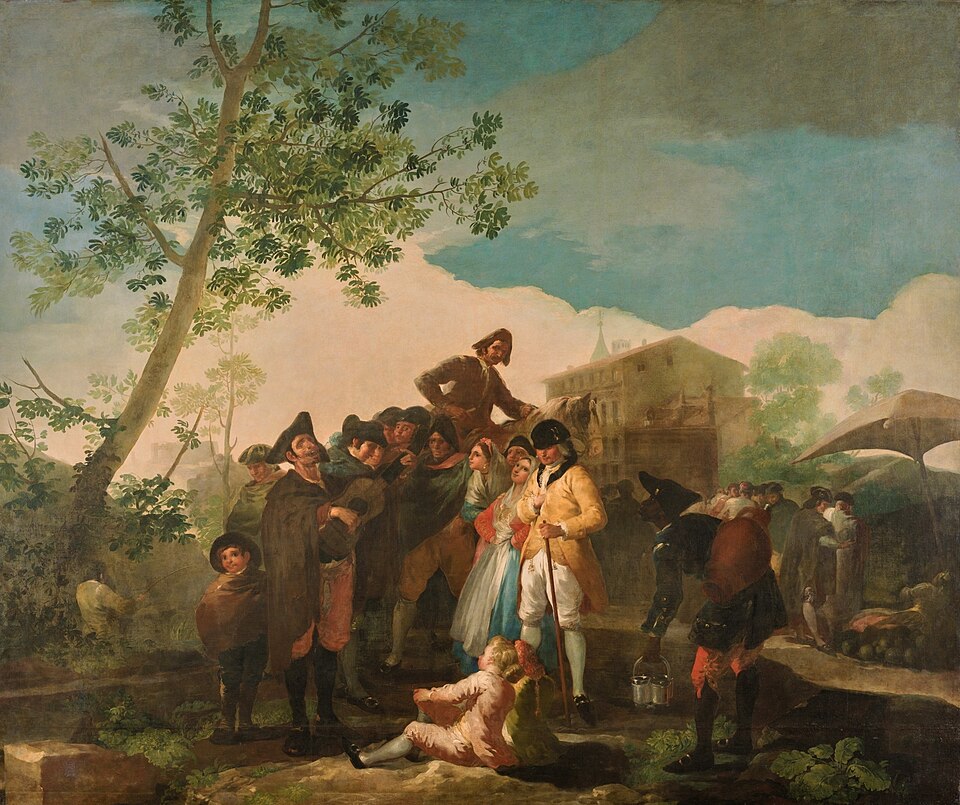
A blind singer with a guitar holds a street crowd spellbound. Goya painted it as a design for a royal tapestry, and the weavers found it so crowded that he had to change it again and again.
The story behind the painting
The Blind Guitarist belongs to Goya's fourth series of tapestry cartoons, full size designs for the royal tapestry factory. All the works in the series were meant for the antechamber of the Prince of Asturias, the future Charles IV, and his wife Maria Luisa of Parma, at the palace of El Pardo. The picture was delivered to the Royal Tapestry Factory on 27 April 1778. It was one of the hardest cartoons Goya made: the weavers judged it too large and too full of figures, and he had to alter it several times to meet their demands.
What to look for
A blind singer, one of those who carried dramatic and colourful stories from town to town, dominates the scene, and a group of curious onlookers gathers around him. According to Goya, the elegant gentleman in the cartoon is a foreigner. Goya also included unusual figures, such as a black water carrier, a popular type of the time, alongside more familiar ones: a fisherman on the left and a melon seller among the crowd. Light falls especially on the women and the man, with metallic glints on the buckets. In the lower part fruit is on sale, reinforcing a pyramid shaped composition.
Meaning and intent
Goya shows the fascination a street performer could hold over very different people. The central group may allude to prostitution, with two brightly dressed majas flirting with a man, and the children in the foreground recall Hogarth and English painting. Colour and light draw more attention than the figures, whose earthy tones recall the early works of Velázquez. On the right the colouring is lively and conveys great joy. The light, quick brushwork seen here would return half a century later in The Milkmaid of Bordeaux and the Portrait of Juan Bautista Muguiro. The canvas was also inspired by Tiepolo.
Legacy
The cartoon was considered lost until 1869, when Gregorio Cruzada Villaamil found it in the basement of the Royal Palace in Madrid. It was handed over to the Prado in 1870 and first appeared in the museum's catalogue in 1876. The series it belonged to also included The Swing, The Washerwomen, The Novillada, The Tobacco Guard, The Woodcutters, The Rendezvous, The Doctor and others, with two cartoons, The Dog and The Fountain, still lost. At about 260 by 311 cm, this large, busy street scene now hangs in room 91 of the Prado.
豆知識
- Delivered to the Royal Tapestry Factory on 27 April 1778.
- Made for the antechamber of the Prince of Asturias at El Pardo.
- Goya reworked it several times because the weavers found it too crowded.
- Rediscovered in 1869 and in the Prado since 1870.
画家について
Francisco Goya (1746-1828)
同じ画家の作品: Francisco Goya
 1808年5月3日 - Francisco Goya (1814)
 裸のマハ - Francisco Goya (1800)
 我が子を食らうサトゥルヌス - Francisco Goya (1819)
 カルロス4世の家族 - Francisco Goya (1800)
 着衣のマハ - Francisco Goya (1800)
 1808年5月2日、エジプト人親衛隊との戦闘 - Francisco Goya (1814)
 犬 - Francisco Goya (1819)
 魔女の夜宴 - Francisco Goya (1820s)
関連する画家の作品
 雲海の上の旅人 - Caspar David Friedrich (c. 1818)
 楡の木のある僧院 - Caspar David Friedrich (1800s)
 民衆を導く自由の女神 - Eugène Delacroix (1830)
 サルダナパールの死 - Eugène Delacroix (1827)
 戦艦テメレール号 - J. M. W. Turner (1839)
 雨、蒸気、速度 - グレート・ウェスタン鉄道 - J. M. W. Turner (1844)
 青衣の少年 - Thomas Gainsborough (1770)
 アンドリューズ夫妻 - Thomas Gainsborough (1748)